Ever look at your electric bill and wonder where all that electricity went? Your air conditioner, refrigerator, water heater, and everyday appliances all contribute, but some use considerably more energy than others.
Understanding what uses the most electricity in a home can help you identify expensive appliances, spot unnecessary energy use, and decide which upgrades are worth considering.
Read Also: How to Lower Your Electric Bill: 35 Proven Ways (Room-by-Room Checklist)
The surprising part? An appliance’s wattage doesn’t tell the whole story. A small device running continuously can consume more electricity over a month than a powerful appliance used for just a few minutes.
This guide breaks down typical household electricity consumption with an easy-to-read appliance kWh chart, realistic monthly costs, and practical ways to measure your own usage.
Whether you own a 2,000-square-foot house or rent a small apartment, you’ll learn where your electricity goes—and which changes may actually make a difference.
Quick Takeaways
- Heating and cooling are often the largest electricity users in homes with electric HVAC systems.
- Electric water heaters can be major energy consumers, especially in larger households.
- Clothes dryers, refrigerators, and electric ovens can contribute significantly to monthly electricity use.
- Appliance wattage matters, but daily operating time determines total energy consumption.
- At $0.17 per kilowatt-hour (kWh), using 100 kWh costs approximately $17.
- Older or poorly maintained appliances may consume more electricity than comparable efficient models.
- Smart plugs, utility usage reports, and appliance labels can help identify electricity hogs.
- Renters can reduce consumption through thermostat settings, laundry habits, and plug-in energy monitors without making major upgrades.
What Uses the Most Electricity in a Home?
For many US households, heating, cooling, and water heating account for some of the largest portions of electricity consumption.
However, the answer depends heavily on which systems run on electricity.
Read Also: How to Lower Your AC Bill: 15 Fixes That Actually Work
A home with a natural gas furnace and gas water heater may use relatively little electricity for heating and hot water. Meanwhile, an all-electric home with resistance heating can consume thousands of additional kilowatt-hours during winter.
According to the US Energy Information Administration (EIA), space conditioning and water heating are major components of residential energy consumption.
Electricity use also depends on household size, climate, equipment efficiency, and daily habits.
Typical ranking of household electricity users
In many all-electric homes, the largest electricity consumers include:
- Space heating
- Air conditioning
- Electric water heating
- Clothes dryers
- Refrigerators and freezers
- Electric cooking appliances
- Lighting, electronics, and miscellaneous devices
This is a general ranking, not a universal one.
An electric vehicle charger or swimming pool pump can move near the top of the list. In a gas-heated home, air conditioning may be the dominant electric load.
The most useful approach is to compare appliances by monthly kWh rather than wattage alone.
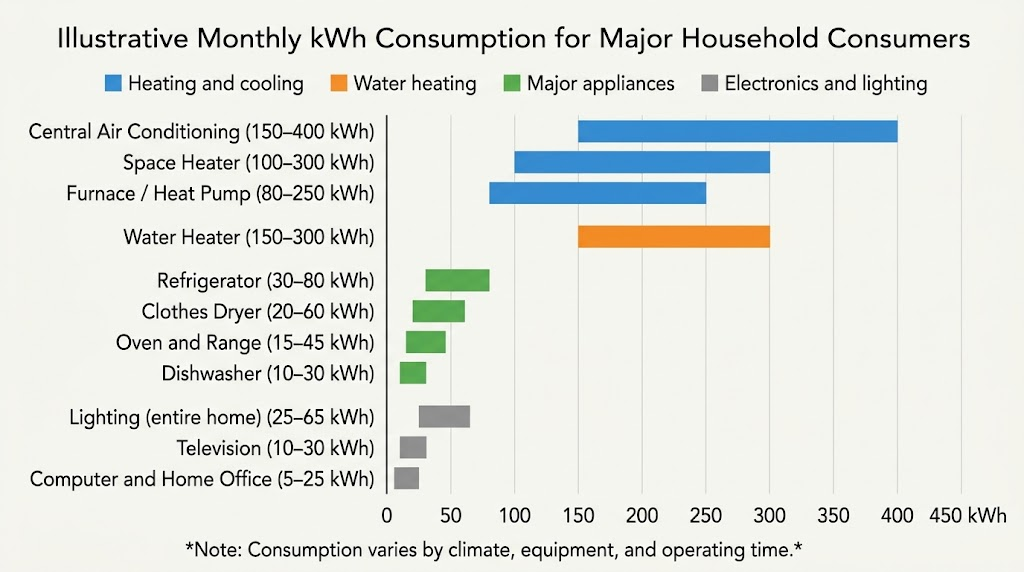
That distinction becomes clearer in the chart below.
Appliance Energy Use Chart: Watts, kWh, and Monthly Costs
The following appliance energy use chart compares approximate operating wattages and illustrative monthly electricity consumption.
A watt measures how quickly a device uses electricity. A kilowatt-hour (kWh) measures the total electricity consumed over time.
For example, a 1,000-watt appliance operating for one hour uses 1 kWh.
The estimated costs below assume an electricity rate of $0.17 per kWh.
This is an example rate, not a claim about the current national average. Check your utility bill for your actual rate.
Read Also: Average Electric Bill by State: How Your Home Compares and Why
Household Appliance Electricity Usage Chart
| Appliance | Typical Operating Wattage | Example Monthly Usage | Monthly Cost at $0.17/kWh |
|---|---|---|---|
| Electric resistance heating | 5,000–15,000 W | 600–2,000 kWh | $102–$340 |
| Central air conditioner | 1,500–5,000 W | 200–900 kWh | $34–$153 |
| Heat pump heating | 1,000–5,000 W | 200–900 kWh | $34–$153 |
| Electric water heater | 3,000–5,500 W | 200–450 kWh | $34–$77 |
| Electric clothes dryer | 1,800–5,000 W | 30–100 kWh | $5–$17 |
| Refrigerator | 100–800 W while running | 25–75 kWh | $4–$13 |
| Standalone freezer | 100–600 W while running | 20–65 kWh | $3–$11 |
| Electric oven | 2,000–5,000 W | 15–60 kWh | $3–$10 |
| Dishwasher | 1,200–1,800 W during heating | 10–30 kWh | $2–$5 |
| Washing machine | 300–1,000 W | 3–15 kWh | $0.50–$2.55 |
| Large LED television | 50–200 W | 8–30 kWh | $1–$5 |
| Desktop computer | 100–500 W | 15–75 kWh | $3–$13 |
| Wi-Fi router | 5–20 W | 4–15 kWh | $0.68–$2.55 |
| LED light bulb | 6–15 W | 1–4 kWh | $0.17–$0.68 |
Important: These are illustrative planning ranges, not measured national appliance averages. Actual consumption varies considerably with equipment size, efficiency, operating conditions, and usage.
Heating and cooling ranges are particularly sensitive to climate and season.
The chart’s wattages also describe approximate power draw while equipment operates. Many appliances cycle on and off, so multiplying their operating wattage by 24 hours would overstate consumption.
Refrigerators, for example, typically run their compressors intermittently rather than continuously.
For a more reliable refrigerator estimate, consult its EnergyGuide label.
What About Electric Vehicle Chargers and Pool Pumps?
Some homes have additional large electricity loads.
| Equipment | Example Monthly Consumption | Cost at $0.17/kWh |
|---|---|---|
| Electric vehicle charging | 200–450 kWh | $34–$77 |
| Swimming pool pump | 100–500 kWh | $17–$85 |
| Portable electric space heater | 90–360 kWh | $15–$61 |
| Dehumidifier | 30–180 kWh | $5–$31 |
These ranges depend on use.
For example, a 1,500-watt space heater running eight hours daily consumes:
1.5 kW × 8 hours × 30 days = 360 kWh
At $0.17 per kWh, that’s approximately $61 per month.
A pool pump’s electricity use depends on its motor, operating speed, and filtration schedule. Variable-speed pumps can offer meaningful savings compared with older single-speed equipment.
How Electricity Usage Is Calculated
Understanding your electric bill starts with one simple equation.
The kWh Formula
Kilowatt-hours = (Watts × Hours Used) ÷ 1,000
To calculate electricity cost:
Electricity Cost = kWh × Electricity Rate
Suppose you operate a 1,500-watt portable heater for four hours daily.
First, convert watts to kilowatts:
1,500 ÷ 1,000 = 1.5 kW
Next, calculate daily electricity consumption:
1.5 × 4 = 6 kWh
Over 30 days:
6 × 30 = 180 kWh
At $0.17 per kWh:
180 × $0.17 = $30.60 per month
This calculation works well for appliances that maintain a relatively steady power draw.
However, refrigerators, air conditioners, and heat pumps cycle or change their power consumption. For those appliances, measured consumption or manufacturer estimates are more useful.
Why Appliance Wattage Can Be Misleading
Consider two appliances:
- A 1,500-watt microwave used for 10 minutes daily.
- A 100-watt device operating continuously.
The microwave consumes approximately 7.5 kWh over 30 days.
The continuously operating device consumes 72 kWh.
Despite having much lower wattage, the second device uses nearly ten times as much electricity.
This explains why operating hours matter just as much as appliance wattage.
How to Use a kWh Calculator
A basic kWh calculator requires three inputs:
- Appliance wattage
- Hours of use
- Electricity price per kWh
For appliances with variable consumption, use the annual kWh estimate printed on the EnergyGuide label whenever available.
Divide annual kWh by 12 for an approximate monthly average.
That approach is especially useful when comparing refrigerators, dishwashers, and other appliances before purchasing replacements.
The 7 Biggest Electricity Users Explained
1. Heating and Cooling: Often the Largest Electricity Expense
Heating and cooling are frequently the biggest factors in household electric bills.
Central air conditioners use electricity to move heat from inside your home to the outdoors.
Heat pumps work similarly but can also reverse the process to heat your home.
Electric resistance heaters—including many baseboard heaters and electric furnaces—convert electricity directly into heat.
Heat pumps can deliver substantially more heat per unit of electricity than resistance heaters under suitable operating conditions.
This efficiency advantage helps explain why heat pumps may reduce heating electricity use when replacing resistance heating.
However, performance depends on outdoor temperatures, equipment sizing, and installation quality.
Why your AC might run constantly
An air conditioner may operate for long periods during extreme summer weather without necessarily being defective.
But unusually long operation can also indicate:
- Dirty air filters
- Blocked supply or return vents
- Air leaks
- Poor attic insulation
- Duct leakage
- Improper equipment sizing
- Maintenance problems
Start by checking the thermostat setting and replacing dirty filters according to manufacturer instructions.
If cooling remains inadequate, hire a qualified HVAC technician.
Replacing a functioning system solely because it runs frequently may not be worthwhile without first understanding the cause.
For replacement equipment, compare total installed costs and efficiency ratings.
Air conditioner efficiency is commonly described using SEER2, or Seasonal Energy Efficiency Ratio 2. A higher SEER2 generally indicates lower electricity consumption under standardized test conditions.
2. Electric Water Heaters: A Major Year-Round Load
Electric water heaters can be among the largest electricity users because households need hot water throughout the year.
Conventional electric storage water heaters use resistance heating elements to warm water.
They also consume energy maintaining tank temperature between uses.
Energy consumption depends on:
- Household size
- Shower duration
- Incoming water temperature
- Water heater efficiency
- Hot water temperature setting
- Hot water use by appliances
A heat pump water heater works differently.
Instead of generating heat directly through electric resistance, it transfers heat from surrounding air into the water.
According to the Department of Energy, heat pump water heaters can be considerably more efficient than conventional electric resistance models.
However, they generally cost more upfront, need appropriate installation space, and may cool the surrounding area.
Before replacing a water heater, compare installation requirements, household hot water needs, and available rebates.
3. Clothes Dryers: High Power Draw in Short Bursts
Electric clothes dryers commonly draw several thousand watts while heating.
Their monthly energy consumption depends on how often you do laundry and how long each cycle lasts.
Overloading a dryer can restrict airflow and increase drying time.
Likewise, a clogged lint screen or obstructed vent can reduce performance.
Clean the lint screen after every load and maintain dryer venting according to manufacturer recommendations.
Avoid operating a dryer with damaged wiring, unusual burning smells, or suspected vent blockages.
Heat pump dryers use a different drying process and can consume less electricity, although drying cycles may take longer.
4. Refrigerators: Always On, but Not Always Running
If you’re wondering how much electricity does a refrigerator use, the answer depends largely on its size, age, design, and efficiency.
An illustrative range for many household refrigerators is approximately 300–900 kWh annually, although individual models can fall outside that range.
That equals roughly 25–75 kWh per month.
At $0.17 per kWh, the example cost is approximately $4–$13 monthly.
Refrigerators consume electricity throughout the year, but compressors usually operate intermittently.
An older refrigerator kept in a garage may consume substantially more energy than an efficient modern kitchen model.
Garage temperatures can also affect performance.
For accurate comparisons, review the appliance’s EnergyGuide label or use the ENERGY STAR product database.
5. Electric Ovens and Cooking Appliances
Electric ovens and stovetops have high operating wattages, but they usually run for relatively short periods.
That’s why they often consume less electricity over a month than heating, cooling, or water heating systems.
Cooking energy use depends on meal preparation habits.
Smaller appliances such as microwaves, toaster ovens, and electric pressure cookers may use less energy for suitable tasks because they heat smaller spaces or cook more quickly.
Induction cooktops transfer energy efficiently to compatible cookware, although total savings depend on how you cook.
Replacing a working stove solely to reduce electricity costs usually deserves careful financial consideration.
6. Dishwashers and Washing Machines
Dishwashers use electricity for pumps, controls, and sometimes water heating and heated drying.
Washing machines primarily use electricity to operate their motors and controls.
However, warm or hot wash cycles can increase household water-heating energy use.
That additional energy may appear under your water heater rather than the washing machine itself.
Using cold water when appropriate, washing full loads, and avoiding unnecessary heated drying can help.
If your home has an electric water heater, changes to hot water consumption may matter more than the washing machine’s motor efficiency.
7. Electronics, Lighting, and Standby Power
Individually, many household electronics consume relatively little electricity.
Collectively, however, televisions, computers, networking equipment, gaming systems, lighting, and devices left plugged in can create a meaningful load.
Some devices use standby power when they appear turned off.
Examples include electronics with clocks, remote-control receivers, and network connections.
Smart power strips can reduce unnecessary standby consumption for compatible devices.
Avoid switching off equipment that needs continuous power for safety, medical, security, or essential networking purposes.
How to Find What’s Using the Most Electricity
You don’t need expensive monitoring equipment to investigate what uses the most electricity in a home.
Start with your utility bill, then narrow down likely causes.
Step-by-Step Home Electricity Audit
Step 1: Find Your Monthly kWh Usage
Look for the total kilowatt-hours consumed during your billing period.
Don’t compare dollar amounts alone.
Electricity prices, billing-period lengths, seasonal adjustments, and utility fees can change even when usage stays similar.
Step 2: Compare the Same Months Across Years
Compare July with previous Julys and January with previous January.
This helps account for seasonal heating and cooling demand.
Also check whether your utility provides daily or hourly electricity usage data.
Step 3: Identify Your Major Electric Appliances
Make a list of electric heating, cooling, water heating, laundry, cooking, and refrigeration equipment.
Pay particular attention to resistance heating and appliances that operate frequently.
Step 4: Check Appliance Energy Labels
Look for yellow EnergyGuide labels or manufacturer specifications.
EnergyGuide labels provide standardized energy consumption estimates for many appliance categories.
Step 5: Measure Compatible Plug-In Devices
A plug-in electricity monitor can measure energy consumption for many ordinary 120-volt household devices.
Choose equipment rated for the outlet and appliance load.
Do not use plug-in monitors with hardwired equipment or appliances that exceed the monitor’s electrical rating.
Step 6: Review HVAC Operation
Check thermostat schedules, filter condition, and visible vent obstructions.
Avoid opening electrical compartments or handling refrigerant components.
Step 7: Track Changes for Several Weeks
Record any changes and compare electricity usage under reasonably similar conditions.
Outdoor temperature, occupancy, and appliance use can significantly affect results.
Home Electricity Audit Checklist
| What to Check | What to Look For | Safe Action |
|---|---|---|
| Utility bill | Increasing monthly kWh | Compare historical usage |
| Thermostat | Unnecessary heating or cooling | Adjust schedules |
| HVAC filter | Visible dirt or restricted airflow | Replace as instructed |
| Refrigerator | Damaged door seals | Inspect and clean seals |
| Water heater | Excessively high temperature | Review manufacturer guidance |
| Dryer | Long drying cycles | Clean lint screen and check airflow |
| Lighting | Frequently used incandescent bulbs | Consider LED replacements |
| Electronics | Unnecessary standby operation | Use compatible smart power strips |
| Attic insulation | Uneven or insufficient coverage | Arrange a professional assessment |
| Outdoor equipment | Excessive pump operating hours | Review manufacturer-recommended schedules |
For a broader evaluation, consider a professional home energy assessment.
The Department of Energy provides guidance on identifying heat loss, air leakage, and inefficient systems.
Realistic Costs & Savings
Understanding what uses the most electricity in a home becomes more useful when you translate consumption into dollars.
Let’s examine an example household.
Example: A 2,000-Square-Foot Home
Assume:
- Home size: 2,000 square feet
- Climate: Mixed heating and cooling
- Electricity rate: $0.17/kWh
- Monthly electricity consumption: 1,100 kWh
- Electric HVAC and water heating
- Three occupants
The monthly electricity supply cost would be:
1,100 kWh × $0.17 = $187
This excludes any separate fixed charges, taxes, or other utility fees.
Now consider several potential changes.
Example 1: Reducing Air Conditioning Consumption
Suppose the air conditioner uses 400 kWh during a summer month.
If thermostat adjustments, filter maintenance, and reduced cooling demand lower consumption by 10%:
400 × 0.10 = 40 kWh saved
40 × $0.17 = $6.80 saved that month
Actual results depend on weather, equipment, thermostat settings, and home characteristics.
Example 2: Reducing Dryer Usage
Suppose an electric dryer consumes 75 kWh per month.
If line-drying some loads or improving laundry habits reduces consumption by 20%:
75 × 0.20 = 15 kWh
15 × $0.17 = $2.55 monthly savings
Over 12 months, that would equal $30.60 if the same monthly reduction continued.
Example 3: Replacing an Inefficient Refrigerator
Suppose an older refrigerator consumes 900 kWh annually.
A replacement model consumes 400 kWh annually.
Annual difference:
900 − 400 = 500 kWh
Estimated annual savings:
500 × $0.17 = $85
These are hypothetical appliance values. Compare actual EnergyGuide ratings before making a purchase.
If a replacement costs $900, the electricity savings alone would take approximately 10.6 years to equal the purchase price.
That simple payback calculation excludes maintenance, repairs, financing, and changes in electricity prices.
A replacement may still make sense if the old refrigerator is failing, but energy savings alone might not justify buying a new one immediately.
Estimated Savings From Common Changes
| Change | Illustrative Annual Electricity Savings | Value at $0.17/kWh |
|---|---|---|
| Reduce unnecessary AC operation | 50–250 kWh | $9–$43 |
| Reduce electric dryer usage | 40–180 kWh | $7–$31 |
| Replace frequently used incandescent bulbs | 100–300 kWh | $17–$51 |
| Reduce standby electricity consumption | 30–150 kWh | $5–$26 |
| Replace an inefficient refrigerator | 150–500 kWh | $26–$85 |
| Improve electric water-heating efficiency | 200–1,000 kWh | $34–$170 |
These are illustrative scenarios, not typical or guaranteed savings. Some households will save less, and others may save more.
The categories also aren’t necessarily additive because household behavior and equipment performance overlap.
How to Calculate Savings Using Your Own Electric Bill
Find the electricity rate on your bill.
If your utility charges different rates depending on time of day, use the rate applicable to the electricity you expect to save.
For a simple estimate:
Estimated Savings = kWh Reduced × Applicable Electricity Rate
For example, saving 150 kWh at $0.22 per kWh would reduce energy charges by approximately $33.
Your bill may include fixed service charges and other adjustments that won’t disappear when electricity consumption falls.
For expensive upgrades such as heat pumps, insulation, or HVAC replacement, request multiple quotes and compare realistic operating costs.
Rebate programs vary by state and change often. Check the ENERGY STAR Rebate Finder, DSIRE, your utility, and your state energy office for current eligibility.
How Climate and Home Size Affect Electricity Use
Geography can significantly change which appliances dominate your electric bill.
Hot and Humid Southern States
In states such as Florida, Texas, Louisiana, and Georgia, air conditioning may represent a major portion of summer electricity consumption.
High humidity also increases cooling demands because air conditioners must remove moisture as well as heat.
Improving attic insulation, sealing air leaks appropriately, and maintaining cooling equipment can help reduce unnecessary operation.
However, ventilation and moisture management remain important.
Avoid sealing vents or modifying attic ventilation without understanding the home’s design.
Cold Northern States
In colder climates, electric heating can dominate winter electricity consumption.
Homes using electric resistance heating may experience especially high winter bills.
Cold-climate heat pumps can operate efficiently at low outdoor temperatures, although their performance and capacity vary by model and conditions.
Professional sizing and installation are essential.
Homes with combustion heating equipment also need functioning carbon monoxide alarms and appropriate ventilation.
Dry Western States
In hot, dry climates, cooling requirements can be substantial.
Some homes use evaporative coolers, which cool air through water evaporation rather than conventional refrigeration.
These systems can use less electricity than compressor-based air conditioners under suitable dry conditions.
However, they are generally less effective in humid weather and require proper water management and maintenance.
Why Square Footage Matters
A larger house often requires more energy for heating and cooling.
But square footage alone doesn’t determine electricity consumption.
Two similarly sized homes can have very different bills because of insulation, air leakage, windows, equipment, and occupant behavior.
A smaller poorly insulated home can sometimes use more heating or cooling electricity than a larger efficient one.
Easy Electricity-Saving Changes for Renters
Renters often have limited control over HVAC replacement, insulation, and major appliances.
Fortunately, many useful changes don’t require permanent modifications.
Consider these options:
- Adjust thermostat schedules. Reduce unnecessary heating and cooling when conditions allow.
- Use LED lighting. Replace compatible bulbs where permitted.
- Wash clothes in cold water. Follow clothing and detergent instructions.
- Avoid unnecessary dryer cycles. Use appropriate settings and full loads without overloading.
- Measure plug-in appliances. Use a properly rated electricity monitor.
- Reduce unwanted solar heat. Close blinds or curtains during hot sunny periods.
- Report maintenance problems. Tell your landlord about failing refrigerator seals, poor cooling, or unusual equipment operation.
If your apartment has electric baseboard heating, thermostat habits may have a particularly large effect on winter consumption.
Never cover electric baseboard heaters or place furniture against them.
Portable space heaters also require care.
Follow manufacturer clearance instructions, plug them directly into appropriate wall outlets, and never use extension cords or power strips with them.
Keep heaters away from combustible materials and turn them off when leaving the room or sleeping, unless manufacturer instructions specifically establish otherwise.
If your landlord controls the thermostat or appliances, ask about maintenance and efficiency improvements rather than attempting unauthorized modifications.
When to Call a Professional
Some electricity problems are simple to investigate. Others require licensed professionals.
Contact a qualified HVAC technician if your heating or cooling system runs unusually long, fails to maintain temperature, makes abnormal noises, or repeatedly shuts down.
Hire a licensed electrician if you notice:
- Frequently tripping breakers
- Hot or discolored outlets
- Burning smells near electrical equipment
- Flickering lights associated with electrical problems
- Damaged wiring or sparking
Do not remove electrical panel covers or attempt wiring repairs.
For water heaters, unusual electrical behavior, leaks near electrical components, or repeated loss of hot water warrants professional evaluation.
Gas water heaters and furnaces require additional precautions because of combustion and carbon monoxide risks.
If a carbon monoxide alarm sounds, follow its emergency instructions and leave the building.
When a Home Energy Audit Makes Sense
A professional energy assessment may be worthwhile when:
- Electricity consumption is unexpectedly high.
- Rooms have major temperature differences.
- Heating or cooling equipment operates excessively.
- You’re considering expensive insulation or HVAC upgrades.
- Your home has persistent drafts or moisture problems.
An assessment may identify problems that appliance replacement alone won’t solve.
Professionals can evaluate insulation, air leakage, ductwork, and equipment performance.
Attic work deserves particular caution because of fall hazards, extreme temperatures, electrical wiring, and potentially hazardous insulation materials.
Avoid disturbing suspected asbestos-containing materials or other questionable insulation.
Common Mistakes to Avoid
Reducing electricity use is easier when you focus on meaningful consumption rather than assumptions.
1. Assuming the Highest-Wattage Appliance Costs the Most
A powerful appliance used briefly can consume less energy than a low-wattage device operating continuously.
Compare kWh, not watts alone.
2. Replacing Appliances Before Measuring Their Usage
A working refrigerator may cost relatively little to operate.
Replacing it without checking its annual electricity consumption can result in a long payback period.
3. Ignoring Electric Water Heating
Long showers and frequent hot-water use can make water heating a major expense.
Reducing unnecessary hot water consumption may be more useful than unplugging small electronics.
4. Comparing Bills Without Considering Weather
A hot summer or unusually cold winter can increase electricity consumption even when household habits remain unchanged.
Compare similar seasons and review actual kWh.
5. Using Space Heaters as an Automatic Money-Saving Strategy
Portable resistance heaters are not inherently more efficient than other electric resistance heating systems.
They may reduce total consumption when used to heat a small occupied area while safely reducing whole-home heating, but results depend on the situation.
6. Overlooking Maintenance
Dirty HVAC filters, dryer vent restrictions, and refrigerator door-seal problems can increase energy consumption.
Follow manufacturer maintenance recommendations.
7. Trusting Guaranteed Savings Claims
An efficient appliance doesn’t guarantee a specific reduction in your bill.
Actual savings depend on the equipment being replaced, operating conditions, and electricity prices.
8. Ignoring Total Ownership Costs
The cheapest appliance to operate isn’t always the cheapest to own.
Consider purchase price, installation, maintenance, expected service life, and available rebates.
Frequently Asked Questions
1. What uses the most electricity in a home?
Heating and cooling are often the largest electricity users, particularly in homes with electric HVAC equipment. Electric water heaters can also consume substantial electricity year-round.
However, the biggest electricity user varies by household. Homes with gas heating may use relatively little electricity for space heating, while electric vehicle charging or pool equipment can become major loads.
2. What are the top 5 appliances that use the most electricity?
In many all-electric households, major electricity consumers include heating equipment, air conditioners, electric water heaters, clothes dryers, and refrigerators.
The ranking depends on appliance efficiency and operating hours. Electric ovens, pool pumps, and EV chargers may also rank highly. Reviewing monthly kWh consumption provides a better comparison than looking only at appliance wattage.
3. How much electricity does a refrigerator use per month?
Many household refrigerators consume approximately 25–75 kWh per month, although actual usage varies.
At an illustrative electricity rate of $0.17 per kWh, that equals roughly $4–$13 monthly.
Larger refrigerators, older equipment, and units operating in hot garages may consume more. Check the EnergyGuide label for a model-specific annual electricity estimate.
4. Does leaving appliances plugged in use electricity?
Some appliances consume standby electricity even when they appear turned off.
Devices with clocks, network connections, remote-control receivers, and internal power supplies may continue drawing power.
However, standby consumption varies widely. A plug-in electricity monitor can help identify which compatible devices use meaningful amounts of electricity when idle.
5. How many kWh does a typical house use per day?
Daily electricity consumption varies by region, season, home size, and fuel type.
For perspective, a household using 900 kWh during a 30-day billing period averages 30 kWh daily.
The EIA publishes residential electricity consumption statistics that can help provide broader context. Your utility’s historical usage information is more useful for evaluating your specific home.
6. Does an air conditioner use more electricity than a refrigerator?
Usually, yes, during periods of substantial cooling demand.
A central air conditioner may consume hundreds of kilowatt-hours during a hot month, while a refrigerator commonly uses a few dozen.
However, air conditioning consumption is seasonal, and smaller cooling systems may use considerably less electricity. Equipment efficiency, operating time, and outdoor temperatures determine the actual difference.
7. Is it cheaper to run appliances at night?
It depends on your utility’s electricity pricing.
Some utilities offer time-of-use plans with different electricity rates during peak and off-peak hours.
Under those plans, running certain appliances during lower-priced periods may reduce costs.
If your electricity rate stays constant throughout the day, changing operating times generally won’t reduce energy charges unless it also reduces consumption.
8. How much does a 1,500-watt heater cost to run?
A 1,500-watt heater uses 1.5 kWh for every hour it operates at full power.
At $0.17 per kWh, that’s approximately $0.26 per hour.
Running it for eight hours daily over 30 days would consume 360 kWh and cost about $61 in electricity.
Thermostat cycling can reduce actual operating hours.
9. Can a smart thermostat really lower electric bills?
A smart thermostat may reduce heating and cooling consumption by adjusting temperatures when less conditioning is needed.
Savings depend on the HVAC system, climate, existing thermostat habits, and how the thermostat is configured.
Some households may see limited savings if they already use efficient schedules.
Choose a thermostat compatible with your equipment and have a professional install it when wiring changes are required.
10. Is an ENERGY STAR appliance worth the extra money?
An ENERGY STAR-certified appliance meets applicable energy-efficiency requirements established by the program.
Whether paying more is worthwhile depends on the price difference, expected energy savings, electricity rates, and how long you’ll use the appliance.
Compare annual kWh estimates and calculate potential operating costs.
Also consider reliability, size, features, and available local rebates rather than focusing only on certification.
11. Why is my electric bill so high when I’m not using much electricity?
High bills can result from electric heating, water heating, malfunctioning equipment, seasonal weather, or changes in electricity prices.
Some equipment operates automatically, so its consumption may not be obvious.
Start by comparing billed kWh with previous periods. Then review major appliances and your utility’s usage data.
If consumption remains unexplained, contact your utility or arrange a professional assessment.
12. How can I tell which appliance is using the most electricity?
Start with the largest electrical loads: heating, cooling, water heating, laundry, and refrigeration.
Check EnergyGuide labels and manufacturer specifications where available.
Use a properly rated plug-in energy monitor for compatible 120-volt appliances.
For hardwired equipment, consider utility interval data, compatible whole-home monitoring services, or a professional energy assessment rather than attempting electrical work yourself.
Conclusion
The answer to what uses the most electricity in a home usually starts with heating, cooling, and water heating.
But the most expensive appliance in your household depends on how often it operates, its efficiency, your climate, and your electricity rate.
Before spending money on upgrades, identify where your electricity actually goes.
Your Electricity-Saving Checklist
- Check your monthly electricity consumption in kWh.
- Compare usage with the same season last year.
- Identify your largest electric appliances.
- Check appliance EnergyGuide ratings.
- Review thermostat settings and HVAC maintenance.
- Look for unnecessary hot water consumption.
- Measure compatible plug-in devices when useful.
- Calculate potential savings before replacing equipment.
- Get professional advice for electrical, HVAC, or major insulation problems.
The goal isn’t to stop using the appliances that make your home comfortable.
It’s to understand which ones consume the most energy, avoid waste, and make informed decisions about maintenance and upgrades.
Pingback: Tank vs Tankless vs Heat Pump Water Heater: Which Is Best for Your Home? – Energy Savings Perlon
Pingback: Heat Pump Water Heater: Costs, Savings, and Is It Worth It? – Energy Savings Perlon
Pingback: Phantom Power: Which Devices Use Electricity When Off (and How to Stop It) – Energy Savings Perlon