Choosing a new water heater is about more than finding one that delivers enough hot water. The type you install can affect your monthly utility bills, maintenance costs, available space, and how comfortably your household handles back-to-back showers.
For many homeowners, the decision starts with a simple comparison: tank vs tankless water heater. But there’s a third option worth considering: the heat pump water heater, which can use substantially less electricity than a conventional electric model.
Read Also: What Uses the Most Electricity in Your Home? (Appliance kWh Chart)
Each technology has advantages, and the most efficient option isn’t necessarily the most practical for every home.
This guide explains how all three systems work, what they typically cost in the United States, and how to estimate potential savings using your actual utility rates.
You’ll also learn what to check before replacing an existing unit, which upgrades renters can make, and when professional installation is essential.
Quick Takeaways
- Traditional tank water heaters generally have the lowest upfront installation costs and provide straightforward replacement options.
- Tankless water heaters heat water on demand, reducing standby energy losses, but installation can be expensive.
- Heat pump water heaters typically use much less electricity than standard electric resistance models.
- Installed replacement costs can range from roughly $900 for a straightforward tank replacement to $6,000 or more for complex upgrades.
- Tankless doesn’t mean unlimited hot water. Every unit has a maximum flow rate.
- Heat pump models need suitable installation space, adequate airflow, and a plan for condensate drainage.
- A water heater setting around 120°F is a common household starting point, although some homes need different settings for health or equipment reasons.
- The best choice depends on your existing fuel, household hot water demand, installation conditions, and local energy prices.
How the Three Types of Water Heaters Work
All residential water heaters perform the same basic job: delivering hot water to showers, sinks, dishwashers, and washing machines.
The main difference is how they heat and store that water.
Read Also: How to Lower Your Electric Bill: 35 Proven Ways (Room-by-Room Checklist)
Traditional Tank Water Heaters
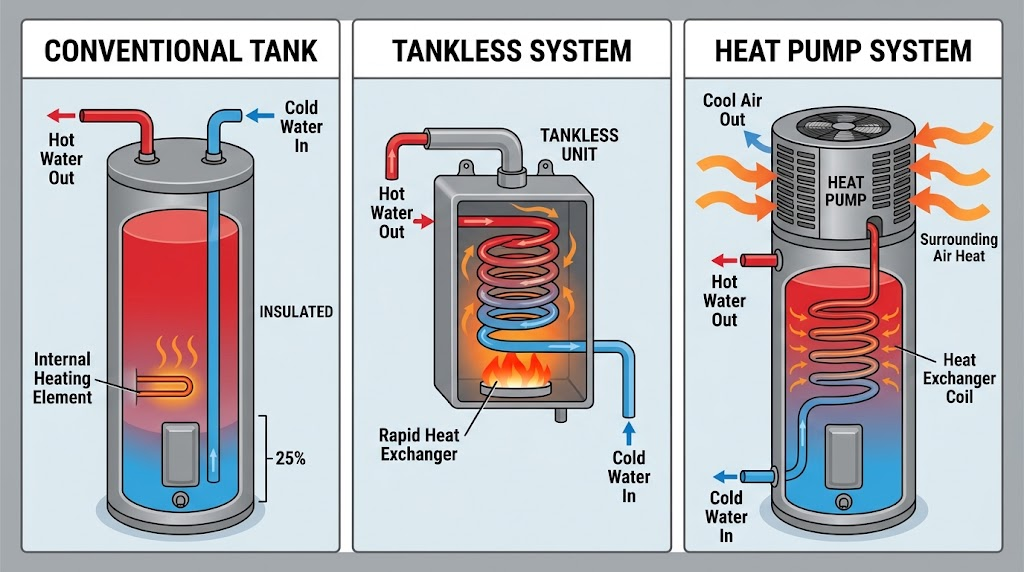
A conventional storage water heater keeps a supply of heated water inside an insulated tank.
Common residential tank capacities include:
- 30 gallons
- 40 gallons
- 50 gallons
- 65 gallons
- 80 gallons
Electric models use resistance heating elements, which turn electricity into heat. Gas models use a burner to heat the stored water.
When someone opens a hot water faucet, heated water leaves the tank and cold water enters to replace it.
The heater then works to restore the desired temperature.
The main disadvantage is standby heat loss.
Even when nobody is using hot water, some heat escapes through the tank and connected pipes. Modern insulation reduces these losses, but it doesn’t eliminate them.
Best for: Households wanting familiar equipment, relatively simple replacement, and lower upfront costs.
Tankless Water Heaters
Tankless systems heat water as it flows through the appliance rather than storing a large heated supply.
When a hot water faucet opens, the heater detects water flow and activates its heating system.
Gas tankless models typically use powerful burners. Electric tankless models use high-output electric heating elements.
Because there is no large storage tank, standby losses are generally lower.
Read Also: How to Lower Your AC Bill: 15 Fixes That Actually Work
However, tankless systems have a maximum heating capacity.
For example, a unit rated to supply 5 gallons per minute (GPM) under specified conditions may struggle to support several showers and appliances operating simultaneously.
Its actual flow capacity depends partly on how much the incoming water temperature must increase.
Best for: Homes with suitable gas or electrical infrastructure, limited installation space, and hot water demand that fits the unit’s capacity.
Heat Pump Water Heaters
A heat pump water heater works differently from conventional electric heating.
Instead of generating all its heat directly, it moves heat from surrounding air into stored water.
It uses a refrigeration cycle similar to an air conditioner, but its primary purpose is heating water.
Most residential models are hybrid systems with backup electric resistance heating elements.
These elements can provide additional heating when demand is high or operating conditions require it.
The key efficiency measurement is the coefficient of performance (COP), which compares useful heat delivered with electricity consumed.
A COP of 3 means the system delivers approximately three units of heat for every unit of electricity used under the measured conditions.
Because heat pumps move heat rather than generating it entirely through resistance, they can achieve much higher efficiency.
The tradeoffs include higher equipment costs, operating noise, airflow requirements, and cooling of the surrounding space.
Best for: Many households replacing electric tank heaters, particularly where installation space and local electricity rates make the upgrade practical.
Tank vs Tankless vs Heat Pump: Side-by-Side Comparison
The following table summarizes the differences that matter most when choosing a water heater.
| Feature | Traditional Tank | Tankless | Heat Pump |
|---|---|---|---|
| How it works | Stores heated water | Heats water on demand | Moves heat from air into stored water |
| Common energy sources | Electricity or gas | Electricity or gas | Electricity |
| Typical upfront cost | Lowest | Moderate to high | Moderate to high |
| Energy efficiency | Varies by model | Often higher than comparable conventional systems | Usually excellent compared with electric resistance |
| Hot water supply | Limited by tank capacity and recovery | Limited by maximum flow rate | Limited by tank capacity and recovery |
| Installation complexity | Often straightforward | Can require major upgrades | Requires suitable space and drainage |
| Space requirements | Tank footprint | Compact wall-mounted equipment | Tank plus airflow clearance |
| Typical service life | Often 10–15 years | Often 15–20 years | Often around 10–15 years |
| Maintenance | Periodic inspection and flushing | Descaling where needed | Filter cleaning and tank maintenance |
| Main drawback | Standby heat loss | High installation cost | Space and ambient temperature requirements |
Service life is a planning estimate, not a guarantee. Water quality, maintenance, installation, and operating conditions can substantially change actual lifespan.
Which Type Usually Wins?
There is no universal winner.
A conventional tank heater may be the most economical option when replacing a functioning system with similar equipment.
A gas tankless unit can make sense when a household wants a compact heater and has infrastructure that supports its heating capacity.
A heat pump model often deserves serious consideration when replacing an electric tank heater because its lower electricity consumption can offset part of the higher purchase price.
The comparison becomes clearer when installation costs are included.
Water Heater Cost: Purchase and Installation
The price printed on a water heater isn’t the same as the total cost of getting hot water back into your home.
A proper replacement estimate should include equipment, labor, permits where required, installation materials, removal of the old unit, and necessary safety upgrades.
Typical Water Heater Replacement Cost
The following are broad US budgeting estimates, not national price averages or contractor quotes.
| Water Heater Type | Approximate Installed Cost |
|---|---|
| Standard electric tank | $900–$2,200 |
| Standard gas tank | $1,100–$2,800 |
| Gas tankless | $2,000–$5,000+ |
| Whole-home electric tankless | $1,500–$4,500+ |
| Heat pump water heater | $2,000–$5,500+ |
Actual prices vary significantly by location, equipment capacity, installation difficulty, and local labor costs.
Complex projects can exceed these ranges.
Why Tankless Installation Can Cost More
Switching from a storage heater to tankless isn’t always a simple equipment swap.
A gas tankless installation may require:
- Changes to gas supply capacity
- New or modified venting
- Condensate management for condensing models
- Electrical power for controls
- Different water connections
- Permits and inspections
A whole-home electric tankless unit may require substantial electrical capacity.
Some homes need expensive electrical service upgrades before they can support one.
Never assume an electric tankless unit can use the same circuit as an existing electric tank heater.
Electrical capacity must be evaluated by a licensed electrician.
Why Heat Pump Installation Costs Vary
Heat pump models resemble traditional storage tanks but have additional requirements.
They typically need adequate surrounding air, manufacturer-specified clearances, and a condensate drain or pump.
Because the heat pump extracts moisture from the air as it operates, water must be directed to an approved drainage location.
Some installations also require electrical or plumbing modifications.
A straightforward replacement in a suitable utility room can cost considerably less than a project requiring relocation or major electrical work.
Check Current Rebates Before Buying
State programs and utilities sometimes offer rebates for qualifying high-efficiency equipment.
Check:
- ENERGY STAR Rebate Finder
- Database of State Incentives for Renewables & Efficiency
- Your state energy office
- Your electric or gas utility
Programs vary by state and change often. Check current eligibility, approved models, contractor requirements, and application deadlines before purchasing.
Federal residential energy tax credits under Sections 25C and 25D ended for expenditures after December 31, 2025. Do not include those expired credits when calculating a 2026 purchase.
Water Heater Efficiency: Which Uses Less Energy?
Water heater efficiency is one of the most confusing parts of comparing equipment.
Manufacturers commonly publish a rating called Uniform Energy Factor (UEF).
UEF measures how efficiently a water heater delivers hot water under standardized testing conditions.
Higher values generally indicate better efficiency within an appropriate equipment category and usage pattern.
However, UEF ratings should not be treated as a complete prediction of your utility bill.
Conventional Electric Tanks
Electric resistance heaters convert nearly all the electricity used by their heating elements into heat.
But the complete system still experiences standby losses.
Typical conventional electric storage models have UEF ratings below 1.
Gas Tank and Tankless Models
Gas water heaters lose some energy through combustion and exhaust.
High-efficiency condensing models recover additional heat from exhaust gases.
Tankless models can reduce standby losses, but the savings depend on usage patterns and equipment design.
According to the US Department of Energy, demand-type water heaters can be approximately 24%–34% more energy efficient than conventional storage water heaters in homes using 41 gallons or less of hot water daily.
For households using around 86 gallons daily, DOE reports a smaller advantage of approximately 8%–14%.
These figures describe broad efficiency comparisons, not guaranteed bill savings.
Heat Pump Models
Heat pump water heaters can achieve UEF ratings substantially above 1 because they move heat from surrounding air.
ENERGY STAR-certified models must meet efficiency requirements that vary by product configuration and draw pattern.
Many current qualifying models have UEF ratings above 3.
That means they can deliver several times as much useful water-heating energy per unit of electricity as conventional electric resistance systems under standardized conditions.
However, performance varies with air temperature, water temperature, and operating mode.
A hybrid heater running frequently on its resistance elements will use more electricity than one operating primarily in heat pump mode.
For a related household efficiency upgrade, see our guide to how to lower your electric bill.
Realistic Costs & Savings
Understanding water heater efficiency is useful, but the practical question is how much different systems might cost to operate.
The answer depends on how much hot water you use, your utility rates, incoming water temperature, and equipment performance.
Worked Example: Electric Tank vs Heat Pump
Consider a hypothetical household with:
- A 2,000 sq ft home in a mixed climate
- Three occupants
- A conventional electric water heater
- Annual water-heating electricity consumption of 3,000 kWh
- Electricity priced at $0.17 per kWh
A kilowatt-hour (kWh) is the amount of energy used by a 1,000-watt appliance operating for one hour.
Home size is included for context; hot water demand depends much more on occupancy and usage than square footage.
Step 1: Calculate Current Annual Cost
Formula:
Annual electricity cost = Annual kWh × Electricity rate
3,000 kWh × $0.17 = $510 per year
This is the estimated annual electricity cost attributable to water heating, excluding fixed utility charges.
Step 2: Estimate Heat Pump Consumption
Suppose the replacement heat pump water heater reduces annual water-heating electricity consumption by 60%.
This is an illustrative assumption, not a guaranteed result.
3,000 kWh × 0.40 = 1,200 kWh per year
Step 3: Calculate New Operating Cost
1,200 kWh × $0.17 = $204 per year
Step 4: Calculate Estimated Savings
$510 − $204 = $306 per year
In this example, the heat pump model reduces annual water-heating electricity costs by approximately $306.
What If Actual Savings Are Lower?
Real-world reductions vary with equipment, climate, hot water demand, and operating mode.
Using the same starting consumption and electricity rate:
| Electricity Reduction | Annual Electricity Savings | Annual Water-Heating Cost |
|---|---|---|
| 40% | $204 | $306 |
| 50% | $255 | $255 |
| 60% | $306 | $204 |
| 70% | $357 | $153 |
These are mathematical scenarios, not predictions for a particular household.
They also exclude any changes to space-heating or cooling energy caused by the heat pump water heater.
What About Gas Water Heaters?
Gas consumption is commonly measured in therms.
One therm represents approximately 100,000 British thermal units (Btu) of energy. A Btu is a unit used to measure heat.
Suppose a conventional gas water heater consumes 180 therms annually.
At $1.50 per therm:
180 × $1.50 = $270 per year
If a replacement system reduces gas use by 20%:
180 × 0.20 = 36 therms saved
36 × $1.50 = $54 in annual savings
Actual reductions may be higher or lower.
This example also shows why replacing a gas heater with an expensive tankless model doesn’t always produce a fast financial payback.
How to Calculate Your Own Costs
Start with your utility bill.
For electricity, divide the relevant variable charges by the kWh used to estimate your effective energy rate.
For gas, use the total applicable per-therm energy, delivery, and other variable charges.
Fixed customer charges generally shouldn’t be counted as savings if you’ll continue paying them after replacing the heater.
Then estimate annual water-heating energy use from equipment data, utility tools, or professional assessment.
Compare annual operating costs using the same hot water demand.
Don’t Forget Installation Cost
Suppose a heat pump installation costs $3,500 while a standard electric replacement costs $1,700.
The additional upfront cost is:
$3,500 − $1,700 = $1,800
Using the earlier $306 annual savings estimate:
$1,800 ÷ $306 = 5.9 years
That’s a simple payback period of approximately six years.
Simple payback doesn’t account for financing, future energy prices, maintenance differences, equipment lifespan, or the time value of money.
It is a useful screening calculation, not a promise of financial return.
Which Water Heater Works Best for Your Household?
The best water heater depends on daily hot water habits, available installation space, and the energy source already serving your home.
Small Households
One- or two-person households often have lower daily hot water demand.
A properly sized storage heater may provide enough hot water without expensive equipment upgrades.
A heat pump model can still offer attractive electricity savings, particularly when replacing an inefficient electric tank.
Tankless systems may also work well, but modest hot water consumption can make it harder to recover a substantial installation premium through energy savings alone.
Families With Multiple Bathrooms
Larger households should focus on simultaneous demand.
Two showers, a dishwasher, and a washing machine can create substantial hot water requirements.
For tank models, contractors commonly evaluate the first-hour rating, which estimates how much hot water a system can deliver during a busy hour.
For tankless equipment, the important measures are maximum flow rate and temperature rise.
Temperature rise is the difference between incoming cold water temperature and the desired hot water temperature.
For example:
Desired output: 120°F
Incoming water: 50°F
Required temperature rise: 70°F
A tankless heater supplies less water per minute at a 70°F rise than at a 40°F rise.
This matters especially in colder regions.
Homes With Existing Natural Gas
If your home already has a working gas storage heater, replacing it with another efficient gas model may be the simplest option.
Tankless may make sense if your household values a compact installation or a different hot water delivery pattern.
Switching to a heat pump requires evaluating electric capacity, equipment location, and the relative cost of electricity and gas.
The cheapest energy source varies across the country.
All-Electric Homes
For many all-electric homes, heat pump water heaters are worth comparing closely with conventional electric tanks.
They can substantially reduce water-heating electricity consumption.
Whole-home electric tankless models deserve careful electrical review because their instantaneous power demands can be much higher than those of storage heaters.
Homes With Solar Panels
If you have rooftop solar, an efficient electric water heater may help you use some of the electricity generated on-site.
However, the economics depend on your utility’s solar compensation rules, your household consumption pattern, and whether the water heater supports scheduling.
A heat pump model can reduce total electricity demand while allowing some flexibility in heating schedules.
For more context, read our guide to whether solar panels are worth it.
Solar compatibility should be evaluated as part of the home’s overall energy use, not as an automatic reason to replace functioning equipment.
How Climate and Installation Location Affect Performance
Climate has less influence on a conventional tank heater than on some heat pump installations.
However, incoming water temperature affects every water heater.
Cold Northern Climates
In colder regions, incoming water may be significantly colder during winter.
Tankless units must provide a greater temperature rise, reducing their available flow rate.
Heat pump water heaters installed in cold garages or unconditioned spaces may experience lower efficiency or rely more heavily on backup resistance heating.
Manufacturers specify acceptable operating temperature ranges.
Check those limits before selecting an installation location.
Hot-Humid Southern Climates
Heat pump water heaters can perform well in warm utility spaces where adequate airflow is available.
Because they remove heat and moisture from nearby air, they may also provide a modest cooling and dehumidifying effect.
That effect can be beneficial in some locations, although it shouldn’t replace properly sized air conditioning or dedicated humidity control.
Dry Western Climates
Dry climates can offer suitable conditions for many heat pump installations, especially where surrounding air temperatures remain within manufacturer specifications.
However, garage temperatures can vary dramatically between seasons.
Hard water is another important consideration in many Western communities.
Mineral deposits can affect tankless heat exchangers and conventional storage equipment.
What About Basement Installations?
Basements may offer adequate room for heat pump equipment.
However, the heater removes heat from surrounding air.
In a heated basement during winter, some of that extracted heat may ultimately be replaced by the home’s heating system.
This interaction can reduce net household energy savings.
Installation location can materially change the economics of a heat pump water heater.
Best Water Heater Temperature and Maintenance Tips
The temperature setting affects comfort, energy consumption, and safety.
The US Department of Energy commonly recommends 120°F as an energy-saving water heater setting for many households.
At this temperature, standby heat losses are generally lower than at higher settings.
However, temperature recommendations require some context.
Water that is too hot can cause scalding injuries, particularly among children and older adults.
Conversely, stored water maintained at insufficient temperatures under certain conditions may increase the risk of Legionella bacteria.
Some systems therefore use higher storage temperatures combined with thermostatic mixing valves, which blend hot and cold water to deliver safer temperatures at fixtures.
Households with vulnerable occupants, recirculation systems, or specific plumbing requirements should ask a qualified professional about appropriate storage and delivery temperatures.
Simple Maintenance Homeowners Can Do
Maintenance requirements vary by heater type.
For a conventional tank:
- Check the surrounding area for visible leaks or corrosion.
- Look for moisture around accessible pipe connections.
- Keep required clearance around the appliance.
- Review the manufacturer’s maintenance schedule.
- Arrange tank flushing and anode rod inspection when recommended.
An anode rod is a replaceable metal component that helps protect many storage tanks from corrosion.
For tankless systems:
- Check for visible leaks.
- Keep intake and exhaust openings unobstructed.
- Review the manufacturer’s water quality requirements.
- Schedule descaling when needed.
- Have combustion components inspected according to manufacturer guidance.
Descaling removes mineral deposits that can reduce performance.
For heat pump models:
- Check the air filter regularly.
- Clean accessible filters according to the manual.
- Keep surrounding airflow paths clear.
- Watch for condensate leaks.
- Schedule maintenance of internal components as recommended.
Do not open electrical compartments or attempt refrigerant repairs.
Why Hot Water Pipes Matter
Insulating accessible hot water pipes can reduce heat loss between the heater and fixtures.
The benefit is often greatest near the water heater and along exposed sections of piping.
Use insulation materials appropriate for pipe temperature and location.
Keep insulation away from prohibited areas around gas burners, vents, and other heat-producing components.
For more household efficiency opportunities, see our home insulation guide.
How to Choose a Replacement Water Heater
Before purchasing equipment, collect a few basic details about your current system.
This can prevent sizing errors and unexpected installation expenses.
Water Heater Replacement Checklist
| What to Check | Why It Matters | What to Record |
|---|---|---|
| Existing heater type | Determines replacement complexity | Electric tank, gas tank, tankless, or heat pump |
| Tank capacity | Helps estimate storage needs | Gallons |
| First-hour rating | Shows storage heater delivery capability | Gallons per hour |
| Fuel source | Affects operating and installation costs | Electric, natural gas, propane |
| Installation space | Determines equipment compatibility | Height, width, clearances |
| Household size | Helps estimate daily demand | Number of occupants |
| Peak hot water use | Helps determine capacity | Simultaneous showers and appliances |
| Incoming water temperature | Affects tankless sizing | Local seasonal estimate |
| Water quality | Influences maintenance | Hardness or treatment information |
| Utility rate | Helps estimate operating cost | $/kWh or $/therm |
| Local rebates | May reduce eligible project costs | Program requirements |
| Contractor estimate | Reveals actual project cost | Written itemized quote |
Step-by-Step: A Safe Way to Plan Replacement
1. Identify your existing equipment.
Find the manufacturer’s label on the water heater.
Record the model number, capacity, fuel source, and approximate age.
Do not remove covers or access internal electrical components.
2. Review household hot water demand.
Consider whether people frequently run out of hot water.
Also note whether multiple showers or appliances operate simultaneously.
3. Check your utility rates.
Find your electricity price per kWh and gas price per therm.
Use recent bills rather than assuming national averages reflect your area.
4. Evaluate available space.
Measure the accessible installation area without moving connected equipment.
For heat pump models, check manufacturer requirements for airflow and condensate management.
5. Compare at least two suitable technologies.
If you currently have an electric tank, compare another electric tank with a heat pump model.
If you have gas, compare efficient storage and appropriately sized tankless options.
6. Request multiple written quotes.
Ask contractors to separate equipment costs, labor, permits, electrical modifications, venting, and disposal.
7. Compare total ownership costs.
Consider installation, expected energy use, maintenance, and realistic service life.
The lowest purchase price isn’t always the lowest long-term cost.
Renter-Friendly Ways to Reduce Hot Water Costs
Renters usually cannot replace a water heater without landlord approval.
Fortunately, several lower-cost strategies can reduce hot water consumption.
Install an Approved Efficient Showerhead
A WaterSense-labeled showerhead uses no more than 2.0 gallons per minute under its certification requirements.
Replacing a higher-flow showerhead may reduce both water use and the energy required to heat it.
Get landlord approval before making plumbing changes.
Reduce Unnecessary Hot Water Use
Shorter showers and avoiding prolonged hot water flow during cleaning can reduce demand.
For laundry, use cold-water cycles when appropriate for the clothing and detergent.
Modern laundry detergents are often designed to work well in cold water.
Report Problems Early
Tell your landlord about:
- Persistent hot water leaks
- Unusually fluctuating temperatures
- Water heater corrosion
- Insufficient hot water
- Strange noises or odors
- Visible moisture around the equipment
Avoid adjusting unfamiliar equipment or attempting repairs yourself.
Check Who Pays for Water Heating
In some rentals, hot water energy is included in rent or building utility charges.
In others, the tenant pays directly.
Understanding your lease and utility billing arrangement helps identify which changes can actually affect your expenses.
When to Call a Professional
Water heater replacement involves pressurized plumbing, electricity, and potentially combustible gas.
These systems can create serious hazards when installed incorrectly.
Hire a Licensed Professional For:
- Installing or replacing a water heater
- Gas line modifications
- Gas venting changes
- Electrical circuit upgrades
- Electrical panel work
- Refrigerant system repairs
- Temperature and pressure relief valve problems
- Recurring leaks or corrosion
- Unexplained shutdowns
- Improper combustion or suspected backdrafting
A temperature and pressure relief valve is a safety device designed to release excessive pressure or temperature from a storage tank.
Never cap, plug, or disable its discharge piping.
Gas Water Heater Safety
Fuel-burning water heaters can produce carbon monoxide if combustion or venting fails.
Carbon monoxide is an odorless, potentially deadly gas.
Install carbon monoxide alarms according to local requirements and manufacturer guidance.
If a carbon monoxide alarm sounds, follow its emergency instructions, move to fresh air, and contact emergency services or the appropriate local responder.
If you smell gas, leave the area and contact your gas utility’s emergency number or emergency services from a safe location. Do not operate switches or equipment.
When Replacement Is More Urgent
Arrange prompt professional evaluation if your heater has:
- An active tank leak
- Repeated overheating
- A leaking pressure relief valve
- Serious corrosion
- Combustion or venting concerns
- Frequent unexplained shutdowns
A leaking storage tank often requires replacement rather than repair.
Common Mistakes to Avoid
1. Choosing Based Only on Equipment Price
A cheaper heater may have higher operating costs.
Compare installed price, utility consumption, maintenance, and expected lifespan.
2. Assuming Tankless Means Endless Hot Water
Tankless systems can heat continuously, but only within their rated flow capacity.
Oversized simultaneous demand can produce disappointing results.
3. Ignoring Electrical Requirements
Whole-home electric tankless heaters may require substantial electrical upgrades.
Get a licensed electrician’s assessment before purchasing.
4. Installing a Heat Pump in an Unsuitable Space
Restricted airflow or temperatures outside the manufacturer’s operating range can affect efficiency.
Check installation requirements before ordering.
5. Oversizing Without Considering Demand
Larger equipment isn’t automatically better.
Oversized tanks can increase standby losses, while unnecessary tankless capacity increases equipment costs.
6. Comparing Efficiency Ratings Without Context
UEF ratings are useful, but fuel prices and actual hot water consumption determine operating expenses.
Compare realistic annual costs.
7. Skipping Maintenance
Sediment accumulation, scaling, and clogged filters can reduce performance.
Follow the manufacturer’s maintenance instructions.
8. Assuming Rebates Are Automatic
Eligibility depends on program rules.
Verify requirements before purchasing or scheduling installation.
Frequently Asked Questions
1. Is a tankless water heater better than a tank water heater?
A tankless water heater can be more efficient because it avoids most storage-related standby losses. It also takes up less space and can deliver hot water continuously within its rated capacity.
However, higher installation costs and flow limitations may make a conventional tank more practical. The better choice depends on your household’s hot water demand, existing infrastructure, and utility prices.
2. Are heat pump water heaters worth the money?
Heat pump water heaters can be worthwhile when replacing conventional electric resistance tanks, especially in homes with suitable installation space and relatively high electricity rates.
Their lower energy consumption may offset the higher installation cost over time. However, the payback period depends on actual hot water use, electricity prices, rebates, and installation expenses. Homes replacing gas equipment need a separate fuel-cost comparison.
3. How much does it cost to replace a 50-gallon water heater?
A straightforward 50-gallon electric tank replacement may cost approximately $900–$2,200 installed, while a comparable gas replacement may cost around $1,100–$2,800.
Prices vary by location and installation conditions. Permits, venting changes, plumbing repairs, electrical upgrades, and difficult access can increase costs. Request itemized estimates from local licensed contractors.
4. What is the best water heater temperature for a house?
Around 120°F is a common starting point recommended by the Department of Energy for many households.
It can reduce standby heat losses and lower scalding risk compared with higher delivery temperatures. However, Legionella control, plumbing design, dishwasher requirements, and vulnerable occupants may call for different storage and delivery settings. Ask a qualified professional about mixing valves and appropriate temperatures for your system.
5. Do tankless water heaters really save money?
They can, but the savings depend on usage patterns and fuel costs.
DOE reports that demand-type water heaters can be approximately 24%–34% more energy efficient than conventional storage models in households using relatively little hot water.
Higher installation expenses can offset operating savings, particularly when gas lines, electrical systems, or venting need substantial modification.
6. How long do water heaters usually last?
Conventional storage water heaters often last approximately 10–15 years, while tankless models may last around 15–20 years with appropriate maintenance.
Heat pump water heaters commonly have expected service lives in a range similar to other storage systems.
These are broad planning estimates. Water quality, corrosion, installation, usage, and maintenance can cause individual units to fail earlier or remain functional longer.
7. Can a heat pump water heater work in a cold climate?
Yes, but installation conditions matter.
Many heat pump water heaters can operate in cold-climate homes when installed in spaces that meet manufacturer temperature requirements.
Very cold surrounding air can reduce efficiency or increase reliance on electric resistance backup heating. An appropriate basement or conditioned utility room may perform better than an unheated garage during a northern winter.
8. Does a tankless water heater provide instant hot water?
Not necessarily.
Tankless means the equipment heats water on demand rather than storing a large supply.
Hot water still needs time to travel through the plumbing to the faucet. Long pipe runs can create noticeable delays.
Some homes use hot water recirculation systems to reduce waiting time, although poorly controlled recirculation can increase energy consumption.
9. Is an electric tankless water heater a good idea?
Electric tankless systems can work well for certain applications, particularly smaller or point-of-use installations.
However, whole-home models may require substantial electrical power.
Homes with limited electrical service capacity could need costly upgrades. Before selecting one, have a licensed electrician evaluate service capacity and ask a plumber to estimate the flow rates needed at your local incoming water temperature.
10. Does a heat pump water heater cool the room?
Yes.
A heat pump water heater removes heat from surrounding air and transfers it into the water.
This process can cool and dehumidify the installation area.
That may be helpful during warm weather, but it can add to space-heating demand during winter. The overall effect depends on the home’s climate, equipment location, ventilation, and heating system.
11. Should I replace my water heater before it fails?
Preventive replacement may make sense when an older heater shows corrosion, develops recurring problems, or is installed where a leak could cause extensive damage.
However, age alone doesn’t establish that replacement is necessary.
Consider the heater’s condition, maintenance history, repair costs, and your ability to manage an unexpected failure. A qualified plumber can help assess whether replacement is appropriate.
12. What water heater qualifies for rebates in 2026?
Eligibility depends on your location and the specific incentive program.
Some utilities and state agencies offer rebates for qualifying heat pump water heaters or other efficient equipment.
Many programs require specific efficiency ratings, approved products, professional installation, or applications submitted at particular stages.
Check ENERGY STAR’s rebate finder, DSIRE, and your utility for current requirements. Federal residential energy tax credits under Sections 25C and 25D are no longer available for expenditures after December 31, 2025.
Final Checklist: Which Water Heater Should You Choose?
The tank vs tankless water heater decision becomes easier when you compare complete ownership costs rather than equipment prices alone.
For many US households, the practical starting points are straightforward:
- Choose a conventional tank when upfront cost, simple replacement, and familiar operation are priorities.
- Consider tankless when space is limited, your plumbing and energy infrastructure are suitable, and the unit can meet peak flow demand.
- Consider a heat pump water heater when replacing electric resistance equipment and you have adequate installation space.
- Check your utility rates before assuming the most efficient equipment will have the lowest operating cost.
- Size the heater for actual demand, not just the number of bathrooms.
- Compare multiple installation quotes that include permits and necessary modifications.
- Verify current rebates before making a purchase.
For homeowners replacing a standard electric tank, comparing a qualifying heat pump model against another conventional electric heater is often a worthwhile first step.
For homes already using natural gas, the economics may be different.
Ultimately, the best water heater is one that reliably meets your household’s hot water needs, fits your home safely, and offers reasonable total costs over its expected service life.