A high electric bill can be frustrating, especially when your daily routine hasn’t changed. Air conditioning, heating, water heaters, appliances, and even devices you rarely think about can all contribute to monthly electricity costs.
The good news? Learning how to lower electric bill costs doesn’t necessarily require expensive renovations or replacing every appliance.
Some of the most useful improvements cost nothing. Others, such as weatherstripping, LED bulbs, and smart thermostats, require a modest investment. Larger upgrades may make sense when existing equipment needs replacement.
This guide covers 35 practical ways to reduce electricity use, organized by room and system. You’ll also learn how to identify unusually high consumption, estimate potential savings using your actual electricity rate, and decide which upgrades deserve your money.
Whether you own a 2,000-square-foot house or rent a small apartment, you’ll find actions you can start with today.
Quick Takeaways
- Start with your electricity bill. Understanding your kilowatt-hour usage helps identify where savings are possible.
- Focus on heating and cooling. HVAC equipment is often one of the largest sources of household energy consumption.
- Adjust thermostat settings gradually. Small changes can reduce heating and cooling demand without sacrificing too much comfort.
- Seal air leaks. Weatherstripping and appropriate caulking can reduce unwanted outdoor air entering your home.
- Use efficient lighting. ENERGY STAR-certified LED bulbs use significantly less electricity than traditional incandescent bulbs.
- Reduce hot water waste. Shorter showers, efficient fixtures, and appropriate water heater settings can help.
- Check utility rate plans. Time-of-use pricing may reward households that shift electricity consumption to cheaper hours.
- Calculate savings before upgrading. An improvement that works well in one home may have a different payoff in yours.
Table of Contents
- Why Is Your Electric Bill So High?
- How to Lower Your Electric Bill: Start With These 5 Steps
- Living Room: 6 Ways to Save Electricity
- Kitchen: 7 Ways to Reduce Electricity Use
- Bedroom: 5 Energy-Saving Improvements
- Bathroom and Laundry: 6 Ways to Save
- Whole Home: 6 Bigger Energy-Saving Opportunities
- Realistic Costs & Savings
- Room-by-Room Energy Saving Checklist
- Energy-Saving Tips for Different US Climates
- Best Ways for Renters to Lower Electric Bills
- When to Call a Professional
- Common Mistakes to Avoid
- Frequently Asked Questions
- Final Checklist
Why Is Your Electric Bill So High?
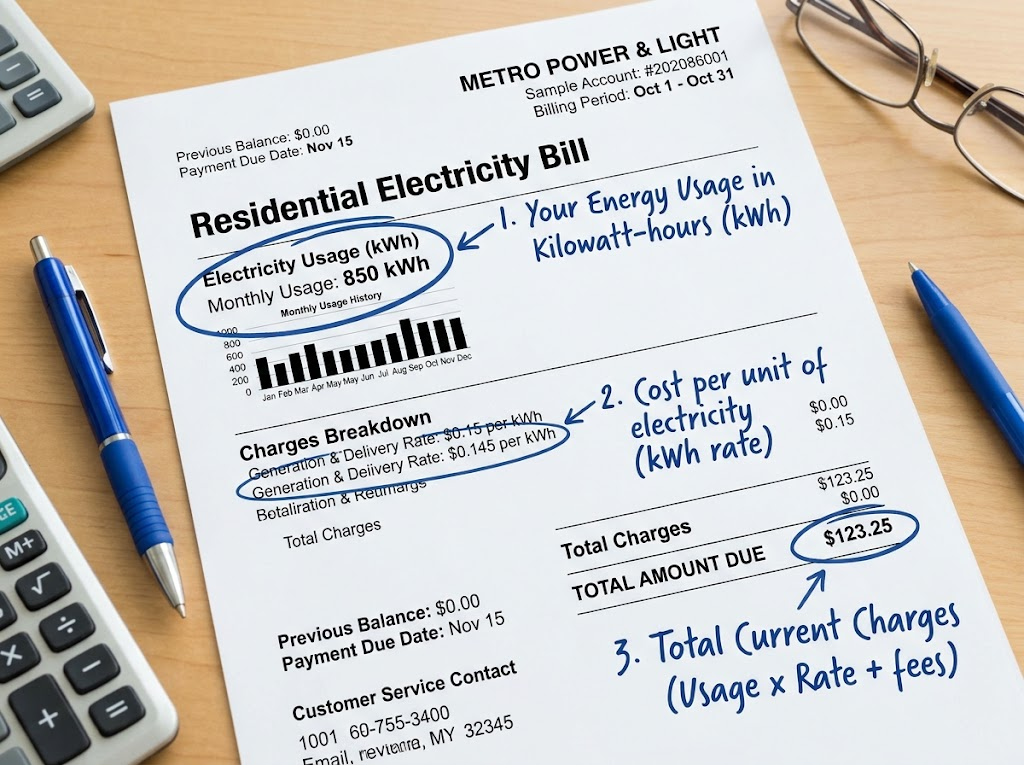
Before making changes, figure out whether your bill increased because you used more electricity or because electricity became more expensive.
Your bill generally reflects two important factors:
- Electricity consumption: Measured in kilowatt-hours (kWh).
- Electricity price: Usually expressed in cents per kWh, although bills may include separate delivery charges and fixed fees.
One kilowatt-hour represents using 1,000 watts of electricity for one hour.
For example, a 1,500-watt space heater running for four hours consumes:
1.5 kW × 4 hours = 6 kWh
At $0.17 per kWh, that costs approximately $1.02.
If it runs four hours daily for 30 days, the electricity cost becomes approximately $30.60.
Common High Electric Bill Causes
Several factors can explain an unexpected increase.
| Possible cause | What to check | Practical response |
|---|---|---|
| Extreme outdoor temperatures | Recent weather and HVAC runtime | Adjust settings and improve efficiency |
| Dirty HVAC filter | Filter condition | Replace with an appropriate filter |
| Electric resistance heating | Heating equipment and thermostat | Reduce unnecessary heating |
| Aging refrigerator | Runtime, door seals, and temperature | Maintain or evaluate replacement |
| Electric water heater | Hot water use and equipment condition | Reduce hot water waste |
| Higher electricity rates | Current and previous bills | Compare available utility plans |
| Additional household members | Occupancy and appliance use | Identify increased consumption |
| Faulty equipment | Unusual cycling or continuous operation | Arrange professional inspection |
| Estimated utility reading | Billing details | Ask the utility about meter readings |
Compare Usage, Not Just Dollar Amounts
Suppose your previous bill was $150 and your current bill is $190.
That doesn’t automatically mean your household used more electricity.
If your electricity rate increased, your total bill could rise even with similar consumption.
Compare the kWh shown on both bills. Also compare usage with the same month last year, if available.
Seasonal comparisons are often more meaningful than comparing January with April.
Helpful resource: The US Energy Information Administration publishes electricity price and consumption information.
Once you understand what’s driving the bill, you can choose improvements that address the actual problem.
How to Lower Your Electric Bill: Start With These 5 Steps
Before buying new equipment, follow this simple process.
Step 1: Find Your Electricity Rate
Look for your electricity consumption in kWh and the charges associated with that consumption.
For a rough calculation, divide your total bill by the total kWh used.
For example:
$204 ÷ 1,200 kWh = $0.17 per kWh
This gives an approximate all-in average rate.
However, fixed monthly charges generally won’t decrease when you save electricity. For more accurate savings estimates, use the variable electricity rate shown on your bill.
Step 2: Review the Last 12 Months
Look for patterns.
Does consumption increase sharply during summer? Your cooling system may be responsible.
Does winter usage rise significantly? Electric heating or a heat pump using auxiliary resistance heat may contribute.
A consistent increase throughout the year may point toward appliances, water heating, or changing household habits.
Step 3: Identify Your Biggest Electricity Users
Typical candidates include:
- Air conditioning and electric heating.
- Electric water heating.
- Clothes dryers.
- Refrigerators and freezers.
- Cooking appliances.
- Entertainment equipment and electronics.
The ranking depends on your home’s equipment, climate, and household habits.
An all-electric home in a cold climate can have a very different consumption profile from a gas-heated apartment in Arizona.
Step 4: Make Free Changes First
Start with thermostat adjustments, shorter showers, reduced standby consumption, and better appliance habits.
These changes cost little or nothing.
Track your usage for several weeks to see whether consumption changes.
Step 5: Evaluate Paid Upgrades
Only after identifying likely energy losses should you consider spending money on equipment.
For example, replacing a working refrigerator may provide relatively modest savings compared with fixing a poorly performing HVAC system.
A useful starting point is the DOE’s Home Energy Assessments guide.
An energy assessment examines how your home uses energy and where improvements may help.
Living Room: 6 Ways to Save Electricity
Your living room can influence electricity consumption through cooling, heating, lighting, and entertainment devices.
These six improvements are generally straightforward.
1. Adjust Your Thermostat by a Few Degrees
Heating and cooling costs depend partly on the difference between indoor and outdoor temperatures.
During summer, a slightly warmer thermostat setting reduces the amount of heat your air conditioner must remove.
During winter, a slightly cooler setting reduces heating demand.
For cooling, try increasing your usual temperature by 1°F or 2°F.
For heating, try reducing it by 1°F or 2°F.
Make gradual changes until you find a comfortable balance.
DOE guidance notes that thermostat setbacks can produce meaningful heating and cooling savings, although results vary with the equipment and climate.
Important: Heat pumps may require different setback strategies, especially when large temperature changes activate electric resistance backup heating.
2. Use Ceiling Fans Correctly
Ceiling fans cool people by moving air across their skin.
They do not directly lower room temperature.
During warm weather, use a fan while you’re in the room to improve comfort.
You may then be able to raise the thermostat slightly.
Turn fans off when rooms are empty.
Fans consume electricity, so running them continuously in unoccupied rooms provides little benefit.
3. Replace Frequently Used Bulbs With LEDs
Lighting is one of the easiest places to reduce electricity consumption.
According to the US Department of Energy, residential LEDs use at least 75% less energy than incandescent lighting and can last much longer.
Start with bulbs used several hours daily.
A living room lamp used five hours every evening is a better replacement candidate than a storage closet bulb used occasionally.
Choose the appropriate brightness, measured in lumens, and color appearance.
4. Reduce TV and Entertainment Standby Power
Some televisions, game consoles, speakers, and streaming devices consume electricity while waiting for commands.
This is commonly called standby power.
Check device settings for energy-saving or low-power modes.
A plug-in power strip can make it easier to disconnect several compatible devices when they’re not needed.
Avoid cutting power to equipment that requires continuous operation, such as necessary medical devices, security systems, or networking equipment.
5. Control Sunlight Through Windows
Windows affect indoor temperatures.
During summer, sunlight entering through windows can increase cooling demand.
Close blinds or curtains on windows receiving strong afternoon sunlight.
During winter, opening curtains on sunny windows can provide useful passive warmth.
Close them again when appropriate to reduce nighttime heat loss.
This strategy works particularly well in rooms with large west-facing windows.
6. Seal Accessible Window and Door Drafts
Air leaks allow conditioned indoor air to escape while outdoor air enters.
Common trouble spots include:
- Door edges.
- Window sash gaps.
- Gaps around trim.
- Worn weatherstripping.
Use removable weatherstripping on operable doors and windows.
Appropriate caulk may help seal stationary gaps, provided the application is suitable and permitted.
Do not block intentional ventilation openings, combustion-air supplies, or required drainage paths.
For a deeper explanation, see our guide to finding and sealing home air leaks.
Kitchen: 7 Ways to Reduce Electricity Use
Kitchen appliances operate throughout the year, making this room a useful place to develop consistent energy-saving habits.
7. Set Your Refrigerator to the Right Temperature
The FDA recommends keeping refrigerator temperatures at or below 40°F and freezers at 0°F.
For practical everyday operation, many homeowners aim for approximately 37°F in the refrigerator and 0°F in the freezer.
Use an appliance thermometer to verify temperatures.
Setting the refrigerator unnecessarily cold can increase electricity use without improving food storage.
8. Check Refrigerator Door Seals
Damaged or dirty seals can allow warm air to enter.
Inspect the gasket around the refrigerator door.
Clean dirt and food residue with mild soap and water.
If the seal is torn, loose, or no longer closes properly, check the manufacturer’s replacement instructions.
A refrigerator that runs unusually often may also need professional service.
9. Keep Refrigerator Ventilation Clear
Refrigerators release heat while cooling their interiors.
Blocking ventilation areas can interfere with proper operation.
Follow the manufacturer’s clearance recommendations.
If the appliance has accessible condenser coils that the manufacturer recommends cleaning, follow its maintenance instructions.
Unplug the appliance first when directed.
Avoid opening sealed electrical or refrigeration components.
10. Run Full Dishwasher Loads
Dishwashers generally use electricity for water heating, pumps, controls, and drying.
Running properly loaded full loads can reduce the number of cycles needed.
Avoid overloading, which can interfere with cleaning.
Use an energy-saving cycle when appropriate.
Consult your dishwasher manual because cycle options vary by model.
11. Turn Off Heated Drying When Practical
Some dishwashers offer heated-dry or air-dry options.
Air drying may reduce electricity consumption.
However, drying performance can vary, especially with plastic containers.
If your dishwasher has an automatic door-opening feature, follow the manufacturer’s recommendations.
Do not manually prop open a dishwasher in a way that creates a safety or moisture problem.
12. Use Smaller Cooking Appliances When Appropriate
A microwave or countertop cooking appliance can use less total electricity than a large oven for certain tasks.
The reason is straightforward: smaller appliances often heat less space.
For example, reheating a single serving in a microwave is usually more efficient than heating an entire conventional oven.
However, energy consumption depends on cooking time, appliance efficiency, and food quantity.
An air fryer isn’t automatically cheaper for every meal.
13. Cook Several Foods During One Oven Session
When using a full-size oven, group compatible dishes together.
This reduces repeated preheating.
Avoid opening the oven door unnecessarily because heat escapes each time.
Use cookware appropriate for the burner or cooking surface.
For electric stovetops, flat-bottomed cookware with good contact can improve heat transfer.
These small kitchen habits become more useful when repeated consistently.
Bedroom: 5 Energy-Saving Improvements
Bedrooms offer opportunities to reduce heating, cooling, and unnecessary electricity use.
Comfort remains important, especially during sleep.
14. Optimize Overnight Temperature Settings
Many households can tolerate slightly different temperatures overnight.
In winter, lowering the heating setting may reduce electricity use.
In summer, some people can tolerate a warmer setting with appropriate bedding and air movement.
However, sleep comfort varies.
Avoid extreme temperatures, particularly in households with infants, older adults, or people with medical conditions.
15. Use a Programmable or Smart Thermostat
A programmable thermostat follows a schedule.
A smart thermostat may offer additional features such as app controls, occupancy detection, and energy reports.
These features can help households avoid unnecessary heating and cooling.
But savings aren’t automatic.
A smart thermostat provides the most value when it improves on an inefficient existing schedule.
Before buying, verify compatibility with your HVAC equipment.
Heat pumps, multi-stage systems, and systems with electric auxiliary heat may have special requirements.
See our comparison of smart thermostats and programmable thermostats.
16. Switch Off Unnecessary Bedroom Electronics
Televisions, gaming equipment, and charging accessories may consume electricity even when not actively used.
Enable energy-saving settings where available.
Disconnect unused chargers and accessories when practical.
Keep essential devices connected.
The savings from a single charger are usually small, so prioritize equipment with higher standby consumption.
17. Use Bedding to Improve Comfort
Comfortable bedding can make modest thermostat changes easier.
During winter, warmer blankets may allow a lower heating setting.
During summer, breathable bedding may help you remain comfortable at a slightly higher cooling temperature.
This approach costs little if you already own suitable bedding.
It also avoids purchasing an appliance solely to compensate for an uncomfortable sleeping environment.
18. Check Window Coverings and Drafts
Bedroom windows can contribute to uncomfortable temperatures.
Close blinds against strong summer sunlight.
Use properly fitted curtains to help improve comfort near cold windows.
Check accessible weatherstripping and window locks.
A window that doesn’t close fully may allow substantial drafts.
Renters should report damaged windows or seals rather than attempting structural repairs.
Bathroom and Laundry: 6 Ways to Save
Water heating and clothes drying can consume substantial electricity in all-electric households.
These six actions address both.
19. Check Your Water Heater Temperature
The Department of Energy recommends 120°F as a suitable water heater setting for many households.
Lowering an unnecessarily high setting may reduce standby heat loss.
However, water heater settings also affect sanitation and scalding risks.
Some households and plumbing systems require different temperatures or mixing valves.
Consult the manufacturer’s instructions and a qualified plumber when necessary.
Do not remove electrical covers or work on wiring.
20. Take Slightly Shorter Showers
Showers require energy when water is heated.
Reducing shower duration lowers hot water consumption.
For example, shortening a shower from 10 minutes to eight minutes reduces water use by approximately 20%, assuming the same flow rate.
Actual electricity savings depend on the shower temperature, water heater efficiency, and whether your water heater uses electricity.
21. Install an Efficient Showerhead
Water-efficient showerheads can reduce hot water consumption while maintaining acceptable performance.
EPA WaterSense-labeled showerheads have a maximum flow rate of 2.0 gallons per minute.
Older standard showerheads may use more.
Compare the existing showerhead’s flow rate before replacing it.
A new fixture provides less benefit if the existing one is already efficient.
Renters should check whether fixture replacement is permitted and retain the original fixture if required.
22. Wash Clothes in Cold Water
Heating water can account for a substantial share of the energy used by many washing machines.
Modern detergents often work effectively in cold water for ordinary laundry.
Use warmer settings when required by fabric instructions, sanitation needs, or the appliance manufacturer.
Cold washing is particularly useful for frequent loads of lightly soiled clothing.
23. Clean the Dryer Lint Filter
A clogged lint filter can restrict airflow and affect drying performance.
Clean the lint screen before or after each load according to the manufacturer’s instructions.
Also inspect the accessible dryer vent outlet for obvious blockage.
Professional dryer vent cleaning may be appropriate when drying times increase or airflow is restricted.
Lint accumulation is a fire hazard, so don’t ignore persistent problems.
24. Air-Dry Clothes When Practical
Air drying avoids the electricity consumed by an electric dryer.
Outdoor clotheslines, indoor drying racks, and suitable hangers can all help.
However, indoor drying adds moisture to the air.
In humid homes, excessive indoor drying can increase condensation and mold risk or make air conditioning work harder.
Use adequate ventilation and monitor indoor humidity.
A useful comparison is available in our electric dryer energy cost guide.
Whole Home: 6 Bigger Energy-Saving Opportunities
Some of the largest improvements involve equipment serving the entire house.
These projects may require professional evaluation, but understanding the options helps you avoid unnecessary spending.
25. Replace Dirty HVAC Filters
A dirty air filter can restrict airflow through a heating or cooling system.
Restricted airflow may reduce efficiency and contribute to equipment problems.
Check filters regularly and replace them according to the manufacturer’s instructions and actual conditions.
Use the correct filter size and a filtration rating compatible with your equipment.
A higher-rated filter isn’t automatically better if it restricts airflow beyond the system’s design.
26. Seal Major Air Leaks
Air sealing can reduce unwanted air movement through the building envelope.
The building envelope is the boundary separating conditioned indoor space from outdoors or unconditioned areas.
Common leakage locations include:
- Attic penetrations.
- Plumbing openings.
- Exterior door gaps.
- Basement rim joists.
- Accessible gaps around windows.
Some simple sealing tasks are DIY-friendly.
However, attic work can involve electrical hazards, insulation irritants, extreme temperatures, and fall risks.
Hire a qualified contractor for inaccessible or complicated areas.
Air sealing should also account for ventilation, combustion safety, and moisture control.
27. Improve Attic Insulation
Insulation slows heat movement.
Its effectiveness is commonly expressed as an R-value, which measures resistance to heat flow.
Higher R-values generally provide greater thermal resistance.
The appropriate insulation level depends on climate, existing insulation, and the building assembly.
Adding attic insulation may be worthwhile when existing coverage is insufficient.
But insulation alone won’t fix every problem.
Air leaks, moisture damage, and ventilation issues should be addressed appropriately before additional material is installed.
Review our attic insulation cost and R-value guide.
28. Maintain Your Air Conditioner or Heat Pump
An air conditioner or heat pump with airflow problems, dirty coils, or refrigerant issues may consume more electricity than necessary.
Homeowners can keep outdoor equipment clear of leaves and debris while following manufacturer clearance instructions.
Professional maintenance can include checking system performance and identifying problems.
Refrigerant handling and electrical repairs must be performed by qualified technicians.
If replacement becomes necessary, compare equipment efficiency, installation quality, climate suitability, and total costs.
Modern cooling efficiency ratings include SEER2, or Seasonal Energy Efficiency Ratio 2, which measures seasonal cooling efficiency under updated testing conditions.
Higher SEER2 ratings generally indicate more efficient cooling equipment, but actual savings depend on installation and operation.
29. Evaluate a Heat Pump Water Heater
A conventional electric resistance water heater generates heat using electrical resistance elements.
A heat pump water heater transfers heat from surrounding air into stored water.
This can use substantially less electricity under suitable conditions.
However, heat pump water heaters may:
- Cost more initially.
- Require adequate installation space.
- Need condensate drainage.
- Cool the surrounding room.
- Produce operating noise.
Performance depends on installation temperature and hot water demand.
A heat pump water heater can be particularly attractive when an aging electric resistance model already needs replacement.
30. Consider an Energy-Efficient HVAC Replacement
Replacing working HVAC equipment solely to reduce electricity costs isn’t always economical.
However, when an old system needs replacement, efficiency matters.
Compare:
- Equipment efficiency ratings.
- Proper system sizing.
- Installation quality.
- Ductwork condition.
- Local climate.
- Expected operating costs.
- Maintenance requirements.
Heat pumps can provide both heating and cooling.
Their heating efficiency is often expressed as COP, or coefficient of performance.
A COP of 3 means the equipment delivers approximately three units of heat for each unit of electricity consumed under the specified operating conditions.
Actual COP changes with outdoor temperature and equipment operation.
Request multiple written quotes from qualified HVAC contractors.
Ask each contractor to explain the recommended equipment size and expected operating costs.
Garage, Home Office, and Outdoor Areas: 5 More Ways to Save
Not every household has these spaces, but they can contain overlooked electricity users.
31. Use Smart Power Strips for Office Equipment
Desktop computers, monitors, speakers, and peripheral devices may continue using electricity when idle.
A smart power strip can automatically disconnect selected outlets when a primary device shuts down.
Check compatibility before connecting equipment.
Never use power strips for high-wattage heating appliances unless specifically permitted by the manufacturer’s instructions.
32. Enable Computer Sleep Settings
A computer left running continuously can consume unnecessary electricity.
Enable automatic sleep settings when inactive.
For laptops, use built-in power management features.
Energy savings vary substantially by computer type, hardware, and usage habits.
33. Replace Outdoor Lights With LEDs
Porch lights, garage lights, and landscape lighting may operate for many hours.
LED replacements can reduce electricity consumption.
Choose bulbs rated for the fixture and outdoor conditions.
For enclosed fixtures, verify that the bulb is approved for enclosed use.
34. Use Timers or Motion Sensors for Outdoor Lighting
Timers and motion sensors reduce unnecessary lighting hours.
A dusk-to-dawn light may run all night even when illumination is only needed occasionally.
Motion-activated lighting may be more appropriate in some locations.
Choose settings that maintain adequate safety and accessibility.
35. Check Garage Refrigerators and Freezers
An older refrigerator in a hot garage may consume more electricity than expected.
Garage temperatures can also affect appliance performance and food safety.
Check whether the appliance is rated for the temperatures it experiences.
If a second refrigerator is rarely needed, consider whether keeping it running year-round is worthwhile.
For households using solar panels or planning an installation, reducing unnecessary consumption can also help clarify how much solar generation is actually needed.
Realistic Costs & Savings
Understanding the math behind electricity savings helps you prioritize changes.
The most useful formula is:
Electricity cost = Power (kW) × Operating hours × Electricity rate ($/kWh)
To estimate savings:
Estimated savings = Electricity avoided (kWh) × Electricity rate ($/kWh)
Example Household
Assume a household has:
| Variable | Assumption |
|---|---|
| Home size | 2,000 sq ft |
| Climate | Mixed heating and cooling climate |
| Electricity rate | $0.17/kWh |
| Monthly electricity use | 1,000 kWh |
| Monthly electricity cost | $170 |
| Annual electricity use | 12,000 kWh |
| Annual electricity cost | $2,040 |
These are illustrative assumptions, not national averages.
Actual consumption depends on home size, insulation, heating fuel, climate, occupancy, and equipment.
Example 1: Replacing Five Incandescent Bulbs
Suppose you replace five 60-watt incandescent bulbs with five 9-watt LEDs.
Power reduction per bulb:
60 W − 9 W = 51 W
Total reduction:
51 W × 5 = 255 W
Convert to kilowatts:
255 ÷ 1,000 = 0.255 kW
Assume each bulb operates four hours daily.
Annual electricity saved:
0.255 × 4 × 365 = 372.3 kWh
Annual electricity savings:
372.3 × $0.17 = $63.29
This example assumes the bulbs operate for the stated hours throughout the year.
Actual savings will be lower if the lights are used less frequently.
Example 2: Reducing Space Heater Usage
A 1,500-watt electric space heater uses 1.5 kWh for each hour of full-power operation.
Suppose you reduce its operation by one hour daily for 90 days.
Electricity avoided:
1.5 × 1 × 90 = 135 kWh
Estimated savings:
135 × $0.17 = $22.95
Actual savings depend on thermostat cycling and whether another heating system must replace the lost heat.
Never sacrifice safe indoor temperatures to achieve energy savings.
Example 3: Reducing Air Conditioning Consumption
Suppose your air conditioner consumes 500 kWh during a particular summer month.
If improved operation reduces that consumption by 10%, the electricity reduction would be:
500 × 0.10 = 50 kWh
At $0.17 per kWh:
50 × $0.17 = $8.50
Across four similar cooling months, that would equal $34.
The 10% reduction is an example assumption, not a predicted result from a specific thermostat change.
Example 4: Estimating Appliance Replacement Savings
Suppose an older appliance uses 700 kWh annually.
A replacement uses 400 kWh annually.
Annual electricity reduction:
700 − 400 = 300 kWh
Annual electricity savings:
300 × $0.17 = $51
If the new appliance costs $800, electricity savings alone would not quickly recover the purchase price.
This illustrates why replacing functioning equipment isn’t always the best first move.
Estimated Costs and Savings by Improvement
The following are broad planning ranges, not verified project quotes or guaranteed savings.
| Improvement | Illustrative upfront cost | Potential annual electricity savings |
|---|---|---|
| Thermostat schedule adjustments | $0 | $0–$100+ |
| Five LED bulb replacements | $10–$40 | $15–$65 |
| Basic weatherstripping | $10–$75 | $0–$75+ |
| Smart thermostat | $75–$300+ | $0–$150+ |
| HVAC filter replacement | $10–$40 per filter | Highly variable |
| Efficient showerhead | $15–$50 | $0–$75+ |
| Attic air sealing | $200–$1,500+ | Highly variable |
| Attic insulation upgrade | $1,000–$4,000+ | Highly variable |
| Heat pump water heater | $1,500–$4,000+ installed | Potentially hundreds annually versus some electric resistance models |
| HVAC replacement | $5,000–$15,000+ | Highly variable |
Important: Cost ranges are illustrative US planning estimates. Local labor, materials, equipment, home conditions, and project scope can produce substantially different prices.
Electricity savings also depend on whether the equipment being replaced is electric.
For example, improving a gas heating system may reduce gas consumption without significantly reducing electricity use.
How to Calculate Savings Using Your Own Bill
Follow these steps:
- Find your electricity rate in dollars per kWh.
- Estimate the electricity your improvement could avoid.
- Multiply avoided kWh by your applicable variable rate.
- Compare annual savings with the upfront cost.
- Consider maintenance, comfort, equipment lifespan, and other benefits.
For simple projects, you can also calculate payback:
Simple payback = Upfront cost ÷ Annual savings
For example:
$100 ÷ $25 per year = 4 years
This calculation doesn’t account for financing, maintenance, changing energy prices, or the time value of money.
It is useful for rough comparisons, not a guarantee.
What About Rebates?
Some state agencies, utilities, and local programs offer incentives for qualifying equipment or efficiency improvements.
Programs vary by location and change frequently.
Check:
- ENERGY STAR Rebate Finder
- DSIRE
- Your state energy office.
- Your electricity provider.
Federal residential energy tax credits under Sections 25C and 25D ended for expenditures after December 31, 2025.
Do not assume an upgrade purchased in 2026 qualifies for those former federal credits.
Always verify current program requirements before purchasing equipment.
Room-by-Room Energy Saving Checklist
Use this checklist to prioritize changes rather than attempting every improvement at once.
| Area | Action | Cost level | DIY-friendly? | Priority |
|---|---|---|---|---|
| Utility bill | Compare kWh and rates | Free | Yes | High |
| Living room | Adjust thermostat | Free | Yes | High |
| Living room | Use fans only when occupied | Free | Yes | Medium |
| Living room | Replace frequently used incandescent bulbs | Low | Yes | Medium |
| Living room | Reduce unnecessary standby consumption | Free | Yes | Medium |
| Living room | Manage window sunlight | Free | Yes | Medium |
| Living room | Apply appropriate weatherstripping | Low | Usually | High |
| Kitchen | Verify refrigerator temperature | Free | Yes | High |
| Kitchen | Inspect refrigerator seals | Free | Yes | Medium |
| Kitchen | Maintain ventilation clearance | Free | Yes | Medium |
| Kitchen | Run appropriately full dishwasher loads | Free | Yes | Medium |
| Kitchen | Use air-dry dishwasher settings | Free | Yes | Medium |
| Kitchen | Choose appropriately sized cooking appliances | Free | Yes | Medium |
| Kitchen | Combine oven cooking tasks | Free | Yes | Low |
| Bedroom | Optimize overnight temperature | Free | Yes | High |
| Bedroom | Program thermostat schedules | Free–Medium | Usually | High |
| Bedroom | Reduce unnecessary electronics use | Free | Yes | Medium |
| Bedroom | Adjust bedding for comfort | Free–Low | Yes | Medium |
| Bedroom | Check windows and drafts | Free–Low | Usually | Medium |
| Bathroom | Review water heater setting | Free | Sometimes | High |
| Bathroom | Reduce shower duration | Free | Yes | High |
| Bathroom | Install efficient showerhead | Low | Usually | Medium |
| Laundry | Wash suitable loads in cold water | Free | Yes | High |
| Laundry | Clean dryer lint filter | Free | Yes | High |
| Laundry | Air-dry clothes when appropriate | Free | Yes | Medium |
| Whole home | Replace HVAC filters | Low | Usually | High |
| Whole home | Address major air leaks | Medium | Sometimes | High |
| Whole home | Evaluate attic insulation | High | Professional often preferred | High |
| Whole home | Maintain HVAC equipment | Medium | Professional | High |
| Whole home | Evaluate water heater replacement | High | Professional | Medium |
| Whole home | Evaluate HVAC replacement | High | Professional | As needed |
| Home office | Use compatible smart power strips | Low | Yes | Medium |
| Home office | Enable computer sleep modes | Free | Yes | Medium |
| Outdoors | Install suitable LED bulbs | Low | Usually | Medium |
| Outdoors | Use timers or motion sensors | Low–Medium | Depends on installation | Medium |
| Garage | Evaluate second refrigerator use | Free | Yes | Medium |
Tip: Start with items marked High priority that apply to your home.
Not every homeowner needs all 35 changes.
Energy-Saving Tips for Different US Climates
The most effective approach depends partly on where you live.
Hot-Humid South
In states such as Florida, Louisiana, and parts of Texas, cooling and humidity control are major concerns.
Prioritize:
- Air conditioner maintenance.
- Attic insulation.
- Appropriate air sealing.
- Solar heat control.
- Indoor humidity management.
Avoid turning off air conditioning for extended periods if doing so creates excessive indoor humidity.
High humidity can contribute to mold growth and discomfort.
Cold Northern States
Homes in Minnesota, Wisconsin, Maine, and similar climates may experience high winter heating demand.
Prioritize:
- Air sealing.
- Adequate insulation.
- Heating system maintenance.
- Proper thermostat programming.
- Window and door draft reduction.
If you use a heat pump, avoid aggressive temperature setbacks that unnecessarily activate electric resistance backup heating.
Dry Western States
In parts of Arizona, Nevada, and inland California, summer cooling can dominate electricity bills.
Strong sunlight can create substantial heat gain through windows.
Exterior shading, suitable window coverings, insulation, and efficient cooling equipment may help.
Where evaporative cooling is appropriate, equipment performance depends strongly on outdoor humidity and water availability.
Mild Coastal Climates
Homes in coastal California and parts of the Pacific Northwest may have lower annual heating and cooling demand.
In these areas, water heating, appliances, and household electronics can represent a larger share of electricity use.
Prioritize improvements based on actual usage rather than assuming HVAC is always the biggest opportunity.
Best Ways for Renters to Lower Electric Bills
Renters often have fewer options for permanent improvements, but meaningful changes are still possible.
Focus on adjustments that don’t require structural work.
Renter-Friendly Improvements
Consider:
- Replacing frequently used bulbs with compatible LEDs.
- Using removable weatherstripping where permitted.
- Managing blinds and curtains.
- Adjusting thermostat schedules.
- Washing clothes in cold water.
- Reducing unnecessary appliance operation.
- Using smart plugs for compatible electronics.
- Checking refrigerator temperatures.
For thermostat replacements, showerhead changes, or other fixture modifications, obtain landlord approval when required.
Keep original fixtures if your lease requires restoration.
What If Utilities Are Included in Rent?
If electricity is included in rent, your personal bill may not change when consumption decreases.
However, efficiency measures can still improve comfort and reduce waste.
If electricity is billed separately through a landlord or submetering arrangement, review the lease and billing terms to understand how charges are calculated.
Ask Your Landlord About Maintenance
Report problems such as:
- HVAC equipment running continuously.
- Damaged window seals.
- Water heater leaks.
- Poorly functioning refrigerators.
- Unusual electrical odors.
- Inadequate heating or cooling.
Document maintenance requests.
Avoid unauthorized electrical, plumbing, or HVAC repairs.
When to Call a Professional
Many electricity-saving improvements are simple.
Others involve safety risks or require specialized equipment.
Call a Licensed Electrician When:
- Breakers trip repeatedly.
- Outlets feel unusually hot.
- Lights flicker persistently without an obvious cause.
- You notice burning smells or buzzing from electrical equipment.
- You need new circuits, wiring, or electrical panel work.
Do not open an electrical panel or attempt internal wiring repairs.
If you notice smoke, sparking, or an immediate fire hazard, move to safety and contact emergency services.
Call a Qualified HVAC Technician When:
- Your cooling system runs continuously without reaching the set temperature.
- The heat pump frequently activates auxiliary heat unexpectedly.
- Cooling performance suddenly declines.
- You notice ice buildup on indoor or outdoor HVAC components.
- Equipment makes unusual noises.
- You suspect refrigerant problems.
Refrigerant work requires qualified handling.
Never attempt to recharge or modify a refrigerant system yourself.
Call an Insulation or Building Performance Contractor When:
- Attic insulation is significantly uneven or damaged.
- You suspect major concealed air leaks.
- Moisture or mold is present.
- Attic access is hazardous.
- Air sealing could affect combustion appliances or ventilation.
A qualified home energy professional can evaluate ventilation and combustion safety before major air sealing.
Carbon Monoxide Safety
Homes with fuel-burning furnaces, fireplaces, water heaters, or attached garages require special attention to carbon monoxide risks.
Install and maintain carbon monoxide alarms according to applicable safety guidance and local requirements.
Never block combustion-air openings to prevent drafts.
If a carbon monoxide alarm sounds, follow the alarm manufacturer’s emergency instructions and contact emergency services as appropriate.
Space Heater Safety
Portable space heaters can create fire risks.
Follow the manufacturer’s instructions, keep combustible materials away, and plug the heater directly into a suitable wall outlet.
Do not use extension cords or power strips with portable space heaters.
Turn heaters off when unattended or sleeping unless the manufacturer’s instructions explicitly permit the intended operation.
Common Mistakes to Avoid
Reducing electricity costs works best when changes are based on actual energy use.
These seven mistakes can undermine otherwise sensible efforts.
1. Assuming Every Expensive Bill Means Higher Consumption
Electricity rates and billing periods can change.
Always compare kWh before assuming something in your home is wasting power.
2. Turning the Thermostat to an Extreme Temperature
Setting an air conditioner to 60°F doesn’t make a typical system cool faster.
It generally tells the equipment to keep cooling longer.
Choose the temperature you actually want.
3. Closing Too Many HVAC Vents
Closing supply vents in unused rooms can increase duct pressure and interfere with airflow in some systems.
It may also reduce efficiency or create equipment problems.
Ask an HVAC professional about proper zoning rather than closing vents indiscriminately.
4. Replacing Appliances Without Checking the Numbers
A new appliance may be more efficient, but electricity savings alone may not justify replacing a functioning model.
Compare annual energy consumption and purchase costs.
ENERGY STAR labels and EnergyGuide information can help.
5. Ignoring Moisture While Air Sealing
Air sealing without considering ventilation and moisture can create indoor air quality problems.
Address leaks and humidity sources appropriately.
6. Assuming Smart Devices Automatically Save Money
Smart thermostats and plugs can help manage consumption.
But a device that doesn’t change energy usage may provide little savings.
Evaluate the feature you actually need.
7. Overlooking Your Utility Rate Structure
Some electricity plans charge different prices depending on time of day.
Others include tiered rates, demand charges, or fixed fees.
Shifting electricity use may help under certain plans, but the same strategy won’t work for everyone.
Frequently Asked Questions
1. What is the fastest way to lower your electric bill?
Start by checking your electricity usage and identifying major appliances or systems that run frequently. Adjust thermostat settings, reduce unnecessary heating and cooling, switch off unused equipment, and wash suitable laundry loads in cold water. These changes require little or no upfront spending. The biggest immediate opportunity depends on what currently consumes the most electricity in your home.
2. Why is my electric bill suddenly so high?
A sudden increase may result from extreme weather, a higher electricity rate, additional household members, equipment problems, or a longer billing period. Compare current kWh usage with previous bills. If consumption increased unexpectedly, check HVAC operation, electric heating, and water heating. Contact your utility if the bill includes unusual readings or unexplained charges.
3. What appliances use the most electricity in a house?
In many US homes, electric heating, air conditioning, and water heating are major electricity users. Clothes dryers, refrigerators, cooking appliances, and other equipment also contribute. The ranking varies depending on climate and fuel type. A home heated with natural gas may use much less electricity for space heating than an all-electric home.
4. Does unplugging appliances really save electricity?
Unplugging devices can reduce standby electricity consumption, but savings vary widely. Some modern electronics use very little power when inactive, while certain entertainment systems and older devices consume more. Smart power strips can help manage compatible equipment. Focus on devices with measurable standby consumption rather than expecting large savings from unplugging every phone charger.
5. What temperature should I set my AC to save money?
There isn’t one ideal temperature for every household. A practical approach is to raise your usual cooling setting by 1°F or 2°F and evaluate comfort. Higher cooling settings generally reduce air conditioning demand when other conditions remain similar. Indoor humidity, health needs, sleeping comfort, and building characteristics should guide your final setting.
6. Is it cheaper to leave the AC running all day?
Keeping the air conditioner at the same low temperature all day isn’t necessarily cheaper than using a warmer setting while away. Reducing cooling demand during unoccupied periods can save electricity. However, humidity control and system type matter. In hot, humid climates, avoid settings that allow excessive indoor moisture accumulation.
7. Do smart thermostats actually lower electric bills?
Smart thermostats may reduce heating and cooling energy consumption when they improve scheduling or prevent unnecessary operation. Savings depend on your previous habits, HVAC equipment, and climate. A household already using an efficient thermostat schedule may see relatively little improvement. Check equipment compatibility before purchasing, particularly with heat pumps and multi-stage systems.
8. Can new windows significantly reduce electricity costs?
Efficient windows can reduce heat transfer and improve comfort, especially when existing windows are damaged, drafty, or poorly insulated. However, full window replacement can be expensive. Weatherstripping, air sealing, and suitable window coverings may provide better value as initial improvements. Compare installation quotes and expected performance before committing to a major project.
9. Is solar worth it just to lower an electric bill?
Solar panels can reduce purchased grid electricity, but the financial outcome depends on installation cost, available sunlight, electricity prices, system size, financing, and utility compensation rules. A lower electric bill doesn’t necessarily mean the system has paid for itself. Compare multiple quotes, review contracts carefully, and evaluate total ownership costs before deciding.
10. How much electricity can attic insulation save?
Savings depend on existing insulation, climate, air leakage, heating fuel, and HVAC efficiency. A poorly insulated attic may offer meaningful improvement potential, while an already well-insulated attic may offer less. A home energy assessment can help estimate likely benefits. Address major air leaks and moisture problems before adding insulation.
11. Why is my electric bill high when I’m not home?
Electricity consumption continues when nobody is home because refrigerators, water heaters, HVAC systems, networking equipment, and other devices may keep operating. Heating or cooling an empty home can be especially costly. Review thermostat settings and utility usage data. If consumption appears unusually high, investigate continuously operating equipment or request assistance from your utility.
12. How can I lower my electric bill without spending money?
Start with thermostat adjustments, appropriate use of blinds, cold-water laundry, shorter showers, and reducing unnecessary equipment operation. Run dishwashers with properly loaded full loads and enable computer sleep settings. These habits may lower consumption without requiring purchases. Track your kWh over time to determine whether the changes are making a measurable difference.
Final Checklist
The most effective approach to lowering electricity costs is to focus on the biggest opportunities first.
Use this short action plan:
- Review your last three electricity bills.
- Find your electricity rate per kWh.
- Compare usage with the same season last year.
- Adjust thermostat settings for comfort and efficiency.
- Inspect HVAC filters.
- Replace heavily used incandescent bulbs.
- Check refrigerator temperatures and door seals.
- Reduce unnecessary hot water consumption.
- Look for accessible drafts around doors and windows.
- Review utility rate plans and available rebates.
- Get professional estimates before major upgrades.
- Track electricity consumption after making changes.
You don’t need to complete all 35 improvements.
Start with three changes that fit your home, budget, and daily routine.
After a full billing cycle, compare electricity consumption with a similar period, accounting for major weather differences when possible.
The best way to lower electric bill costs is to understand where your electricity goes, reduce unnecessary consumption, and invest in improvements that make financial and practical sense for your household.
Pingback: DIY Home Energy Audit: A Step-by-Step Guide & Costs (Before You Hire a Pro) – Energy Savings Perlon
Pingback: Best Thermostat Settings for Summer and Winter (Save Money, Stay Comfortable) – Energy Savings Perlon
Pingback: What Uses the Most Electricity in Your Home? (Appliance kWh Chart) – Energy Savings Perlon