Replacing a water heater isn’t something most homeowners look forward to. But if your current unit is getting older, choosing the right replacement could make a noticeable difference in your electricity bills for years.
One option getting attention is the heat pump water heater, sometimes called a hybrid water heater. Unlike conventional electric models, these appliances move heat from surrounding air into the water instead of relying primarily on electric resistance heating.
Read Also: What Uses the Most Electricity in Your Home? (Appliance kWh Chart)
But is a heat pump water heater worth it once you factor in purchase price, installation, maintenance, and your local climate?
For many households replacing an electric water heater, the answer may be yes. However, installation conditions, electricity rates, and hot water demand can change the economics considerably.
This guide explains how heat pump water heaters work, what they realistically cost, how much electricity they may save, and when a conventional water heater might be the better choice.
Quick Takeaways
- Lower operating costs: Heat pump water heaters can use substantially less electricity than conventional electric resistance models.
- Higher upfront price: A typical installed replacement may cost roughly $2,000–$5,500, depending on the equipment and installation requirements.
- Potential annual savings: Some households replacing electric resistance water heating may save several hundred dollars annually.
- Installation matters: These appliances need adequate airflow, drainage, and suitable surrounding temperatures.
- Climate affects performance: Warm spaces generally favor heat pump operation, while cold spaces can reduce efficiency.
- Rebates may help: State, local, and utility incentives can reduce costs, but availability and eligibility vary.
- Not ideal everywhere: Tight closets, cold garages, and certain gas-to-electric conversions can make installation expensive.
- Best buying strategy: Compare total installed costs, estimated operating expenses, and warranty coverage before deciding.
What Is a Heat Pump Water Heater?
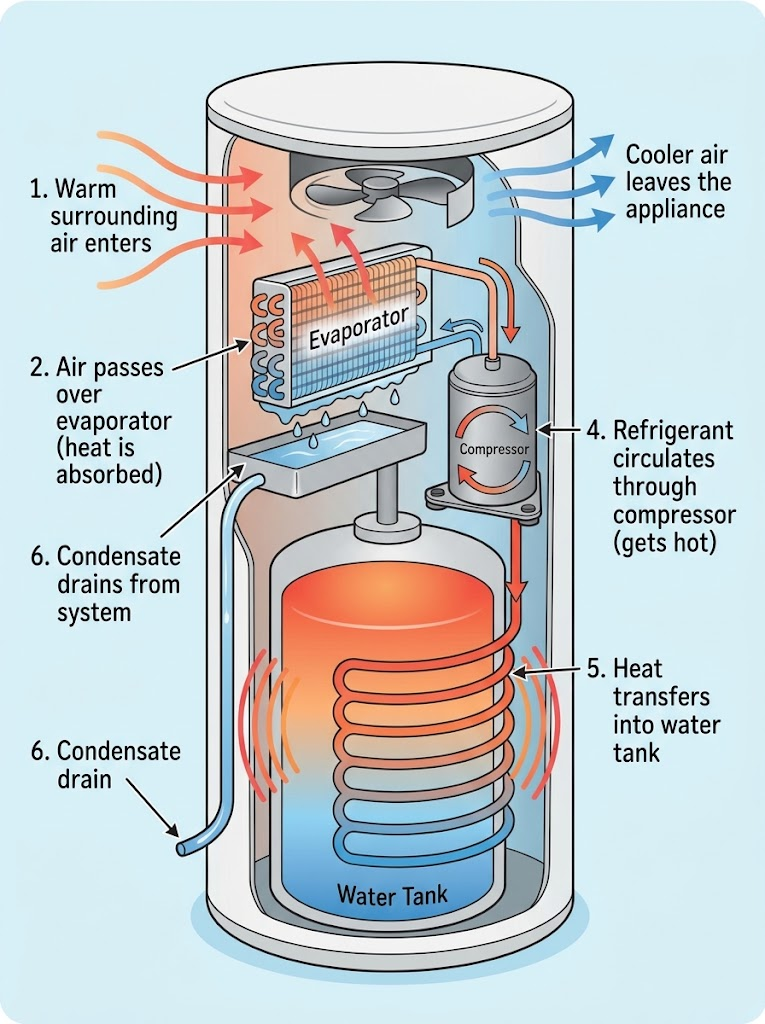
A heat pump water heater (HPWH) is an electric appliance that heats water by transferring heat from the surrounding air into a storage tank.
Instead of creating most of its heat directly through electrical resistance, it uses a refrigeration system similar to the technology found in air conditioners and refrigerators.
Read Also: Tank vs Tankless vs Heat Pump Water Heater: Which Is Best for Your Home?
According to the U.S. Department of Energy (DOE), heat pump water heaters can be two to three times more energy efficient than conventional electric resistance water heaters.
That difference is what makes them attractive for households trying to reduce electricity consumption.
How Does a Heat Pump Water Heater Work?
The process has four basic stages:
- Air intake: A fan draws surrounding air into the appliance.
- Heat collection: Refrigerant absorbs heat from the air through an evaporator.
- Heat compression: A compressor increases the refrigerant’s temperature.
- Water heating: Heat transfers into the tank’s water before the cycle repeats.
The refrigerant circulates through a sealed system. Homeowners should not attempt to open or service that system.
Because the appliance transfers heat rather than generating all of it directly, it can deliver more heat energy than the electrical energy it consumes.
This relationship is often described using the coefficient of performance (COP).
For example, a COP of 3 means the appliance delivers approximately three units of heat for every unit of electricity consumed under the measured conditions.
Actual performance changes with air temperature, water temperature, and operating mode.
Read Also: Which Home Energy Upgrade Should You Do First? (Priority Guide)
Why Is It Called a Hybrid Water Heater?
Many residential heat pump water heaters are marketed as hybrid models.
They combine two heating technologies:
- A heat pump for efficient everyday operation.
- Electric resistance heating elements for additional heating capacity.
Some units allow users to select operating modes.
An efficiency-focused mode prioritizes heat pump operation, while hybrid or high-demand modes may use resistance elements when hot water demand increases.
The tradeoff is straightforward: faster recovery can require more electricity.
A household that regularly runs several showers, a dishwasher, and laundry close together may use more resistance heating than a household with moderate demand.
Understanding this distinction helps explain why advertised efficiency and actual household savings can differ.
Heat Pump Water Heater Pros and Cons
A heat pump water heater has several advantages, but it also introduces considerations that don’t apply to basic electric tank models.
| Advantages | Potential Drawbacks |
|---|---|
| Uses less electricity than conventional electric resistance heating | Higher purchase and installation cost |
| May reduce annual water heating expenses | Requires adequate airflow |
| Can provide useful cooling in warm spaces | May make surrounding rooms cooler |
| Many models offer programmable operating modes | Fan and compressor produce noise |
| Can work well with time-of-use electricity rates | Recovery may be slower in efficiency mode |
| No combustion occurs inside the appliance | Condensate drainage is required |
| May qualify for local or utility rebates | Installation can require electrical upgrades |
Why Lower Electricity Use Matters
Water heating is a significant household energy expense.
Unlike occasional appliances, a water heater operates throughout the year. It must replace heat lost from stored water and heat additional water whenever someone showers, washes dishes, or uses a hot-water appliance.
Small efficiency improvements can therefore accumulate over time.
Heat pump technology offers a substantial efficiency improvement compared with electric resistance heating.
However, the financial benefit depends on what you’re replacing.
Switching from an older electric resistance tank may produce meaningful savings. Replacing an efficient gas water heater can be a more complicated financial comparison.
The Cooling Effect Homeowners Sometimes Overlook
A heat pump water heater removes heat from the surrounding air.
That means the room containing the appliance becomes cooler while the heat pump operates.
In summer, this cooling may be useful in a warm utility room or basement.
During winter, however, a heat pump water heater installed inside conditioned living space can increase the home’s heating demand.
The impact depends on the heating system, climate, installation location, and household hot water consumption.
This is one reason installation location deserves as much attention as the appliance’s efficiency rating.
Realistic Costs & Savings
The biggest question for most buyers is whether lower electricity bills justify the additional upfront expense.
To answer it, compare three things:
- Total installed cost.
- Expected annual operating cost.
- Additional upfront investment compared with your alternative.
Heat Pump Water Heater Cost in 2026
The following ranges are general planning estimates for U.S. residential installations, not national price averages or contractor quotes.
| Expense | Estimated Cost |
|---|---|
| Heat pump water heater equipment | $1,300–$3,500 |
| Basic professional installation | $500–$1,500 |
| Condensate drainage or minor installation modifications | $100–$600 |
| Electrical upgrades, when required | $300–$2,000+ |
| Typical straightforward installed replacement | $2,000–$5,500 |
| Complex installations | $5,500+ |
Actual prices vary by tank capacity, location, labor rates, electrical infrastructure, and installation complexity.
An existing electric tank in a spacious utility room is generally simpler to replace than a gas water heater in a cramped closet.
A gas-to-electric conversion may involve electrical work and properly decommissioning gas and venting connections.
Those tasks belong to qualified professionals.
Worked Example: How Much Could You Save?
Consider a 2,000-square-foot home in a mixed climate.
Assume:
- Household: Three or four occupants.
- Existing heater: Conventional electric resistance tank.
- Electricity price: $0.17 per kilowatt-hour (kWh).
- Annual electric resistance water heating consumption: 3,600 kWh.
- Replacement heat pump water heater consumption: 1,200–1,800 kWh.
- Hot water use remains approximately unchanged.
A kilowatt-hour is the electricity billing unit shown on most utility bills.
Annual operating cost formula:
Annual electricity cost = Annual kWh × Electricity rate
For the existing water heater:
3,600 kWh × $0.17 = $612 per year
For the heat pump water heater:
1,200 kWh × $0.17 = $204 per year
At the higher consumption estimate:
1,800 kWh × $0.17 = $306 per year
Estimated annual electricity savings:
$612 − $204 = $408
Or:
$612 − $306 = $306
In this example, the household might save approximately $306–$408 annually on water heating electricity.
These are illustrative calculations, not measured results or guaranteed savings.
They also exclude potential changes in space-heating and cooling costs caused by the water heater’s effect on surrounding air.
How Long Would It Take to Pay Back?
Suppose the installed heat pump water heater costs $3,200.
A comparable conventional electric replacement would cost $1,500.
The additional investment is:
$3,200 − $1,500 = $1,700
Simple payback formula:
Additional upfront cost ÷ Annual savings = Payback period
Using annual savings of $306–$408:
$1,700 ÷ $408 = 4.2 years
$1,700 ÷ $306 = 5.6 years
That produces an illustrative simple payback period of approximately 4–6 years.
Simple payback does not account for financing, future electricity rates, repairs, maintenance differences, or the time value of money.
A rebate could shorten that period. Expensive installation modifications could lengthen it.
Calculate Savings Using Your Own Electric Bill
Find the electricity supply rate on your utility bill.
If your utility separates generation, delivery, and other per-kWh charges, include applicable variable charges when estimating the cost of additional electricity use.
Fixed monthly customer charges generally won’t change when you install a more efficient water heater.
For example, suppose your applicable electricity rate is $0.24/kWh.
If the new appliance uses 2,000 fewer kWh annually:
2,000 × $0.24 = $480 in estimated annual savings
At $0.12/kWh, the same reduction would save approximately $240.
Households on time-of-use plans should also consider when the appliance operates.
For a broader explanation of appliance electricity costs, see our guide to calculating home appliance energy use.
Heat Pump vs. Electric vs. Gas Water Heaters
A heat pump water heater isn’t automatically the least expensive option for every home.
The comparison depends heavily on your existing fuel type.
| Feature | Heat Pump Water Heater | Electric Resistance Tank | Gas Storage Water Heater |
|---|---|---|---|
| Main energy source | Electricity | Electricity | Natural gas |
| Energy efficiency | Generally highest of these options | Lower | Varies by model |
| Upfront equipment cost | Higher | Usually lower | Often moderate |
| Installation complexity | Moderate to high | Usually straightforward | Depends on gas and venting |
| Typical operating cost | Often low | Often high | Depends on gas rates |
| Airflow requirements | Yes | Usually minimal | Combustion and venting requirements |
| Noise | Fan and compressor | Usually quiet | Usually quiet |
| Maintenance | Filter, drainage, tank maintenance | Tank maintenance | Tank and combustion-system maintenance |
Replacing an Electric Water Heater
This is often the strongest financial case for upgrading.
Conventional electric resistance heaters convert electricity directly into heat.
Heat pump models use electricity to move additional heat from the surrounding air.
If the existing electrical circuit and installation space are suitable, upgrading may require fewer modifications than a gas-to-electric conversion.
Replacing a Gas Water Heater
The economics are less predictable.
Natural gas is billed in therms, a unit of heat energy equal to 100,000 British thermal units (Btu).
You cannot compare the price of one therm directly with the price of one kWh without accounting for energy content and equipment efficiency.
A useful conversion is:
1 therm ≈ 29.3 kWh of energy.
For example, natural gas priced at $1.50 per therm provides fuel energy at approximately $0.051 per kWh before accounting for water heater efficiency.
A heat pump water heater may still have competitive operating costs because it delivers several units of heat per unit of electricity.
However, the result depends on local gas and electricity rates.
Gas-to-electric conversion costs can also change the financial picture.
If you’re replacing a gas appliance, ask contractors for an operating-cost comparison using your actual utility rates.
What About Tankless Water Heaters?
Tankless units heat water on demand rather than storing a large volume in a tank.
They can reduce standby heat losses, but installation requirements and operating costs vary.
Gas tankless systems require appropriate combustion venting and gas capacity. Electric tankless models can require substantial electrical capacity.
A tankless heater is not necessarily cheaper to operate than a heat pump water heater.
Compare installation cost, household demand, energy rates, and maintenance requirements before deciding.
Does Your Home Have Enough Space?
A heat pump water heater needs more than enough floor space for its tank.
It also needs sufficient surrounding air for the heat pump to operate effectively.
Installation Space Checklist
| Requirement | What to Check | Why It Matters |
|---|---|---|
| Air volume | Manufacturer’s minimum room-volume requirement | Supports adequate heat exchange |
| Ceiling height | Total appliance height and service clearance | Allows installation and maintenance |
| Airflow clearance | Required distance around intake and exhaust openings | Prevents restricted airflow |
| Temperature | Manufacturer’s permitted operating range | Affects heat pump performance |
| Drainage | Suitable condensate drain or pump arrangement | Removes collected moisture |
| Electrical supply | Required voltage, circuit capacity, and connection type | Ensures safe operation |
| Floor support | Tank weight when filled with water | Prevents structural problems |
| Noise | Distance from bedrooms and living areas | Improves comfort |
| Service access | Space for filter cleaning and repairs | Simplifies maintenance |
Some models require substantial surrounding air volume, while others support approved ducting arrangements or are designed for smaller spaces.
Always follow the specific manufacturer’s installation instructions rather than relying on a universal clearance rule.
Best Installation Locations
Common possibilities include:
- Spacious basements.
- Utility rooms with adequate airflow.
- Warm garages within the appliance’s operating limits.
- Mechanical rooms designed for heat pump water heaters.
A large basement can be particularly suitable when temperatures remain relatively stable.
A small interior closet may require a different model or a professionally designed airflow solution.
What About Cold Garages?
A garage installation can work, but climate matters.
Cold air contains less usable heat, making the heat pump work harder.
If temperatures drop below the model’s heat pump operating range, some hybrid units may switch to electric resistance heating.
That increases electricity consumption.
Do not assume every heat pump water heater is suitable for freezing conditions.
The manufacturer’s specifications should determine whether a garage installation makes sense.
For homes with uncomfortable utility spaces, our home insulation guide explains how air sealing and insulation affect temperatures throughout the house.
How Climate Changes the Savings
Heat pump water heaters can operate in many U.S. climates, but surrounding air conditions influence their performance.
Hot-Humid South
Warm air generally helps heat pump efficiency.
A heat pump water heater may also remove some moisture from the surrounding air as it operates.
In a warm basement or garage, that can provide a useful secondary benefit.
However, it is not a substitute for a dedicated dehumidifier when moisture control is necessary.
Proper condensate drainage remains essential.
Cold Northern States
Cold basements and garages can reduce efficiency.
A unit installed inside heated space also draws some heat that the home’s heating system must replace.
For example, a home heated with electric resistance equipment may experience a larger winter energy penalty than a home with an efficient space-heating heat pump.
A suitable location and operating mode can help, but savings estimates should account for winter conditions.
Dry Western States
Warm utility rooms and garages may provide favorable operating conditions.
However, extremely hot garages can exceed the recommended temperature limits of certain models.
Dust accumulation can also make regular filter inspection important.
Check the appliance’s rated operating temperature range.
Mixed-Climate Regions
Homes with warm summers and cold winters experience changing performance throughout the year.
A basement that stays relatively moderate may offer more consistent conditions than an unconditioned garage.
For these households, year-round installation conditions matter more than summer efficiency alone.
Rebates and Incentives
Rebates can improve the economics of a heat pump water heater, but programs differ significantly across the country.
Some utilities offer incentives for qualifying ENERGY STAR-certified equipment.
Certain state programs may provide additional support, sometimes with income, equipment, installation, or contractor requirements.
Important for 2026: Federal residential energy tax credits under Sections 25C and 25D ended for expenditures after December 31, 2025. Do not include those expired credits when calculating the cost of a new 2026 installation.
Other incentive programs may still exist.
To check current opportunities:
- Visit the ENERGY STAR Rebate Finder.
- Search the Database of State Incentives for Renewables & Efficiency.
- Check your state energy office’s website.
- Review your electric utility’s current water heating programs.
- Ask whether installation must be completed by an approved contractor.
- Confirm application deadlines and eligibility before purchasing equipment.
Some programs require preapproval or specific product certifications.
Others may limit incentives to certain households or installation types.
Programs change frequently, so verify current terms directly with the administrator.
How to Choose the Right Heat Pump Water Heater
Price matters, but tank capacity, efficiency, noise, and installation requirements can be equally important.
1. Choose the Right Tank Size
Common residential tank capacities include 40, 50, 65, and 80 gallons, although availability varies.
Household size is a useful starting point, but hot water usage patterns matter more.
A family that takes several consecutive showers may need greater hot water delivery than a similarly sized household with staggered schedules.
Look for the first-hour rating (FHR).
This measures approximately how many gallons of hot water the unit can deliver during an hour of heavy use under standardized test conditions.
A larger tank isn’t always necessary.
However, undersizing can cause more frequent resistance-element operation or insufficient hot water during peak demand.
2. Compare UEF Ratings
The Uniform Energy Factor (UEF) is a standardized measure of water heater efficiency.
Higher UEF values generally indicate greater efficiency within an appropriate product comparison.
For example, a heat pump water heater with a UEF near 3.5 is substantially more efficient under standardized testing than a conventional electric resistance model with a UEF near 0.9.
Actual household performance will vary.
Compare models within relevant draw-pattern categories, and use ENERGY STAR listings to identify certified products.
3. Check Noise Ratings
Heat pump water heaters contain fans and compressors.
Noise levels differ by model and operating mode.
A unit installed beside a bedroom may be more noticeable than one placed in a distant basement.
Review manufacturer noise specifications and consider how sound may travel through nearby rooms.
4. Review Warranty Coverage
Compare warranties for:
- Storage tank coverage.
- Compressor and heat pump components.
- Electrical and electronic components.
- Labor coverage.
- Replacement limitations.
A longer warranty does not necessarily cover every repair expense.
Read exclusions and service requirements carefully.
5. Consider Smart Controls
Some models offer Wi-Fi connectivity, scheduling, vacation modes, and energy monitoring.
These features may help households on time-of-use electricity plans.
For example, scheduling more water heating during lower-priced hours may reduce costs if sufficient hot water remains available.
However, smart features aren’t essential for every household.
A properly sized, efficient appliance with simple controls can still deliver strong performance.
Installation and Maintenance
Heat pump water heater installation is generally a professional job.
The work may involve electrical connections, plumbing changes, condensate management, and equipment handling.
However, homeowners can safely complete several planning and routine maintenance tasks.
Step-by-Step: Prepare for Installation
- Record your current water heater details. Note its fuel type, tank capacity, approximate age, and model number.
- Measure the installation space. Record available height, width, and depth without moving electrical or plumbing connections.
- Check the surrounding temperature. Note whether the location becomes unusually cold in winter or hot in summer.
- Review your electricity bill. Find your applicable per-kWh rate and whether you have time-of-use pricing.
- Compare suitable models. Look at capacity, UEF, noise, warranty, and manufacturer clearance requirements.
- Request multiple installation quotes. Ask contractors to itemize equipment, labor, drainage, electrical work, permits, and removal of the old unit.
- Check rebates before purchasing. Confirm equipment and contractor eligibility.
- Keep the installation documentation. Save the manual, warranty, permit records, and final invoice.
Basic Maintenance Homeowners Can Perform
Routine maintenance depends on the manufacturer.
Common tasks include checking and cleaning an accessible air filter according to the manual, keeping airflow openings unobstructed, and visually inspecting the surrounding floor for moisture.
Some models provide maintenance reminders or diagnostic messages.
Follow the manufacturer’s instructions rather than using a generic schedule for every appliance.
Tank flushing and anode rod inspection may also be recommended, but these tasks involve hot water, pressure, and potentially heavy components.
If you are unfamiliar with the procedure, hire a qualified plumber.
Never remove panels exposing energized electrical components.
When to Call a Professional
A qualified plumber or water heater installer should handle installation, replacement, and plumbing modifications.
Hire a licensed electrician for new circuits, electrical panel changes, or electrical connection work requiring professional installation.
An HVAC technician experienced with heat pump water heaters may be needed for heat pump system diagnostics.
Contact a professional if:
- The unit repeatedly trips a circuit breaker.
- You notice persistent leaks or water around electrical components.
- The appliance displays recurring compressor or refrigeration errors.
- Condensate drainage repeatedly overflows.
- Hot water performance suddenly declines.
- You hear new grinding, rattling, or unusually loud compressor noises.
- The installation location doesn’t meet manufacturer airflow requirements.
Do not attempt refrigerant repairs or electrical panel modifications.
For gas water heater replacements, use qualified professionals to disconnect and safely decommission gas and venting components.
If you smell gas, leave the area and contact your gas utility or emergency services from a safe location.
Gas appliances can also create carbon monoxide hazards if combustion or venting systems malfunction. Follow applicable detector requirements and have gas equipment serviced by qualified personnel.
Common Mistakes to Avoid
1. Comparing Equipment Prices Instead of Installed Costs
A discounted unit may become expensive if it requires electrical upgrades, ducting, or condensate pumping.
Compare complete written quotes.
2. Installing the Unit in a Space That’s Too Small
Restricted airflow can reduce efficiency and create operating problems.
Follow manufacturer requirements for room volume and ventilation.
3. Ignoring Winter Temperatures
A cold garage can significantly change expected performance.
Check the appliance’s operating limits before choosing a location.
4. Buying the Wrong Tank Size
An undersized unit may struggle during consecutive showers.
Compare first-hour ratings and household hot water demand.
5. Assuming Every Hybrid Mode Saves the Same Amount
High-demand settings may activate electric resistance elements more frequently.
Understand how your model operates.
6. Forgetting Condensate Drainage
Heat pump operation can produce condensate.
Improper drainage may cause water damage or maintenance problems.
7. Assuming a Rebate Is Guaranteed
Programs can have eligibility restrictions, funding limits, and application requirements.
Verify details before purchase.
8. Overestimating Payback Savings
Savings depend on electricity rates, usage, climate, and the existing water heater.
Calculate the incremental cost and compare realistic operating scenarios.
Frequently Asked Questions
Is a heat pump water heater worth it in 2026?
A heat pump water heater can be worth it for homeowners replacing conventional electric resistance water heating, particularly when electricity rates are high and installation is straightforward. The higher purchase price may be offset by lower operating expenses over several years. Compare local installation quotes, available rebates, electricity rates, and expected ownership length before deciding.
How much does a heat pump water heater cost installed?
A straightforward residential installation may cost approximately $2,000–$5,500, although complex projects can exceed that range. Equipment capacity, electrical requirements, labor rates, drainage, and installation location affect the price. Replacing an existing electric tank is often simpler than converting from gas. Request multiple itemized estimates rather than relying on advertised equipment prices alone.
How much electricity does a heat pump water heater use?
Electricity consumption depends on household size, hot water demand, inlet water temperature, operating mode, and surrounding air conditions. Some households may use roughly 1,000–2,000 kWh annually, while others consume more. ENERGY STAR product information and manufacturer estimates provide useful comparisons, but actual utility consumption can differ from standardized test results.
How much money can a heat pump water heater save per year?
Savings depend largely on the existing water heater and local electricity prices. For example, reducing annual consumption by 2,000 kWh at $0.17/kWh would save approximately $340 before accounting for interactions with home heating and cooling. Households replacing gas water heaters may see different results. Use your utility rates and realistic consumption estimates rather than assuming a fixed savings percentage.
Do heat pump water heaters work in cold climates?
Yes, many models can operate in cold-climate homes, but installation location matters. A unit in a moderately warm basement may perform better than one in a freezing garage. Some hybrid models use electric resistance heating when surrounding temperatures become too low. Check the manufacturer’s minimum operating temperature and consider any additional winter heating demand.
Are heat pump water heaters noisy?
Heat pump water heaters make some noise because they contain a compressor and fan. Noise levels vary between models, installation locations, and operating modes. Many homeowners find the sound manageable in basements or utility rooms, but placement near bedrooms can be less desirable. Review published noise specifications and consider nearby living spaces before installation.
How long does a heat pump water heater last?
Service life varies with water quality, maintenance, usage, and equipment design. DOE guidance commonly describes storage water heater lifetimes in the range of roughly 10–15 years, although individual units may last longer or fail earlier. Heat pump models also contain compressors and electronic components. Compare warranty terms and local repair availability when evaluating long-term ownership costs.
Can I install a heat pump water heater myself?
Professional installation is generally recommended because the work may involve plumbing, electrical connections, drainage, permits, and heavy equipment. Some models have different electrical requirements, but that doesn’t eliminate the need to follow applicable codes and manufacturer instructions. Homeowners can safely measure spaces, compare specifications, and prepare installation questions. Leave electrical, gas, and refrigerant work to qualified professionals.
Does a heat pump water heater cool your house?
Yes. During heat pump operation, the appliance removes heat from surrounding air and transfers it into the water. This can make a utility room cooler. The effect may be helpful during summer but less desirable during winter, particularly inside heated living space. The net energy impact depends on climate, location, and the home’s heating and cooling systems.
Are heat pump water heaters better than tankless water heaters?
Neither technology is universally better. Heat pump water heaters often offer excellent electric efficiency and stored hot water capacity. Tankless systems can reduce standby losses and provide continuous heating within their rated flow capacity. Installation requirements, energy prices, maintenance, and household usage determine the better choice. Compare total ownership costs rather than focusing on equipment efficiency alone.
Can renters benefit from heat pump water heaters?
Renters usually cannot replace a permanently installed water heater without landlord approval. However, they can ask property owners about efficient replacement options when existing equipment reaches the end of its useful life. Renters who pay electricity bills may benefit from lower consumption if a heat pump model is installed. Smaller changes, such as reducing unnecessary hot water use, can help without replacing equipment.
Do heat pump water heaters qualify for rebates?
Some heat pump water heaters qualify for state, local, or utility rebates, depending on the equipment and program rules. Availability varies by location and changes over time. Federal residential energy tax credits under Sections 25C and 25D are no longer available for expenditures after December 31, 2025. Check ENERGY STAR’s Rebate Finder, DSIRE, your state energy office, and your utility for current programs.
Final Verdict
Is a heat pump water heater worth it? For many homeowners replacing conventional electric resistance water heating, it can be a financially sensible upgrade.
Lower electricity consumption may offset the higher installed price, particularly in households with substantial hot water demand and favorable installation conditions.
However, the calculation becomes less predictable when converting from natural gas, installing equipment in cold spaces, or paying for major electrical modifications.
The best choice is the one that fits your household’s water usage, installation space, utility rates, and budget.
Final Buying Checklist
Before purchasing, confirm that you have:
- Compared the total installed cost with a conventional replacement.
- Checked your electricity rate and estimated annual operating costs.
- Verified tank capacity and first-hour hot water delivery.
- Confirmed airflow, temperature, and drainage requirements.
- Reviewed UEF efficiency ratings and warranty coverage.
- Checked current state and utility rebates.
- Requested at least two itemized installation quotes.
- Considered how long you expect to remain in the home.
A heat pump water heater doesn’t need to deliver spectacular savings to be worthwhile. It needs to provide reliable hot water at a reasonable total cost over the years you expect to use it.