Is your electric bill higher than it should be? Whether you’re paying $90, $180, or $300 a month, knowing how your costs compare with other households can help you understand where your money goes.
The average electric bill by state varies considerably across the United States. Electricity prices, climate, home size, heating systems, and daily habits all influence what households pay.
But comparing monthly bills alone doesn’t tell the whole story. A household in California might pay more per unit of electricity while using less power than a household in Louisiana.
This guide explains how electricity costs differ across states, what a normal electric bill looks like, and how to determine whether your household is spending more than necessary.
You’ll also find practical ways to reduce electricity consumption without sacrificing comfort.
Quick Takeaways
- The typical U.S. residential electric bill is roughly $140–$160 per month, based on recent U.S. Energy Information Administration (EIA) data.
- Electricity prices vary substantially by state, with some states charging more than twice as much per kilowatt-hour as others.
- Your monthly bill depends on both your electricity rate and the amount of energy your household uses.
- Air conditioning, electric heating, water heaters, and major appliances are common contributors to high bills.
- Comparing electricity usage in kilowatt-hours (kWh) is often more useful than comparing dollar amounts.
- Renters can lower electricity usage through thermostat adjustments, lighting changes, and appliance habits.
- Homeowners may benefit from insulation improvements, HVAC maintenance, and efficient equipment.
- The most accurate comparison starts with your own electricity bill and your utility’s rate information.
Average Electric Bill by State: Comparison
Electricity costs differ across the country because states have different electricity prices, weather conditions, housing characteristics, and energy consumption patterns.
The U.S. Energy Information Administration publishes residential electricity statistics covering average prices, monthly consumption, and monthly bills.
These figures are useful for comparing states, but they represent averages across many different households.
A one-bedroom apartment and a 3,000-square-foot house can have dramatically different electricity needs, even within the same ZIP code.
State-by-State Electric Bill Comparison
The following table provides an illustrative comparison using rounded residential electricity rates and monthly consumption assumptions.
Important: These are planning estimates, not verified 2026 state averages. The rates are approximate reference values informed by historical EIA state-level patterns. Actual rates and consumption change over time.
For the latest official state figures, consult the EIA residential electricity price and bill data.
| State | Illustrative Rate ($/kWh) | Assumed Monthly Usage (kWh) | Estimated Monthly Bill |
|---|---|---|---|
| Alabama | $0.15 | 1,100 | $165 |
| Alaska | $0.24 | 600 | $144 |
| Arizona | $0.15 | 1,050 | $158 |
| Arkansas | $0.13 | 1,050 | $137 |
| California | $0.30 | 550 | $165 |
| Colorado | $0.15 | 650 | $98 |
| Connecticut | $0.29 | 700 | $203 |
| Delaware | $0.17 | 850 | $145 |
| Florida | $0.15 | 1,100 | $165 |
| Georgia | $0.14 | 1,100 | $154 |
| Hawaii | $0.41 | 500 | $205 |
| Idaho | $0.12 | 850 | $102 |
| Illinois | $0.16 | 700 | $112 |
| Indiana | $0.15 | 900 | $135 |
| Iowa | $0.14 | 850 | $119 |
| Kansas | $0.14 | 950 | $133 |
| Kentucky | $0.13 | 1,050 | $137 |
| Louisiana | $0.12 | 1,200 | $144 |
| Maine | $0.28 | 550 | $154 |
| Maryland | $0.18 | 900 | $162 |
| Massachusetts | $0.30 | 600 | $180 |
| Michigan | $0.19 | 650 | $124 |
| Minnesota | $0.15 | 750 | $113 |
| Mississippi | $0.14 | 1,150 | $161 |
| Missouri | $0.13 | 1,000 | $130 |
| Montana | $0.13 | 800 | $104 |
| Nebraska | $0.12 | 950 | $114 |
| Nevada | $0.16 | 850 | $136 |
| New Hampshire | $0.25 | 600 | $150 |
| New Jersey | $0.19 | 650 | $124 |
| New Mexico | $0.15 | 700 | $105 |
| New York | $0.25 | 600 | $150 |
| North Carolina | $0.14 | 1,000 | $140 |
| North Dakota | $0.12 | 1,000 | $120 |
| Ohio | $0.16 | 850 | $136 |
| Oklahoma | $0.13 | 1,100 | $143 |
| Oregon | $0.14 | 850 | $119 |
| Pennsylvania | $0.18 | 850 | $153 |
| Rhode Island | $0.29 | 600 | $174 |
| South Carolina | $0.15 | 1,100 | $165 |
| South Dakota | $0.14 | 900 | $126 |
| Tennessee | $0.13 | 1,150 | $150 |
| Texas | $0.15 | 1,100 | $165 |
| Utah | $0.12 | 850 | $102 |
| Vermont | $0.23 | 550 | $127 |
| Virginia | $0.15 | 1,050 | $158 |
| Washington | $0.13 | 900 | $117 |
| West Virginia | $0.15 | 1,000 | $150 |
| Wisconsin | $0.18 | 650 | $117 |
| Wyoming | $0.12 | 900 | $108 |
How these estimates were calculated:
Estimated monthly bill = Assumed monthly electricity usage × Illustrative electricity rate.
For example, a household using 1,100 kWh at $0.15 per kWh would have an estimated monthly electricity cost of:
1,100 × $0.15 = $165
These calculations exclude any differences caused by fixed customer charges, tiered pricing, taxes, or other bill adjustments.
The figures should not be interpreted as actual statewide billing averages or used to rank states by their current electricity costs.
Which States Tend to Have Higher Electric Bills?
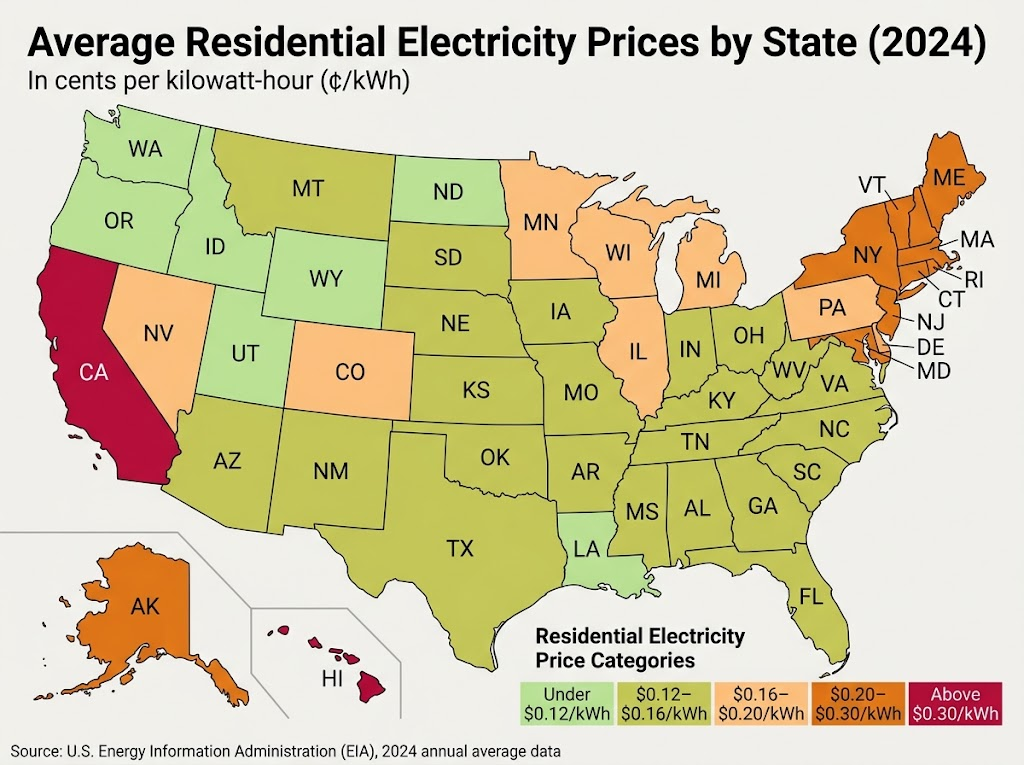
States such as Hawaii, Connecticut, Massachusetts, and Rhode Island frequently have relatively high residential electricity prices.
However, expensive electricity does not automatically mean high electricity consumption.
For example, Hawaii has historically had some of the nation’s highest electricity rates, but households there may use less electricity than households in hot Southern states.
Conversely, households in Louisiana, Alabama, and Tennessee often use substantial amounts of electricity, partly because of cooling demand and electric appliances.
The important distinction is between electricity price and electricity consumption.
Understanding both makes comparisons much more meaningful.
Average Electricity Cost per kWh
Electricity is billed primarily in kilowatt-hours, abbreviated kWh.
A kilowatt-hour measures how much electrical energy you consume.
For example, running a 1,000-watt appliance for one hour uses 1 kWh of electricity.
At $0.17 per kWh, that hour of operation costs approximately 17 cents.
What Is the Average Electricity Rate in the US?
Recent EIA data places the national residential electricity price in the mid-to-upper teens per kWh.
However, the average electricity cost per kWh varies significantly depending on location.
Broadly speaking:
| Electricity Price | General Cost Category |
|---|---|
| Under $0.12/kWh | Relatively low |
| $0.12–$0.16/kWh | Low to moderate |
| $0.16–$0.20/kWh | Moderate |
| $0.20–$0.30/kWh | High |
| Above $0.30/kWh | Very high |
These are descriptive comparison bands, not official EIA classifications.
Your actual rate may also vary depending on your utility plan.
Why Electricity Rates Differ Between States
Several factors influence electricity rates by state.
Power generation costs: Utilities generate electricity using sources such as natural gas, nuclear power, coal, hydropower, wind, and solar.
Transmission infrastructure: Electricity must travel through transmission lines and local distribution systems before reaching homes.
Fuel prices: Natural gas and other fuel prices can influence electricity generation costs.
Regulation: State utility commissions and local authorities influence how electricity providers recover costs.
Market structure: Some states allow customers to choose competitive electricity suppliers, while others primarily use regulated utility service.
Geography: Remote locations and island systems may face higher infrastructure and fuel transportation costs.
Even neighboring households can pay different rates when they have different utility providers or rate plans.
That is why your own utility bill is a better starting point than a national average.
What Is a Normal Electric Bill?
A normal electric bill depends on more than where you live.
Home size, occupancy, climate, insulation, heating equipment, and appliance efficiency all matter.
A small apartment with gas heating may use relatively little electricity.
A large house with electric resistance heating, a pool pump, and several occupants may consume several times as much.
Typical Monthly Electricity Usage by Home Type
The following ranges are illustrative household planning estimates, not measured national averages for each housing type.
| Home Type | Illustrative Monthly Usage |
|---|---|
| Studio apartment | 200–450 kWh |
| One-bedroom apartment | 300–650 kWh |
| Two-bedroom apartment | 450–900 kWh |
| Small single-family home | 600–1,100 kWh |
| Medium single-family home | 800–1,500 kWh |
| Large single-family home | 1,200–2,500+ kWh |
These ranges can be exceeded in either direction.
For instance, a small apartment with electric heating may use more electricity during winter than a larger, well-insulated home with gas heating.
What Does 1,000 kWh Cost?
At different electricity rates, 1,000 kWh costs:
| Electricity Rate | Cost for 1,000 kWh |
|---|---|
| $0.12/kWh | $120 |
| $0.15/kWh | $150 |
| $0.17/kWh | $170 |
| $0.20/kWh | $200 |
| $0.25/kWh | $250 |
| $0.30/kWh | $300 |
These calculations represent usage-based electricity costs before additional fixed charges or adjustments.
A household paying $250 per month may therefore be using a normal amount of electricity in an expensive market.
Meanwhile, a household paying $150 in a low-rate state might consume considerably more energy.
What About the Average Monthly Utility Bill?
The average monthly utility bill is not necessarily the same as the average electric bill.
A complete household utility budget may include:
- Electricity
- Natural gas
- Water
- Sewer service
- Trash collection
- Internet service, depending on how expenses are categorized
Electricity statistics from the EIA generally do not include these other household services.
When comparing your costs with published averages, make sure you are comparing electricity with electricity—not electricity with total household utilities.
Why Electric Bills Vary So Much
Two similar homes on the same street can have very different electricity bills.
The biggest reasons usually involve heating and cooling, building efficiency, appliances, and household behavior.
Heating and Cooling
Heating, ventilation, and air conditioning (HVAC) systems can account for a substantial share of household energy use.
According to the U.S. Department of Energy, heating and cooling represent major energy expenses for many American households.
In hot climates, air conditioners may run for long periods during summer.
In cold climates, electric heating systems may consume large amounts of electricity during winter.
Electric resistance heating is particularly energy-intensive compared with efficient heat pumps.
A heat pump transfers heat between indoors and outdoors rather than producing all its heat through electrical resistance.
This allows it to deliver more heating energy than the electrical energy it consumes under suitable operating conditions.
Insulation and Air Leakage
Insulation slows heat movement through walls, ceilings, and floors.
Its effectiveness is commonly expressed as an R-value.
A higher R-value generally indicates greater resistance to heat flow.
However, insulation alone cannot prevent all energy loss.
Air leakage around doors, windows, attic openings, and other building gaps can also increase heating and cooling demand.
A poorly sealed home may require longer HVAC operating times to maintain a comfortable indoor temperature.
For more detail, see Home Insulation Guide: Where to Add Insulation and What It Costs.
Electric Water Heating
Water heaters can be significant electricity users.
Traditional electric resistance water heaters consume electricity to produce heat directly.
Heat pump water heaters use electricity to move heat from surrounding air into the water.
According to ENERGY STAR, qualifying heat pump water heaters can use substantially less energy than conventional electric resistance models.
However, installation requirements, room temperature, available space, and household hot-water demand affect suitability.
Appliances and Everyday Habits
Refrigerators, clothes dryers, dishwashers, cooking equipment, and electronics all contribute to electricity consumption.
Older or inefficient appliances may use more energy than comparable efficient models.
Operating habits matter too.
Running half-empty dishwasher loads, using high-temperature laundry settings, and leaving unnecessary lighting on can increase usage.
Still, homeowners should prioritize major electricity loads before focusing on small devices.
How to Calculate Your Electricity Costs
You can estimate your monthly electricity expenses using information already printed on your bill.
The process takes only a few minutes.
Step 1: Find Your Monthly Electricity Usage
Look for a line labeled:
- Energy used
- Electricity consumption
- Total kWh
- Monthly usage
Suppose your bill shows 950 kWh.
This means your household consumed 950 kilowatt-hours during that billing period.
Step 2: Find Your Electricity Rate
Look for the rate charged per kWh.
Some utilities display a single combined rate.
Others separate charges into categories such as:
Energy supply: The cost of producing or purchasing electricity.
Delivery: The cost of transporting electricity through the utility network.
Customer charge: A fixed monthly amount that may apply regardless of usage.
Step 3: Calculate Your Effective Rate
For a simple comparison, divide your electricity bill total by the number of kWh consumed.
Formula:
Effective electricity rate = Total electric bill ÷ Total kWh
Example:
$171 ÷ 950 kWh = $0.18/kWh
This means the household paid an effective average of 18 cents per kWh.
The effective rate includes fixed charges when those charges are part of the bill total.
It is useful for comparisons, but it may not equal the price of each additional kWh saved.
Step 4: Compare Usage, Not Just Dollars
Review your usage from the previous month and the same month last year.
A comparison with the same month last year is particularly helpful because seasonal temperatures often influence electricity demand.
For example:
| Billing Period | Electricity Usage |
|---|---|
| July last year | 1,100 kWh |
| July this year | 1,350 kWh |
| Difference | +250 kWh |
The increase is approximately 23%.
Possible explanations include hotter weather, additional occupants, new appliances, or HVAC problems.
Before assuming something is wrong, check whether the billing periods cover the same number of days.
Step 5: Check Your Utility’s Online Dashboard
Many utilities provide online electricity usage graphs.
Some show daily or hourly consumption.
These tools can help identify unusual patterns and reveal whether electricity use increases during certain times.
If your utility offers a home energy comparison report, review its assumptions before comparing your household with nearby homes.
Realistic Costs & Savings
Electricity savings depend on your rate, current usage, equipment condition, climate, and the changes you make.
The following examples illustrate how different reductions in electricity consumption affect monthly costs.
They are calculations, not guaranteed outcomes.
Example: A 2,000-Square-Foot Home
Assume a household has:
- Home size: 2,000 sq ft
- Climate: Mixed heating and cooling
- Monthly electricity usage: 1,000 kWh
- Electricity rate: $0.17/kWh
- Monthly usage-based electricity cost: $170
The basic calculation is:
Monthly electricity cost = kWh used × Electricity rate
1,000 × $0.17 = $170
Now suppose the household reduces electricity consumption through several improvements.
Scenario 1: Reduce Usage by 5%
Electricity saved:
1,000 × 0.05 = 50 kWh
Monthly savings:
50 × $0.17 = $8.50
Annual savings at the same monthly reduction:
$8.50 × 12 = $102
Scenario 2: Reduce Usage by 10%
Electricity saved:
1,000 × 0.10 = 100 kWh
Monthly savings:
100 × $0.17 = $17
Annual savings:
$17 × 12 = $204
Scenario 3: Reduce Usage by 15%
Electricity saved:
1,000 × 0.15 = 150 kWh
Monthly savings:
150 × $0.17 = $25.50
Annual savings:
$25.50 × 12 = $306
These examples assume the same reduction occurs every month.
Actual savings may vary seasonally.
They also assume a flat electricity rate without changes to fixed charges.
Savings Comparison
| Usage Reduction | Monthly Savings | Annual Savings |
|---|---|---|
| 5% | $8.50 | $102 |
| 10% | $17 | $204 |
| 15% | $25.50 | $306 |
| 20% | $34 | $408 |
A 20% reduction is not necessarily achievable for every household.
Homes that are already efficient may have fewer inexpensive opportunities to reduce consumption.
Conversely, homes with unusually high HVAC demand or inefficient equipment may have more potential.
How to Use Your Own Electricity Rate
Replace the example’s $0.17 rate with your actual usage-based rate.
For instance, saving 100 kWh would be worth:
- $12 at $0.12/kWh
- $17 at $0.17/kWh
- $25 at $0.25/kWh
- $30 at $0.30/kWh
For the most accurate estimate, use the rate that applies to the electricity you would avoid purchasing.
If your utility uses time-of-use pricing, this rate can change depending on when electricity is consumed.
Fixed monthly charges generally remain even when you use fewer kWh.
How to Lower Your Electric Bill
Reducing electricity costs usually works best when you focus on the equipment that consumes the most energy.
Start with inexpensive changes before committing to major home improvements.
Step-by-Step Energy-Saving Checklist
| Action | Typical Upfront Cost | Best For | What to Check |
|---|---|---|---|
| Review utility usage data | $0 | Everyone | Unusual consumption patterns |
| Adjust thermostat settings | $0 | Heating and cooling | Comfort and HVAC operation |
| Replace dirty HVAC filters | $10–$40 per filter | Forced-air systems | Correct filter size and airflow |
| Switch remaining bulbs to LEDs | $2–$10 per bulb | Homes using older bulbs | Brightness and compatibility |
| Use smart power strips | $15–$50 | Entertainment setups | Standby electricity consumption |
| Seal accessible air leaks | $10–$100 in materials | Drafty homes | Moisture and ventilation |
| Install a compatible smart thermostat | $80–$250 | Suitable HVAC systems | Equipment compatibility |
| Schedule HVAC maintenance | $100–$250 | Aging or poorly performing systems | Contractor findings |
Costs are approximate planning ranges. Local pricing, equipment, and installation requirements can change actual expenses.
1. Start With Thermostat Settings
The Department of Energy recommends adjusting thermostat settings when practical to reduce heating and cooling energy use.
For cooling, a higher indoor temperature generally reduces air-conditioning demand.
For heating, a lower indoor temperature generally reduces heating demand.
However, the best strategy depends on your HVAC system.
Some heat pump systems may use auxiliary electric resistance heat during large temperature recoveries, which can reduce the expected savings from aggressive setbacks.
Smart thermostats can help automate appropriate schedules, but compatibility matters.
See Smart Thermostat Savings: What to Expect and How to Choose.
2. Replace Dirty HVAC Filters
Dirty filters can restrict airflow.
Restricted airflow may reduce comfort and contribute to inefficient operation or equipment problems.
Check the filter according to the manufacturer’s instructions.
Use the correct size and an appropriate filtration rating.
Do not assume that the highest-efficiency filter is always suitable for your HVAC system.
3. Improve Air Sealing
Small gaps around doors and windows can allow conditioned air to escape.
Weatherstripping and appropriate caulking may reduce drafts.
However, do not seal intentional ventilation openings or combustion-air pathways.
Major attic air sealing and insulation work may be better handled by qualified contractors, particularly when moisture, recessed lighting, wiring, or ventilation concerns are present.
4. Replace Inefficient Lighting
LED bulbs generally consume much less electricity than traditional incandescent bulbs.
For example, replacing a 60-watt incandescent bulb with a 9-watt LED saves 51 watts while both are operating.
If the light runs four hours daily:
51 watts × 4 hours = 204 watt-hours per day.
That equals 0.204 kWh.
Over 30 days:
0.204 × 30 = 6.12 kWh.
At $0.17/kWh:
6.12 × $0.17 = approximately $1.04 per month.
The savings from one bulb are modest, but replacing several frequently used incandescent bulbs can add up.
5. Review Major Equipment Before Replacing It
An aging air conditioner, electric water heater, or heating system may be worth evaluating.
However, replacement costs can be substantial.
Compare installation quotes, estimated energy consumption, warranty terms, and expected equipment life.
A licensed HVAC contractor can help assess whether repairs, maintenance, or replacement make the most sense.
Regional and Climate Differences
Climate has a major influence on household electricity consumption.
Understanding your region’s typical energy demands can help explain why your bills rise during certain months.
Hot-Humid South
Homes in Florida, Louisiana, Mississippi, Alabama, and other humid Southern states often experience substantial cooling demand.
Air conditioners must remove both heat and moisture.
Excess indoor humidity can also make occupants feel uncomfortable, even when the thermostat temperature appears reasonable.
Helpful priorities include maintaining cooling equipment, sealing air leaks, managing indoor moisture, and improving attic insulation where appropriate.
Oversized air-conditioning systems can create humidity problems because they may cool the home quickly without running long enough to remove sufficient moisture.
Cold Northern States
Homes in the Northeast and Upper Midwest often face significant winter heating demand.
However, electric bills depend heavily on the type of heating system.
A home heated with natural gas may have a relatively modest winter electric bill but a much larger gas bill.
An all-electric home may show most heating costs on its electric bill.
Air sealing, insulation, and heating-system efficiency are important considerations.
Dry Western States
Homes in Arizona, Nevada, and inland California may experience extremely hot summer temperatures.
Cooling demand can increase sharply during heat waves.
In dry climates, shading windows and reducing unwanted solar heat gain may improve comfort.
Some homes use evaporative cooling, which cools air through water evaporation.
These systems can work well in suitable dry conditions but are generally less effective in humid climates.
Pacific Northwest
Some Pacific Northwest communities benefit from relatively moderate summer temperatures.
However, winter heating requirements can still be significant.
Heat pumps are common efficiency considerations, particularly when replacing electric resistance heating.
The best system depends on the home’s insulation, ductwork, climate, and existing equipment.
Renter-Friendly Ways to Save
Renters often have fewer options for permanent home improvements.
Fortunately, several effective electricity-saving strategies require little or no modification to the property.
Start With Changes You Control
Use thermostat settings that balance comfort and energy consumption.
Replace frequently used incandescent bulbs with compatible LEDs if your lease permits it.
Unplug unnecessary chargers and electronics, or use suitable plug-in power strips.
Wash clothes in cold water when appropriate for the fabric and detergent.
Run full dishwasher and laundry loads without overloading the equipment.
Keep furniture and other objects from blocking supply and return air vents.
Ask About Maintenance Problems
If the air conditioner runs continuously or the refrigerator struggles to maintain temperature, notify the landlord or property manager.
Equipment problems can increase electricity consumption.
Document unusual operation and request maintenance through the normal property-management process.
Avoid making permanent HVAC, plumbing, or electrical modifications without authorization.
Compare Apartments Before Signing a Lease
When possible, ask about previous electricity consumption.
Some utilities provide historical usage information for an address, subject to their policies.
Also ask whether the apartment uses electric or gas heating.
A lower rent does not always mean lower total housing expenses.
An apartment with poor insulation and electric resistance heating may have higher winter operating costs than a better-insulated unit.
When to Call a Professional
Some energy improvements are appropriate DIY projects.
Others involve electrical, HVAC, structural, or ventilation risks.
Call a Licensed Electrician When:
- Breakers trip repeatedly.
- Outlets or switches become unusually hot.
- Lights flicker along with other electrical problems.
- You notice burning smells near electrical equipment.
- You need new circuits or electrical panel modifications.
Do not open electrical panels or attempt wiring repairs yourself.
Call a Licensed HVAC Technician When:
- Your air conditioner runs continuously without maintaining temperature.
- Heating or cooling performance drops noticeably.
- You hear unusual equipment noises.
- Your system frequently shuts down or restarts.
- You suspect a refrigerant problem.
- You are considering heat pump or HVAC replacement.
Refrigerant handling and major HVAC repairs require qualified professionals.
Call a Qualified Insulation or Home Performance Contractor When:
- Attic insulation is damaged or contaminated.
- You suspect hidden moisture or mold.
- Your home has significant drafts despite basic weatherstripping.
- You need extensive attic air sealing.
- You are considering a whole-home energy assessment.
Attics can contain electrical hazards, unsafe walking surfaces, extreme temperatures, and contaminated materials.
Avoid disturbing suspect insulation or entering unsafe attic areas.
Important Carbon Monoxide Safety Note
Homes with fuel-burning equipment should have properly installed carbon monoxide alarms.
Never block combustion-air openings or exhaust vents to reduce drafts.
If a carbon monoxide alarm sounds, follow the alarm manufacturer’s emergency instructions, leave the affected area, and contact emergency services as appropriate.
Energy savings should never come at the expense of ventilation or safety.
Common Mistakes to Avoid
1. Comparing Dollar Amounts Without Comparing kWh
A $200 bill does not necessarily mean excessive electricity consumption.
Check both your usage and your rate.
2. Ignoring Seasonal Changes
Summer cooling and winter heating can significantly increase electricity demand.
Compare bills from similar seasons rather than relying only on month-to-month changes.
3. Assuming Every High Bill Means Equipment Failure
Weather, billing-period length, rate changes, and additional household occupants can all increase costs.
Investigate the likely causes before paying for repairs.
4. Replacing Windows Before Checking Easier Improvements
New windows can improve comfort, but they are often expensive.
Air sealing, insulation, and HVAC maintenance may offer more practical starting points.
Window replacement makes more sense when existing windows are damaged, failing, or being replaced for broader renovation reasons.
5. Buying a Smart Thermostat Without Checking Compatibility
Not every smart thermostat works with every HVAC system.
Heat pumps, multi-stage equipment, and certain proprietary systems may have special requirements.
6. Ignoring Fixed Utility Charges
Reducing electricity consumption does not necessarily eliminate monthly customer charges.
Separate fixed charges from usage-dependent charges when estimating savings.
7. Assuming Solar Automatically Eliminates Electric Bills
Solar panels can offset purchased electricity, but their financial impact depends on system production, installation costs, utility rules, and compensation for exported electricity.
Some utility charges may remain.
Battery storage adds further costs and capabilities that require separate evaluation.
FAQ
What is the average electric bill in the United States?
Recent EIA data indicates that the average U.S. residential electric bill is roughly $140–$160 per month. The exact figure depends on the reporting year. This is a national average, not a recommended spending target. Electricity rates, home size, climate, and appliance usage can make an individual household’s monthly costs substantially higher or lower.
Which state has the highest average electric bill?
The answer depends on the year and whether you are comparing electricity prices or actual monthly bills. Hawaii frequently has among the highest residential electricity rates, while states with high cooling demand may have large monthly bills despite lower rates. For an accurate ranking, consult the EIA’s latest state-level average residential monthly bill data.
Which state has the cheapest electricity?
States such as North Dakota, Idaho, Washington, and Nebraska have historically appeared among lower-priced residential electricity markets in various EIA reporting periods. However, rankings change over time. The cheapest electricity rate does not necessarily produce the lowest monthly bill because households in different states consume different amounts of power.
Is $200 a month a high electric bill?
A $200 monthly electric bill may be normal for a large all-electric home, especially during extreme summer or winter temperatures. It could be unusually high for a small apartment with gas heating. Divide your bill by your electricity usage to determine your effective rate, then compare your kWh consumption with previous billing periods.
Is 1,000 kWh per month a lot?
Using 1,000 kWh per month is within a plausible range for many U.S. single-family homes. However, the amount may be high for a small apartment or low for a large all-electric home in an extreme climate. Household size, heating fuel, air-conditioning demand, and equipment efficiency all influence whether that usage is reasonable.
Why is my electric bill suddenly so high?
Common causes include unusually hot or cold weather, increased HVAC operation, rate changes, longer billing periods, and malfunctioning appliances. Start by comparing your current kWh consumption with the same month last year. If usage has increased significantly without an obvious explanation, review your utility’s daily usage data and consider an equipment inspection.
How much electricity does a 2,000-square-foot house use?
A 2,000-square-foot house might use approximately 700–1,800 kWh per month under a wide range of conditions, but usage can fall outside that range. An all-electric home with substantial heating or cooling demand may consume considerably more. Square footage alone is not enough to predict electricity usage accurately.
Does turning the thermostat up save electricity?
During air-conditioning season, raising the thermostat setting generally reduces cooling demand. The savings depend on outdoor temperatures, insulation, occupancy, and HVAC operation. During heating season, lowering the thermostat generally reduces heating demand. Heat pump owners should consider manufacturer guidance because aggressive temperature setbacks can sometimes trigger inefficient auxiliary heating.
Do smart thermostats really lower electric bills?
Smart thermostats may reduce heating and cooling energy consumption by automatically following suitable temperature schedules. Actual savings depend on the household’s previous habits and HVAC equipment. A household already using efficient thermostat settings may see limited improvement. Before purchasing, verify compatibility and check whether your utility offers a qualifying rebate.
Can solar panels eliminate my electric bill?
Solar panels may offset much of a home’s purchased electricity, but eliminating the entire bill is not guaranteed. Utility fixed charges, solar production, household consumption, and compensation for excess generation all affect the result. Get multiple installation quotes and review utility interconnection rules, contract terms, maintenance responsibilities, and financing costs before making a decision.
Why is electricity more expensive in some states?
Electricity prices reflect generation costs, fuel markets, infrastructure, regulations, utility investment, and geography. States with remote electrical systems or expensive imported fuels may face higher costs. Differences in utility rate structures also matter. Even within one state, customers served by different utilities can pay noticeably different prices.
How can I find my home’s actual electricity rate?
Look for your electricity supply and delivery charges on your utility bill. For a quick comparison, divide your total electric bill by the kWh consumed. This produces an effective average rate that may include fixed charges. For calculating the savings from using less electricity, identify the usage-based charges that would actually decrease.
Conclusion
The average electric bill by state is a useful comparison point, but it does not tell you whether your particular home is energy-efficient.
A household’s electricity costs depend on the price per kWh, total consumption, climate, heating and cooling systems, and everyday habits.
The most useful approach is to compare your own electricity usage over time and investigate changes that seem unusual.
Your Electric Bill Checklist
- Find your monthly electricity usage in kWh.
- Calculate your effective electricity rate.
- Compare usage with the same month last year.
- Review heating and cooling settings.
- Check HVAC filters and maintenance needs.
- Replace frequently used incandescent bulbs.
- Identify obvious drafts and air leaks.
- Investigate unusual increases in electricity consumption.
- Check current utility rebates before purchasing major equipment.
Start with the changes that cost little or nothing.
Then evaluate larger improvements using realistic installation costs, estimated energy savings, and your home’s actual needs.
Pingback: What Uses the Most Electricity in Your Home? (Appliance kWh Chart) – Energy Savings Perlon