Choosing between a heat pump and a furnace is one of the biggest decisions homeowners face when replacing a heating system. Both can keep your home comfortable, but they work differently, cost different amounts to operate, and perform differently depending on your climate.
The heat pump vs furnace decision isn’t simply about which system is more efficient. Your electricity rates, natural gas prices, existing ductwork, insulation, and winter temperatures all affect which option makes financial sense.
Read Also: How to Lower Your AC Bill: 15 Fixes That Actually Work
A heat pump can provide both heating and air conditioning, while a furnace focuses on heating. Modern cold-climate heat pumps also perform much better in freezing weather than older models.
This guide compares installation costs, monthly heating expenses, efficiency ratings, maintenance, and real-world performance. You’ll also learn how to estimate operating costs using your utility bills and determine which system best fits your home.
Quick Takeaways
At a Glance: Heat Pump or Furnace?
- Heat pumps provide heating and cooling. Furnaces provide heating only and usually need a separate air conditioner.
- Heat pumps are highly efficient. They move heat instead of generating it, often delivering two to four units of heat for each unit of electricity consumed.
- Furnaces can cost less to install. Replacing an existing gas furnace is often simpler than converting to a heat pump.
- Energy prices determine operating costs. A heat pump isn’t automatically cheaper when electricity is expensive and natural gas is relatively inexpensive.
- Modern cold-climate heat pumps work below freezing. However, efficiency and heating capacity vary by model and outdoor temperature.
- Dual-fuel systems offer flexibility. They combine an electric heat pump with a gas furnace for colder weather.
- Insulation and air sealing matter. Improving your home’s building envelope can reduce the heating capacity needed.
- Get multiple HVAC quotes. Compare equipment performance, installation details, warranties, and estimated operating costs—not just the purchase price.
How Heat Pumps and Furnaces Work
Although both systems heat your home, they use different methods to produce comfortable indoor temperatures.
Understanding this difference helps explain why installation costs, efficiency ratings, and monthly bills can vary so much.
How a Heat Pump Works
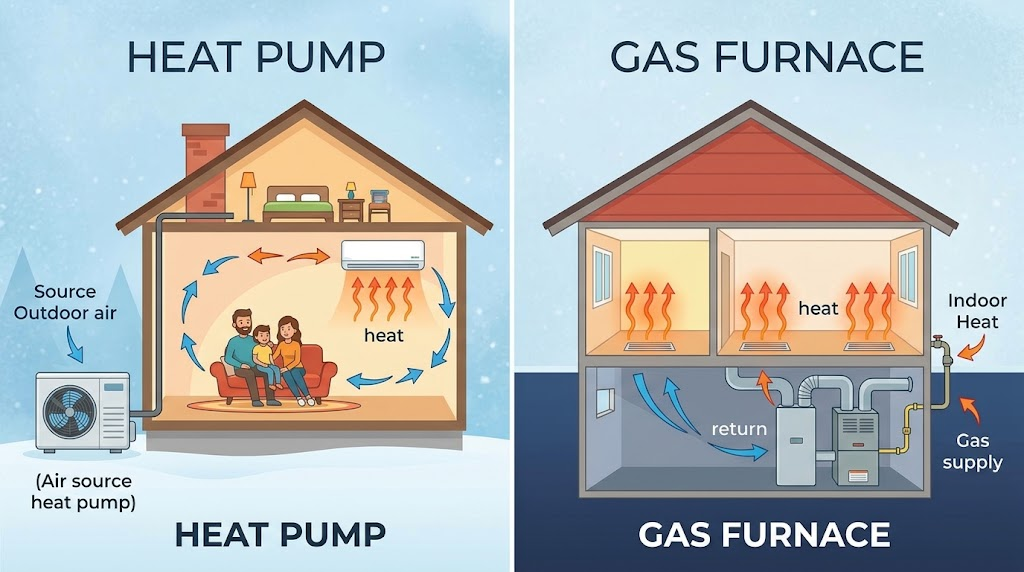
An air-source heat pump transfers heat between your home and the outdoor air.
During winter, it extracts heat from outside air and moves that heat indoors. Even when outdoor temperatures drop below freezing, some usable heat remains in the air.
During summer, the process reverses. The system removes heat from your home and releases it outside, functioning like an air conditioner.
Read Also: Best Thermostat Settings for Summer and Winter (Save Money, Stay Comfortable)
A typical air-source heat pump contains:
- An outdoor unit with a compressor and heat exchanger
- An indoor air handler or compatible furnace-based indoor system
- Refrigerant lines connecting indoor and outdoor equipment
- A thermostat or compatible control system
- Ductwork or indoor wall-mounted units that distribute conditioned air
Refrigerant is a specialized fluid that absorbs and releases heat as it moves through the system.
Heat pumps can operate efficiently because electricity powers the movement of heat rather than directly creating all the heat delivered indoors.
According to the U.S. Department of Energy, properly installed air-source heat pumps can deliver substantially more heating energy than the electrical energy they consume.
However, performance changes with outdoor temperatures, equipment design, and installation quality.
How a Furnace Works
A furnace generates heat and distributes it throughout your home.
Most residential furnaces use natural gas, although propane, oil, and electric models are also available.
A typical gas furnace works through a straightforward process:
- The thermostat requests heat.
- The furnace burns natural gas in a sealed combustion area.
- A heat exchanger transfers heat to indoor air.
- A blower pushes the heated air through ductwork.
- Combustion gases exit through a properly installed venting system.
A heat exchanger is the component that transfers heat without intentionally mixing combustion gases with the air circulating through your home.
Unlike a heat pump, a conventional furnace does not provide air conditioning.
Homes with gas furnaces commonly use a separate central AC system.
The key distinction: Heat pumps transfer heat, while furnaces generate it.
That difference influences operating costs and is central to comparing these systems.
Heat Pump vs Furnace: Side-by-Side Comparison
The following table summarizes the practical differences homeowners should consider before replacing their heating equipment.
| Feature | Air-Source Heat Pump | Gas Furnace |
|---|---|---|
| Primary function | Heating and cooling | Heating |
| Energy source | Electricity | Natural gas |
| Typical installed replacement cost | $6,000–$15,000+ | $3,500–$8,000+ |
| Heating efficiency | Often 200%–400% under favorable conditions | Approximately 80%–98% AFUE |
| Cooling included | Yes | No |
| Cold-weather performance | Depends on model and temperature | Generally maintains rated heating output |
| Monthly operating cost | Depends on electricity rates and efficiency | Depends on gas prices and efficiency |
| Ductwork required | For ducted models | Usually |
| Combustion gases | None at the equipment | Requires safe venting |
| Outdoor unit | Yes | Not for furnace-only installation |
| Maintenance | Indoor and outdoor equipment | Combustion, venting, and airflow components |
| Typical service life | Often around 10–15 years | Often around 15–20 years |
| Best fit | Homes needing efficient heating and cooling | Homes with existing gas infrastructure and favorable gas rates |
Cost note: These are broad illustrative US installed-price ranges, not national averages or contractor quotes. Actual prices vary with capacity, efficiency, location, labor, electrical work, and installation complexity.
Read Also: HVAC Efficiency Guide: How to Cut Heating and Cooling Costs
Equipment lifespan also varies significantly with climate, maintenance, installation quality, and usage.
A furnace may last longer than a heat pump because a heat pump operates during both heating and cooling seasons. However, individual systems can last longer or shorter than these general planning ranges.
The most important comparison is usually not equipment price alone.
Instead, consider the total cost of purchasing, installing, operating, and maintaining the system over the years you expect to use it.
Heat Pump Cost vs Furnace Installation Cost
Installation cost is often the first concern for homeowners comparing heating systems.
The price difference depends heavily on what equipment your home already has.
Typical Heat Pump Installation Costs
For budgeting purposes, a conventional ducted air-source heat pump replacement may fall around $6,000–$15,000 installed.
More complex installations can exceed that range.
Higher costs may result from:
- Cold-climate, variable-speed equipment
- Replacing or modifying ductwork
- Installing new refrigerant lines
- Electrical upgrades
- Adding supplemental heating
- Difficult equipment access
- Larger homes requiring more capacity
A variable-speed heat pump adjusts its output instead of operating only at full capacity. This can improve comfort and efficiency, although it generally increases equipment cost.
Ductless mini-split heat pumps are another option.
A mini-split uses one or more indoor units to heat and cool specific rooms without conventional ducts.
A simple single-zone installation may cost several thousand dollars, while a multi-zone system serving an entire house can cost considerably more.
Typical Furnace Installation Costs
A straightforward natural gas furnace replacement may cost approximately $3,500–$8,000 installed.
Costs can rise when the installation requires:
- New venting
- Gas system modifications
- Ductwork repairs
- Condensate drainage
- Higher-efficiency equipment
- Changes to equipment location
A high-efficiency condensing furnace extracts additional heat from combustion gases and produces condensate that must drain safely.
Replacing an existing gas furnace with a similar model is often less complicated than converting the entire heating system to a heat pump.
However, the comparison changes when your air conditioner also needs replacement.
What If You Need Heating and Cooling?
Suppose your home needs both a new furnace and a new central air conditioner.
Illustrative installed quotes might look like this:
| Replacement Option | Example Installed Cost |
|---|---|
| Gas furnace only | $5,500 |
| Gas furnace plus central AC | $11,000 |
| Ducted heat pump providing heating and cooling | $10,500 |
| Dual-fuel heat pump and gas furnace | $14,000 |
These figures are hypothetical examples showing how project scope affects the decision.
In this situation, the heat pump may be competitive because it replaces two functions with one heating-and-cooling system.
If your existing AC is relatively new, however, replacing only a failed furnace could cost substantially less upfront.
What About Rebates?
Utility, state, and local programs may help reduce eligible installation costs.
Programs vary by state and change often. Check current eligibility before assuming a rebate applies.
Useful resources include:
- ENERGY STAR Rebate Finder
- DSIRE Incentive Database
- Your state energy office
- Your electric or gas utility
Federal residential energy tax credits under Sections 25C and 25D ended for expenditures after December 31, 2025. Do not include those credits when estimating costs for a new 2026 installation.
Request itemized contractor quotes showing equipment, labor, electrical work, permits, and any confirmed incentives separately.
Realistic Costs & Savings
A heat pump’s operating cost depends on three main factors: how much heat your home needs, how efficiently the system delivers that heat, and what your utility charges.
This section shows how to compare costs using actual energy prices.
Understanding the Units on Your Utility Bill
Electric utilities generally bill in kilowatt-hours (kWh).
One kWh represents using 1,000 watts of electrical power for one hour.
Natural gas utilities often bill in therms.
One therm contains approximately 100,000 British thermal units (Btu) of energy. A Btu is a standard measurement of heat.
To compare heating systems fairly, we need to account for both energy content and equipment efficiency.
Example: A 2,000-Square-Foot Home
Consider a hypothetical 2,000 sq ft home in a mixed climate with moderate winters.
Assume:
- Annual useful space-heating demand: 40 million Btu
- Electricity price: $0.17/kWh
- Natural gas price: $1.50/therm
- Heat pump seasonal COP: 2.8
- Gas furnace efficiency: 95% AFUE
These are illustrative assumptions, not national averages or predictions for a particular home.
COP means coefficient of performance. It measures how much heating energy a heat pump delivers compared with the electricity it consumes.
A COP of 2.8 means the system delivers 2.8 units of heat for every unit of electricity used under the conditions represented.
AFUE means Annual Fuel Utilization Efficiency. It estimates the percentage of fuel energy a furnace converts into useful heat over a heating season.
A 95% AFUE furnace converts approximately 95% of its fuel’s energy into useful heating.
Step 1: Calculate Heat Pump Running Cost
One kWh contains approximately 3,412 Btu of energy.
Use this formula:
Electricity required (kWh) = Annual heating demand (Btu) ÷ (3,412 × seasonal COP)
For our example:
40,000,000 ÷ (3,412 × 2.8)
= approximately 4,187 kWh
Now multiply by the electricity rate:
Annual heating cost = kWh used × electricity price
4,187 × $0.17
= approximately $712 per year
This represents modeled electricity used for space heating, not the household’s entire electric bill.
Step 2: Calculate Gas Furnace Running Cost
One therm contains approximately 100,000 Btu.
Use this formula:
Therms required = Annual heating demand ÷ (100,000 × AFUE)
For a 95% efficient furnace:
40,000,000 ÷ (100,000 × 0.95)
= approximately 421 therms
Now multiply by the gas price:
Annual heating cost = Therms used × gas price
421 × $1.50
= approximately $632 per year
Step 3: Compare the Results
| System | Annual Energy Use | Example Annual Heating Cost |
|---|---|---|
| Heat pump, seasonal COP 2.8 | 4,187 kWh | $712 |
| Gas furnace, 95% AFUE | 421 therms | $632 |
| Difference | — | Gas furnace costs about $80 less |
In this example, the gas furnace has a modest operating-cost advantage.
That doesn’t mean gas furnaces are generally cheaper.
Change the utility prices, heating demand, or heat pump efficiency, and the result can reverse.
What Happens When Energy Prices Change?
Keeping the same heating demand and equipment efficiency:
| Electricity Rate | Heat Pump Annual Cost |
|---|---|
| $0.12/kWh | $502 |
| $0.15/kWh | $628 |
| $0.17/kWh | $712 |
| $0.20/kWh | $837 |
| $0.25/kWh | $1,047 |
At $0.12/kWh, the heat pump costs approximately $130 less annually than the gas furnace in our example.
At $0.25/kWh, it costs approximately $415 more.
These differences illustrate why heat pump running cost should be calculated using local utility prices, not national generalizations.
How to Find Your Own Energy Rates
Follow these steps:
- Open a recent electric bill and locate your total electricity usage in kWh.
- Find the electricity supply and delivery charges that vary with usage.
- Divide those variable charges by your kWh usage to estimate your effective marginal energy rate.
- Repeat the process for natural gas, using therms.
- Include variable fuel adjustments and applicable usage-based taxes.
- Compare your rates using the formulas above.
For example, if your variable electricity charges total $153 for 900 kWh:
$153 ÷ 900 = $0.17/kWh
Fixed monthly customer charges generally should not be included when comparing incremental energy use.
However, if switching systems would allow you to eliminate gas service entirely, avoided fixed gas charges may become relevant.
Don’t Forget Supplemental Heating
Some heat pumps use electric resistance heating during very cold weather or certain operating conditions.
Electric resistance heating turns electricity directly into heat and has a COP of approximately 1.
If backup resistance heating operates frequently, actual seasonal costs may exceed a simple heat pump estimate.
A qualified HVAC contractor can estimate seasonal performance using your climate, equipment specifications, and building heat loss.
For a closer estimate, ask for annual heating-energy projections rather than relying only on equipment efficiency labels.
Heat Pump Efficiency vs Furnace Efficiency
Efficiency ratings help compare equipment, but heat pumps and furnaces use different measurements.
Knowing what those ratings mean can prevent expensive purchasing mistakes.
Heat Pump Efficiency: COP, HSPF2, and SEER2
Heat pumps commonly have three relevant efficiency measurements.
COP (coefficient of performance) measures instantaneous heating efficiency.
For example:
- COP 1.0: One unit of heat delivered per unit of electricity
- COP 2.0: Two units of heat delivered
- COP 3.0: Three units of heat delivered
COP changes with outdoor temperature and operating conditions.
HSPF2 (Heating Seasonal Performance Factor 2) measures seasonal heating output relative to electricity consumed, using an updated federal test procedure.
Higher HSPF2 ratings generally indicate better seasonal heating efficiency under the rating’s standardized conditions.
SEER2 (Seasonal Energy Efficiency Ratio 2) measures seasonal cooling efficiency under updated testing conditions.
A higher SEER2 rating generally indicates lower electricity use for the same amount of cooling under comparable conditions.
Because a heat pump handles both heating and cooling, homeowners should compare both HSPF2 and SEER2.
Furnace Efficiency: AFUE
Gas furnaces use AFUE.
Common categories include approximately:
- 80% AFUE: Standard-efficiency equipment
- 90%–95% AFUE: Higher-efficiency equipment
- 96%–98% AFUE: Very high-efficiency models
An 80% AFUE furnace delivers approximately 80 units of useful heat from every 100 units of fuel energy.
A 96% AFUE furnace delivers approximately 96 units.
Higher efficiency generally reduces fuel consumption for the same heating demand, although savings depend on fuel prices and existing equipment.
Why Heat Pumps Can Exceed 100% Efficiency
A heat pump doesn’t create all the heat it delivers.
Instead, it uses electricity to move heat from one location to another.
That’s why its heating output can exceed the electrical energy consumed.
This does not violate the laws of physics or mean the equipment creates free energy.
It means the system transfers additional heat from the outdoor environment.
For equipment comparisons, consult the ENERGY STAR heating and cooling resources.
Efficiency is important, but the equipment must also deliver enough heat during your home’s coldest expected conditions.
Do Heat Pumps Work in Cold Weather?
Yes. Modern cold-climate heat pumps can operate in temperatures well below freezing.
However, not every heat pump is designed for the same winter conditions.
What Happens as Outdoor Temperatures Fall?
As outdoor temperatures drop, a heat pump generally has to work harder to move heat indoors.
Two things may happen:
- Heating efficiency decreases.
- Maximum heating output decreases.
Some advanced models maintain a substantial portion of their rated heating capacity at temperatures near 5°F or lower.
Actual performance depends on the model.
Homeowners in colder regions should review manufacturer capacity tables showing heating output at low outdoor temperatures.
For example, a unit advertised as a 36,000 Btu-per-hour heat pump may not provide that full output at every winter temperature.
Its available capacity at 5°F could be different from its rating at 47°F.
What Makes a Cold-Climate Heat Pump Different?
A cold climate heat pump is designed to maintain useful heating performance during low outdoor temperatures.
Features may include:
- Variable-speed compressors
- Enhanced refrigerant controls
- Improved low-temperature heating capacity
- Intelligent defrost operation
- Controls designed for cold-weather performance
Defrost operation is necessary because frost can accumulate on the outdoor coil during certain winter conditions.
The system periodically removes that frost to maintain airflow and heat transfer.
Some homeowners notice temporary changes in sound or heating delivery during these cycles.
When Is Backup Heat Necessary?
Backup heating may be appropriate when a heat pump cannot fully meet the home’s heating demand at the local design temperature.
The design temperature is an outdoor temperature used by HVAC professionals to size equipment for typical severe weather conditions in a particular location.
Backup options include:
- Electric resistance heating
- Existing gas furnaces
- New dual-fuel configurations
Backup heat is not automatically required in every cold-climate installation.
A properly selected cold-climate system may cover the full heating load in some homes.
Ask the contractor to demonstrate how the proposed equipment meets your home’s calculated heating demand at the local winter design temperature.
For additional guidance, see the DOE’s air-source heat pump information.
Which System Works Best in Your Climate?
Climate strongly influences heating-system performance.
However, local utility prices and building characteristics can be just as important as geography.
Hot-Humid South
In much of the Southeast and Gulf Coast, cooling is a major household energy expense.
Heat pumps can be attractive because one system provides efficient cooling and handles relatively mild winter heating needs.
Homeowners should pay particular attention to humidity control.
Oversized cooling equipment may run for short periods, reducing its ability to remove indoor moisture effectively.
Variable-speed equipment can help maintain longer, lower-output operating cycles when properly designed.
For homes in humid regions, ask about cooling capacity, moisture removal, duct leakage, and thermostat controls.
Cold North and Upper Midwest
In northern states, heating demand is often substantial.
A high-performance cold-climate heat pump may work well, but low-temperature capacity must be checked carefully.
Natural gas can remain financially competitive where gas rates are relatively low.
Homeowners should compare:
- Local electricity and gas prices
- Heating capacity at 5°F and lower
- Seasonal efficiency
- Backup heating requirements
- Expected annual operating costs
Dual-fuel systems may be worth considering, particularly when an existing gas furnace is still serviceable.
Dry West and Mountain Regions
Many western locations experience large differences between daytime and nighttime temperatures.
Heat pumps can work efficiently during moderate conditions, while colder mountain locations require closer attention to winter capacity.
Dust, wildfire smoke, and outdoor debris can also influence maintenance needs.
Maintain appropriate filtration and follow local indoor-air guidance during smoke events.
Pacific Northwest
The Pacific Northwest often has relatively moderate coastal winters.
Heat pumps can be well suited to these conditions, especially where electricity prices are favorable.
However, high-elevation and inland locations may experience substantially colder temperatures.
Avoid choosing equipment based solely on the climate of the nearest major city.
Mixed-Climate States
States such as Virginia, Missouri, Kentucky, and parts of Pennsylvania experience both meaningful heating and cooling seasons.
Heat pumps can be competitive because they provide both services.
The best choice often depends on whether you’re replacing only a furnace or replacing both heating and cooling equipment.
Before installing a larger system, consider whether insulation and air sealing could reduce your home’s heating load.
Our related guide, Home Insulation Basics: Where to Start and What Matters Most, explains how improving the building envelope can support lower heating and cooling costs.
Dual-Fuel Systems: A Practical Middle Ground
A dual fuel system combines an electric heat pump with a gas furnace.
The heat pump handles heating during conditions when it operates efficiently.
The furnace provides heat when outdoor temperatures fall below a selected changeover point.
This arrangement can offer flexibility in regions with cold winters and existing natural gas service.
How Dual-Fuel Heating Works
A compatible thermostat or control system determines which heating source operates.
For example:
- Above 35°F: Heat pump runs.
- Below 35°F: Gas furnace runs.
These temperatures are illustrative, not recommended universal settings.
The best changeover temperature depends on the equipment, local energy prices, and the home’s heating demand.
Some systems use outdoor temperature to select the heating source.
More sophisticated controls may consider additional operating conditions.
How to Estimate the Economic Changeover Point
An economic changeover point is the temperature at which one fuel becomes less expensive than the other for delivering the same amount of heat.
For a heat pump:
Cost per million Btu delivered = (293.1 × electricity rate) ÷ COP
For a gas furnace:
Cost per million Btu delivered = (10 × gas price per therm) ÷ AFUE
Using our earlier rates:
Electricity: $0.17/kWh
Gas: $1.50/therm
Furnace efficiency: 95%
Gas heating cost:
(10 × $1.50) ÷ 0.95
= approximately $15.79 per million Btu delivered
To match that cost, the heat pump would need a COP of:
(293.1 × $0.17) ÷ $15.79
= approximately 3.16
When the heat pump’s COP exceeds approximately 3.16, electricity is the cheaper heating source under these assumptions.
Below that COP, gas is cheaper.
This calculation excludes fixed utility charges, maintenance, and other ownership costs.
A contractor can use manufacturer performance data to estimate the outdoor temperature where the COP crosses that threshold.
Is Dual Fuel Worth the Extra Cost?
Dual fuel may make sense when:
- You already have natural gas service.
- Your winters include extended cold periods.
- Your electricity rates are relatively high.
- You want heat pump cooling and moderate-weather heating.
- You prefer to retain gas heating for colder conditions.
Potential drawbacks include higher installation costs and maintaining two heating technologies.
A dual-fuel system also does not automatically operate during a power outage. Its furnace, blower, and controls generally still require electricity.
For homeowners replacing both a furnace and air conditioner, dual fuel is worth pricing alongside an all-electric heat pump.
Maintenance, Lifespan, and Reliability
Installation cost and energy efficiency aren’t the only long-term considerations.
Maintenance affects comfort, equipment lifespan, and the likelihood of unexpected repairs.
Heat Pump Maintenance
Heat pumps contain both indoor and outdoor components.
Common maintenance tasks include:
- Replacing or cleaning air filters
- Keeping outdoor equipment clear of leaves and debris
- Checking for blocked airflow
- Scheduling professional inspections
- Monitoring unusual noises or changes in performance
Because heat pumps provide heating and cooling, they may operate throughout much of the year.
That makes regular maintenance particularly important.
Homeowners should not open refrigerant circuits or attempt electrical repairs.
Refrigerant handling requires appropriately certified professionals.
Furnace Maintenance
Gas furnaces require attention to combustion safety as well as airflow.
Professional inspections may include:
- Checking the heat exchanger
- Testing combustion operation
- Inspecting venting
- Checking safety controls
- Evaluating blower operation
A damaged heat exchanger or venting problem can create carbon monoxide hazards.
Carbon monoxide is a colorless, odorless gas that can cause serious injury or death.
Homes with fuel-burning appliances should have properly located carbon monoxide alarms installed and maintained according to manufacturer instructions and local requirements.
Which System Lasts Longer?
Gas furnaces often have a longer expected service life than air-source heat pumps.
However, equipment age alone doesn’t determine whether replacement is necessary.
Consider repair frequency, comfort problems, energy consumption, and replacement-part availability.
For a system nearing the end of its expected lifespan, request estimates for both repair and replacement.
A relatively inexpensive repair may make sense if the equipment is otherwise in good condition.
Repeated major repairs on older equipment may justify considering replacement.
How to Choose the Right System
Rather than starting with equipment brands, start with your home’s heating needs.
The following process helps homeowners make a more informed decision without attempting unsafe HVAC work.
Step-by-Step: Compare Your Options
1. Identify your existing equipment.
Record whether you have a gas furnace, electric furnace, heat pump, boiler, or another heating system.
Also note whether you have central air conditioning and approximately how old the equipment is.
2. Gather 12 months of utility bills.
Look at total electricity usage, natural gas consumption, and seasonal changes.
This provides a useful starting point for evaluating heating costs.
3. Check your home’s insulation and air sealing.
Look for drafts near accessible windows and doors.
Check whether attic insulation appears uneven or missing, but avoid entering unsafe attic spaces.
Do not disturb suspected asbestos, damaged wiring, or contaminated insulation.
Air sealing and insulation improvements may reduce the heating capacity your home requires.
See How to Lower Your Heating Bill Without Replacing Your HVAC System for practical improvements worth evaluating first.
4. Determine whether your AC also needs replacement.
If your furnace is failing but your AC is relatively new, replacing only the furnace may be less expensive.
If both systems are aging, a heat pump becomes more competitive.
5. Request a Manual J load calculation.
Manual J is an industry-standard method for calculating a home’s heating and cooling requirements.
A qualified HVAC professional uses information about home size, insulation, windows, air leakage, and climate to estimate the necessary equipment capacity.
Square footage alone is not enough for accurate sizing.
6. Compare at least three itemized quotes.
Ask contractors to identify:
- Equipment model numbers
- Heating and cooling capacity
- HSPF2 and SEER2 ratings
- Low-temperature heating performance
- Ductwork modifications
- Electrical requirements
- Warranty terms
- Installation and permit costs
7. Ask for estimated annual operating costs.
Provide your utility rates.
Ask contractors to explain their assumptions about seasonal efficiency, backup heat, and local weather.
8. Compare total ownership costs.
A more expensive system may have lower operating costs, but the difference might not repay the installation premium during your ownership period.
A simple comparison is:
Total estimated cost = Installation cost + expected energy cost + expected maintenance and repair costs
Use the same evaluation period for each option.
For example, over 10 years:
| Expense | Heat Pump | Gas Furnace + AC |
|---|---|---|
| Installation | $10,500 | $11,000 |
| Annual heating energy | $712 | $632 |
| Annual cooling energy | Requires separate estimate | Requires separate estimate |
| Maintenance and repairs | Requires estimate | Requires estimate |
The table deliberately leaves cooling and maintenance costs open.
Those expenses must be estimated before making a meaningful whole-system comparison.
A heat pump could have higher heating costs but lower cooling costs—or the reverse.
Home Heating Decision Checklist
| Question | Why It Matters | What to Check |
|---|---|---|
| Do you already have natural gas? | Existing infrastructure affects installation cost | Current utility service |
| Is your AC nearing replacement? | A heat pump provides cooling too | Equipment age and condition |
| Are electricity rates competitive? | Determines operating economics | Utility bill |
| Do winters regularly fall below 0°F? | Low-temperature capacity becomes important | Local climate data |
| Is your home well insulated? | Reduces heating demand | Insulation and air leaks |
| Are ducts in good condition? | Leaky ducts waste conditioned air | HVAC inspection |
| Is electrical capacity adequate? | Some installations require upgrades | Licensed electrician |
| Are local rebates available? | May reduce upfront expense | Utility and state programs |
| Will you stay in the home long term? | Affects the value of operating-cost differences | Expected ownership period |
The best heating system is the one that matches your home’s actual load, utility rates, comfort needs, and budget.
Options for Renters
Renters usually cannot replace a home’s furnace or central heating system without the property owner’s approval.
However, there are still practical ways to improve comfort and reduce unnecessary heating use.
Low-Cost Improvements
Depending on your lease and local rules, consider:
- Using removable weatherstripping around drafty doors
- Closing curtains at night
- Keeping heating vents unobstructed
- Replacing filters when permitted
- Reporting damaged ductwork or malfunctioning equipment
- Using an approved programmable thermostat if the landlord allows it
Avoid permanently modifying building systems without permission.
If your rental has a heat pump, ask the property manager how the thermostat and backup heating operate.
Some thermostat settings can unnecessarily activate electric resistance heat.
Portable Heat Pumps and Space Heaters
Certain portable air conditioners also provide heat pump heating.
However, heating performance varies, and some models cannot operate effectively in very cold conditions.
Review manufacturer specifications before relying on one for winter heating.
Electric resistance space heaters may provide localized warmth, but they generally cost more per unit of delivered heat than an efficient heat pump.
Space heaters also present fire risks.
Keep them at least 3 feet from combustible materials, plug them directly into a suitable wall outlet, and never leave them operating unattended or while sleeping.
Renters experiencing inadequate heating should report the problem promptly and review applicable local housing requirements.
When to Call a Professional
Some homeowner tasks are safe to perform without specialized tools.
Others involve electrical systems, refrigerants, natural gas, or combustion safety and should be left to qualified professionals.
Tasks Homeowners Can Usually Handle
Follow manufacturer instructions when:
- Changing accessible air filters
- Clearing leaves from around outdoor equipment
- Checking thermostat settings
- Inspecting accessible vents for obstructions
- Reviewing utility bills
- Testing carbon monoxide alarms
Do not remove secured equipment panels or reach into operating machinery.
Hire a Licensed HVAC Technician For
Contact a qualified professional when:
- Installing or replacing heating equipment
- Diagnosing refrigerant leaks
- Performing combustion testing
- Inspecting furnace venting
- Evaluating low-temperature heat pump capacity
- Repairing electrical controls
- Modifying ductwork
- Determining equipment sizing
Hire a licensed electrician for electrical panel upgrades, new circuits, or other permanent wiring work.
Gas piping and connections require appropriately licensed professionals.
Important Carbon Monoxide Safety Warning
If a carbon monoxide alarm sounds, follow its emergency instructions immediately.
Move everyone to fresh air and contact emergency services or the appropriate emergency responder from a safe location.
Do not assume the alarm is malfunctioning.
A furnace producing unusual odors, soot, or unexplained combustion-related problems should be inspected promptly.
If you smell natural gas, leave the area and contact your gas utility or emergency services from a safe location. Do not operate electrical switches or attempt repairs.
For heat pumps, unusual ice accumulation, repeated shutdowns, or persistent backup-heat operation are reasons to schedule professional service.
Common Mistakes to Avoid
Even efficient equipment can perform poorly when selected or installed incorrectly.
These are some of the most common mistakes homeowners should watch for.
1. Comparing Only the Installation Price
A lower upfront quote may involve less efficient equipment, fewer installation services, or excluded work.
Compare itemized quotes and expected operating costs.
2. Assuming Heat Pumps Are Always Cheaper to Run
Heat pumps are highly efficient, but electricity prices vary widely.
Use your actual utility rates and realistic seasonal performance estimates.
3. Buying an Oversized System
Larger equipment isn’t automatically better.
Oversized systems may cycle excessively, reduce comfort, and create humidity problems.
Ask for a proper heating and cooling load calculation.
4. Ignoring Cold-Weather Capacity
A heat pump’s advertised capacity may be measured at a relatively mild outdoor temperature.
Check its heating output at temperatures representative of your local winters.
5. Overlooking Ductwork Problems
Leaky, poorly insulated, or undersized ducts can undermine either system.
Have ducts evaluated when replacing central heating equipment.
6. Assuming Backup Electric Heat Is Always Necessary
Some modern cold-climate systems can meet a home’s heating demand without routine backup operation.
Others need supplemental heat.
Base the decision on calculated heating loads and model-specific performance.
7. Forgetting Maintenance and Safety
Dirty filters, blocked airflow, neglected outdoor coils, and uninspected combustion equipment can affect performance and safety.
Follow manufacturer maintenance schedules and arrange appropriate professional inspections.
8. Treating Rebates as Guaranteed
Eligibility requirements and available funding can change.
Confirm current programs before signing a contract, and ask how any rebate is reflected in the quoted price.
FAQ
1. Is a heat pump better than a furnace?
A heat pump may be better for homes that need both heating and cooling, especially where electricity is reasonably priced and winters are moderate. A gas furnace may be more economical in colder areas with inexpensive natural gas. The best choice depends on installation costs, local energy prices, insulation, and heating requirements.
2. Is it cheaper to heat a house with gas or a heat pump?
Neither option is universally cheaper. A heat pump’s cost depends on electricity prices and seasonal efficiency, while a gas furnace’s cost depends on gas prices and AFUE. Compare the cost of delivering the same amount of heat using your utility rates. A high-efficiency heat pump can be economical even when electricity costs more per unit of purchased energy.
3. How much does a heat pump cost for a 2,000 sq ft house?
A ducted heat pump installation for a 2,000 sq ft house might cost approximately $6,000–$15,000 or more. However, square footage alone cannot determine equipment size or installation price. Insulation, windows, climate, ductwork, electrical capacity, and equipment efficiency all matter. Request a professional load calculation and multiple local quotes.
4. Can a heat pump replace a gas furnace?
Yes. A properly designed heat pump can replace a gas furnace in many homes. The conversion may require electrical work, indoor equipment changes, thermostat compatibility checks, and ductwork adjustments. In colder climates, contractors should verify heating capacity at the local winter design temperature and determine whether supplemental heat is necessary.
5. Do heat pumps work when it’s 0°F outside?
Some modern cold-climate heat pumps operate at 0°F and below. However, their heating capacity and efficiency vary by model and temperature. A system that runs at 0°F may not necessarily deliver enough heat for a particular home. Review manufacturer low-temperature performance data and ask your contractor to compare it with the home’s calculated heating load.
6. Does a heat pump use more electricity than an air conditioner?
A heat pump operating in cooling mode works similarly to an air conditioner. Electricity consumption depends on efficiency, capacity, outdoor conditions, and usage. Because a heat pump also provides heating, it may increase winter electricity consumption when replacing a gas furnace. That increase does not automatically mean total household energy expenses will rise.
7. How long does a heat pump last compared with a furnace?
Air-source heat pumps often last approximately 10–15 years, while gas furnaces commonly last around 15–20 years. These are general planning ranges rather than guaranteed lifespans. Installation quality, maintenance, climate, and operating hours influence longevity. A well-maintained system may exceed its typical lifespan, while neglected equipment may fail earlier.
8. Is a dual-fuel heat pump worth it?
A dual-fuel system may be worthwhile in colder regions where natural gas is relatively inexpensive. It uses a heat pump during favorable conditions and a gas furnace when appropriate. However, the installation can cost more because it includes both technologies. Compare annual operating costs, installation premiums, maintenance, and the expected changeover strategy before deciding.
9. Do heat pumps need backup heat?
Not always. Some cold-climate heat pumps can meet a home’s heating needs without regular supplemental heating. Other installations require backup electric resistance heat or a furnace during extreme temperatures. The decision should be based on professional load calculations, manufacturer heating-capacity data, and local climate conditions rather than a universal temperature cutoff.
10. Will switching from a furnace to a heat pump lower my electric bill?
Switching from a gas furnace to an electric heat pump will usually increase electricity consumption during heating season because electricity replaces gas as the heating energy source. However, your combined gas and electric expenses may decrease or increase. Compare total utility costs rather than looking only at the electric bill.
11. Are heat pumps noisy?
Modern heat pumps can operate relatively quietly, particularly variable-speed models running at reduced output. However, noise varies by equipment, installation, and operating conditions. Outdoor unit placement also matters. Compare manufacturer sound ratings, usually expressed in decibels (dB), and ask your contractor about placement near bedrooms, patios, and neighboring properties.
12. Should I replace a working furnace with a heat pump?
Replacing a functioning furnace may make sense if your air conditioner also needs replacement, local rebates are available, or projected operating costs justify the investment. However, replacing relatively new equipment solely for potential energy savings may not provide a favorable financial return. Compare installation costs, expected energy expenses, equipment age, and your planned time in the home.
Conclusion
The heat pump vs furnace decision depends on more than efficiency ratings.
Heat pumps can provide efficient heating and cooling in one system, making them particularly attractive when both existing systems need replacement.
Gas furnaces remain a practical option for homes with existing natural gas service, especially where gas prices are favorable and winters are cold.
Dual-fuel systems offer another option for homeowners who want electric heat pump operation without fully giving up gas heating.
Before deciding, use this short checklist:
- Check your electricity and natural gas rates.
- Determine whether your AC also needs replacement.
- Evaluate insulation, air sealing, and ductwork.
- Request a professional Manual J load calculation.
- Compare low-temperature heat pump performance.
- Get at least three itemized installation quotes.
- Check current state and utility rebates.
- Compare estimated ownership costs, not just installation prices.
The best heating system is the one properly sized for your home, suited to your climate, and economical under your local energy rates.
A qualified HVAC contractor should be able to explain why a recommended system meets those requirements.
Pingback: Heat Pump Cost Guide: Installation Prices, Running Costs, and Payback – Energy Savings Perlon
Pingback: Ductless Mini-Split Guide: Costs, Pros, Cons, and Energy Savings – Energy Savings Perlon