Choosing the right insulation can make your home more comfortable, reduce heating and cooling costs, and help your HVAC system maintain consistent temperatures.
But with several insulation materials available, knowing where to spend your money isn’t always straightforward.
Read Also: Attic Insulation Cost Guide: R-Values, Types, and DIY vs. Pro
The spray foam vs fiberglass debate often focuses on insulation performance and price. However, cellulose insulation deserves equal consideration, especially for homeowners improving existing attics and walls.
Each material has strengths, limitations, and installation requirements. The best choice depends on your climate, budget, existing insulation, and whether you’re insulating an attic, exterior wall, basement, or crawl space.
This guide compares all three options using practical cost estimates, insulation R-values, installation considerations, and realistic energy savings.
You’ll also learn when upgrading insulation makes financial sense, which improvements are suitable for DIY projects, and when professional installation is the safer choice.
Quick Takeaways
- Best budget option: Fiberglass is usually among the least expensive insulation materials.
- Best for many existing attics: Blown-in cellulose and blown-in fiberglass can provide cost-effective coverage.
- Best for air sealing: Properly installed spray foam can insulate and reduce air leakage in one application.
- Highest R-value per inch: Closed-cell spray foam generally provides the most thermal resistance in limited space.
- Best use of existing insulation: Adding insulation over suitable existing material is often more economical than removing everything.
- Biggest performance factor: Correct installation and air sealing can matter as much as insulation material.
- Typical project cost: Prices vary substantially by material, installation method, accessibility, and location.
- Best first step: Check your current insulation depth and air leaks before requesting contractor quotes.
How Home Insulation Actually Works
Insulation slows the movement of heat between your home’s conditioned living space and the outdoors.
During winter, insulation helps keep indoor heat from escaping. During summer, it reduces heat entering your home through the attic, walls, and floors.
This means your furnace, air conditioner, or heat pump may need to operate less frequently to maintain your thermostat setting.
Read Also: Air Sealing Guide: How to Find and Fix Air Leaks in Your Home
What Is Insulation R-Value?
R-value measures resistance to heat flow.
A higher R-value means greater resistance to heat moving through a material.
For example:
- R-13 provides less resistance to heat flow than R-30.
- R-30 provides less resistance than R-49.
- R-49 generally provides better thermal resistance than R-38.
However, R-value alone doesn’t tell the whole story.
Gaps, compression, moisture, and air leaks can reduce the effectiveness of an insulation installation.
Insulation R-Value Chart
The following ranges represent approximate thermal resistance per inch. Actual values depend on the specific product and installation.
| Insulation Material | Approximate R-Value Per Inch | Common Applications |
|---|---|---|
| Fiberglass batts | R-2.9 to R-3.8 | Walls, floors, attics |
| Blown-in fiberglass | R-2.2 to R-2.7 | Attics, enclosed cavities |
| Loose-fill cellulose | R-3.2 to R-3.8 | Attics, existing walls |
| Open-cell spray foam | R-3.5 to R-3.8 | Walls, roof assemblies |
| Closed-cell spray foam | R-6.0 to R-7.0 | Limited-depth cavities, selected moisture-control applications |
Source: General ranges based on the U.S. Department of Energy’s Insulation Materials guidance and typical manufacturer specifications.
Important: Higher R-value per inch does not automatically mean better overall value.
A lower-cost material installed at greater thickness may achieve the same target R-value.
Why Air Sealing Matters
Insulation and air sealing perform different jobs.
Insulation resists heat movement through building materials. Air sealing reduces unwanted airflow through cracks and openings.
Read Also: Heat Pump vs Furnace: Costs, Efficiency, and Which Is Right for Your Home
Common leakage points include:
- Attic access doors
- Openings around plumbing penetrations
- Gaps around recessed lights
- Wall-to-ceiling connections
- Duct penetrations
- Openings around windows and doors
According to the U.S. Department of Energy, air sealing can improve comfort and energy efficiency.
For many homes, sealing accessible attic leaks before adding insulation is a sensible approach.
Spray Foam vs Fiberglass vs Cellulose: Quick Comparison
Before choosing an insulation material, compare installation costs, performance characteristics, and long-term maintenance.
| Feature | Spray Foam | Fiberglass | Cellulose |
|---|---|---|---|
| Typical installed cost | $1.50–$7+ per sq ft | $0.80–$2.50 per sq ft | $1.00–$2.50 per sq ft |
| R-value per inch | Approximately R-3.5–R-7 | Approximately R-2.2–R-3.8 | Approximately R-3.2–R-3.8 |
| Air sealing | Yes, when properly installed | No | Limited air leakage reduction |
| Moisture behavior | Depends on foam type | Generally vapor-permeable | Can absorb and release moisture |
| DIY suitability | Generally professional installation | Some applications | Some open-attic applications |
| Existing attic upgrades | Sometimes suitable | Often suitable | Often suitable |
| Initial cost | Usually highest | Usually lowest | Low to moderate |
| Installation complexity | High | Low to moderate | Moderate |
Cost note: These are broad planning estimates for common residential projects, not national average quotes. Spray foam pricing varies particularly widely because thickness, foam type, and application area affect cost. Small jobs, difficult access, removal work, and regional labor rates can increase prices.
Which Material Offers the Best Value?
Fiberglass and cellulose frequently provide strong value when there is enough space to install the required thickness.
Spray foam becomes more attractive when air sealing, limited cavity depth, or a particular building assembly justifies its higher cost.
For example, a homeowner upgrading an accessible attic may get better value from air sealing followed by blown-in insulation than from covering the entire roof deck with spray foam.
However, a complicated roof assembly with limited space may require a different solution.
The location of the insulation matters as much as the material.
Spray Foam Insulation: Benefits and Drawbacks
Spray polyurethane foam is applied as a liquid mixture that expands and hardens into insulating foam.
Unlike fiberglass and cellulose, spray foam can reduce air leakage while providing thermal resistance.
There are two main types.
Read Also: How to Lower Your AC Bill: 15 Fixes That Actually Work
Closed Cell vs Open Cell Spray Foam
Open-cell spray foam has a relatively soft structure and lower density.
It commonly provides approximately R-3.5 to R-3.8 per inch.
Potential advantages include:
- Lower cost than closed-cell foam
- Good air sealing at sufficient thickness
- Ability to fill irregular cavities
- Useful applications in walls and roof assemblies
However, open-cell foam is generally vapor-permeable and may require additional moisture-control measures depending on climate and building design.
Closed-cell spray foam is denser and provides greater thermal resistance per inch.
It commonly delivers approximately R-6 to R-7 per inch.
Its advantages can include higher R-value in limited space, lower vapor permeability at sufficient thickness, and added rigidity.
Closed-cell foam is generally more expensive. Some products also have greater environmental impacts associated with their blowing agents, although formulations differ.
Where Spray Foam Makes Sense
Spray foam can be useful for:
- Irregular framing cavities
- Rim joists
- Selected basement applications
- Roof assemblies designed for foam insulation
- Spaces where insulation thickness is limited
However, spray foam isn’t automatically the right choice for every attic.
Applying foam directly to the underside of a roof deck changes the roof assembly’s thermal and moisture behavior.
That decision requires careful consideration of ventilation, roof condition, climate, and applicable building codes.
Spray Foam Safety Considerations
Professional spray foam installation involves chemical components that require appropriate handling.
The EPA advises consumers to understand potential health concerns associated with spray polyurethane foam installation.
Occupants and pets may need to remain outside the work area during application and for a manufacturer-specified reentry period.
Professional installers should follow product-specific ventilation, protective equipment, curing, and reoccupancy requirements.
Spray foam may also require an approved thermal or ignition barrier, depending on where it is installed.
Learn more from the EPA’s spray polyurethane foam guidance.
For most homeowners, two-component spray foam installation is a professional project rather than a DIY upgrade.
Fiberglass Insulation: Benefits and Drawbacks
Fiberglass insulation is made from fine glass fibers that trap air and slow heat transfer.
It is available in two common forms.
Fiberglass batts are pre-cut blankets designed to fit between framing members.
Blown-in fiberglass consists of loose fibers installed using specialized blowing equipment.
Both can provide effective insulation when installed correctly.
Why Fiberglass Remains Popular
Fiberglass is widely available and generally affordable.
It is also noncombustible in its unfaced form, although facing materials may have different fire characteristics.
For accessible attic floors and unfinished walls, fiberglass can be a practical choice.
Additional benefits include:
- Broad product availability
- Multiple R-value options
- Familiar installation methods
- Compatibility with many conventional building assemblies
- Potential DIY suitability for straightforward projects
Where Fiberglass Falls Short
Fiberglass does not create an air barrier.
If gaps around pipes, wiring penetrations, or framing remain open, air can move through those openings even when the cavity contains insulation.
Fiberglass batts also lose effectiveness when improperly installed.
Common problems include compression, gaps around electrical boxes, and poorly fitted pieces.
For example, squeezing a thick fiberglass batt into a shallow wall cavity does not preserve its labeled full-thickness R-value.
Blown-in fiberglass can provide more continuous coverage across attic floors, but it still requires proper air sealing beneath the insulation.
When Fiberglass Is a Good Choice
Fiberglass is particularly attractive when:
- The attic is accessible.
- Budget is a major consideration.
- Existing insulation is dry and serviceable.
- The project uses conventional framing.
- Air leaks can be sealed separately.
For many straightforward attic projects, fiberglass can provide dependable performance without the higher upfront cost of spray foam.
The key is installation quality.
Cellulose Insulation: Benefits and Drawbacks
Cellulose insulation is typically made from recycled paper products treated with fire-retardant chemicals.
It is commonly installed as loose-fill insulation in attics or densely packed into enclosed wall cavities.
Cellulose has been used in US homes for decades.
Why Homeowners Consider Cellulose
One advantage is its ability to settle around irregular shapes and framing details when properly installed.
This makes cellulose useful for existing attics with numerous joists, pipes, and other obstacles.
Its typical R-value is approximately R-3.2 to R-3.8 per inch.
Read Also: Ductless Mini-Split Guide: Costs, Pros, Cons, and Energy Savings
Cellulose also often contains a substantial percentage of recycled material.
However, recycled content varies by manufacturer and should not be treated as proof that every cellulose product has the same environmental footprint.
Does Cellulose Insulation Settle?
Yes. Loose-fill cellulose can settle after installation.
Manufacturers account for expected settling through coverage charts and installed-thickness requirements.
A professional installer should provide enough material to achieve the intended settled R-value.
This is why simply measuring the freshly installed depth may not accurately indicate long-term performance.
What About Moisture?
Cellulose can absorb and release moisture.
That characteristic does not mean it should be installed in a wet attic or used to conceal roof leaks.
Persistent moisture can damage building materials and reduce insulation performance.
Water intrusion should be corrected before insulation is added.
When Cellulose Makes Sense
Cellulose is often a practical option for:
- Existing attics
- Older homes with irregular framing
- Enclosed wall retrofits
- Projects prioritizing recycled content
- Homeowners seeking an alternative to fiberglass
For an older house with little attic insulation, blown-in cellulose may provide a cost-effective upgrade.
It is not a substitute for fixing air leaks, roof leaks, or ventilation problems.
Which Insulation Is Best for Your Attic?
For many existing homes, the best insulation for attic upgrades is blown-in fiberglass or cellulose installed over a properly air-sealed attic floor.
That doesn’t mean spray foam is unsuitable.
It means the correct answer depends on where the home’s thermal boundary should be located.
Attic Floor vs Roof Deck Insulation
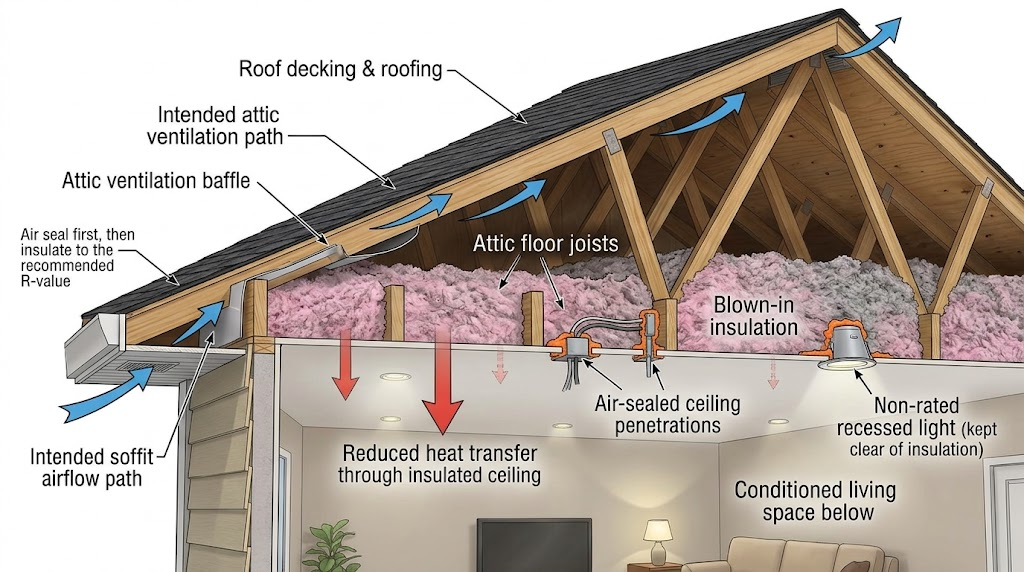
In a conventional vented attic, insulation typically sits on the attic floor.
The living space below is conditioned, while the attic above remains outside the conditioned space.
A different approach places insulation along the underside of the roof deck.
This may be used in certain unvented attic designs.
These arrangements should not be treated as interchangeable.
Moving insulation to the roofline changes moisture-control requirements and may affect the performance of HVAC equipment or ducts located in the attic.
A qualified insulation contractor or building professional should evaluate roof-deck insulation before installation.
Recommended Attic R-Values
ENERGY STAR recommends attic insulation levels based on climate and existing conditions.
Common retrofit targets fall approximately between R-38 and R-60, although the appropriate target varies by climate zone and the insulation already present.
| Existing Attic Condition | Practical Next Step |
|---|---|
| Little or no insulation | Air seal and insulate to the appropriate regional target |
| Existing insulation below recommended levels | Consider adding compatible insulation |
| Adequate insulation with noticeable drafts | Investigate air leaks before adding more insulation |
| Wet or mold-damaged insulation | Correct moisture problems before replacement |
| HVAC equipment or ducts in attic | Evaluate duct leakage and attic configuration |
| Roofline insulation being considered | Obtain a professional assembly assessment |
Check the ENERGY STAR insulation recommendations for guidance relevant to your home.
Can You Add New Insulation Over Old Insulation?
Often, yes.
If existing insulation is dry, clean, and in acceptable condition, adding new insulation may be reasonable.
For example, blown-in cellulose or fiberglass can sometimes be installed over existing fiberglass batts.
However, the old insulation should not conceal:
- Roof leaks
- Mold or persistent moisture
- Pest contamination
- Unsafe wiring
- Unprotected heat-producing fixtures
- Significant air leakage paths
Do not assume that more insulation will solve an underlying building problem.
For additional ways to improve attic performance, see our related guide: Attic Air Sealing: Where Homes Lose Energy.
Realistic Costs & Savings
Insulation costs depend on the material, required R-value, labor, existing conditions, and access.
Comparing prices only by square foot can be misleading because different materials need different thicknesses to reach the same R-value.
Insulation Cost Per Square Foot
The following estimates represent broad installed-price planning ranges.
| Insulation Type | Approximate Installed Cost per Sq Ft | Estimated Cost for 1,000 Sq Ft |
|---|---|---|
| Fiberglass batts | $0.80–$2.00 | $800–$2,000 |
| Blown-in fiberglass | $1.00–$2.50 | $1,000–$2,500 |
| Blown-in cellulose | $1.00–$2.50 | $1,000–$2,500 |
| Open-cell spray foam | $1.50–$4.00+ | $1,500–$4,000+ |
| Closed-cell spray foam | $3.00–$7.00+ | $3,000–$7,000+ |
These are illustrative US market ranges rather than quotes for identical R-values. Spray foam prices in particular depend heavily on installed thickness.
For spray foam, contractors commonly use a measurement called a board foot.
One board foot equals one square foot of material installed one inch thick.
For example, covering 1,000 square feet with three inches of foam requires:
1,000 sq ft × 3 inches = 3,000 board feet.
A contractor’s board-foot price must therefore be multiplied by the required thickness.
A quote should clearly state the foam type, installed thickness, target R-value, preparation, and any required protective coatings.
Worked Example: Insulating a 2,000-Square-Foot Home
Assume a homeowner has:
- A 2,000-square-foot house
- A 1,000-square-foot attic floor
- A mixed climate with both heating and cooling needs
- Existing attic insulation below recommended levels
- Electric heating and cooling for simplified calculations
- An electricity rate of $0.17 per kilowatt-hour (kWh)
A kWh is the amount of electricity used by a 1,000-watt device operating for one hour.
Suppose the household spends $2,400 annually on electricity, with an estimated $1,200 attributable to heating and cooling.
Assume an insulation and air-sealing project reduces heating and cooling electricity consumption by 10% to 20%.
These percentages are hypothetical project scenarios, not predicted savings for a particular home.
The calculation is:
Annual savings = Annual heating and cooling cost × Percentage reduction
Lower scenario:
$1,200 × 0.10 = $120 per year
Higher scenario:
$1,200 × 0.20 = $240 per year
Using the assumed $0.17/kWh electricity rate:
$120 ÷ $0.17 = approximately 706 kWh saved annually.
$240 ÷ $0.17 = approximately 1,412 kWh saved annually.
Read Also: Heat Pump Cost Guide: Installation Prices, Running Costs, and Payback
The actual result could be lower or higher, depending on the home’s starting insulation, air leakage, climate, HVAC efficiency, and thermostat habits.
Estimating Simple Payback
Suppose the completed air-sealing and insulation project costs $2,000.
Simple payback is calculated as:
Project cost ÷ Annual energy savings = Simple payback period
Using the example savings:
$2,000 ÷ $120 = approximately 16.7 years.
$2,000 ÷ $240 = approximately 8.3 years.
This produces an illustrative simple payback range of approximately 8–17 years.
Simple payback does not account for future energy prices, maintenance, financing, inflation, or the value of improved comfort.
Insulation upgrades should also be evaluated for draft reduction, room temperature consistency, and moisture management.
How to Calculate Savings Using Your Utility Bill
Find your electricity price in dollars per kWh.
If your bill lists cents per kWh, divide by 100.
For example:
17 cents ÷ 100 = $0.17/kWh.
If your electricity use falls by 800 kWh annually:
800 × $0.17 = $136 in estimated annual electricity savings.
Use the applicable variable energy rate, including usage-based delivery charges where appropriate. Fixed monthly utility fees generally do not disappear when consumption decreases.
For homes heated with natural gas, calculate gas savings separately using therms.
A therm is a unit of energy commonly used on US natural gas bills.
For example:
50 therms saved × $1.50 per therm = $75.
These calculations estimate bill impacts once energy savings have been established. They do not predict how much insulation alone will save.
For broader context, DOE provides information on home insulation and energy efficiency.
Are Insulation Rebates Available in 2026?
Some homeowners may have access to state, utility, or local insulation incentives.
Programs vary by location and change frequently.
Federal residential energy tax credits under Sections 25C and 25D ended for expenditures after December 31, 2025. Do not assume a 2026 insulation project qualifies for those former credits.
Check current opportunities through:
- ENERGY STAR Rebate Finder
- DSIRE
- Your state energy office
- Your electric or natural gas utility
Confirm eligibility and application requirements before signing a contract.
How Climate Changes Your Insulation Choice
Insulation works in every US climate, but temperature, humidity, and building design affect the most appropriate installation.
Cold Northern Climates
Homes in colder regions generally benefit from higher attic insulation levels.
Air sealing is especially important because warm indoor air can carry moisture into cold attic assemblies.
Potential consequences include condensation and roof-deck moisture problems.
Fiberglass and cellulose can both work well in properly designed attic assemblies.
Spray foam may also be appropriate, but roofline applications require careful moisture-control planning.
Hot-Humid Southern Climates
In the Southeast and Gulf Coast, insulation helps reduce heat entering conditioned living areas.
Humidity control is equally important.
Incorrect vapor-retarder placement or poorly designed roof assemblies can create moisture problems.
Homeowners should avoid assuming that the insulation with the highest R-value per inch is automatically the best option.
Air sealing, HVAC sizing, duct leakage, and humidity management all affect comfort.
Hot, Dry Western Climates
In hot, dry regions, attic temperatures can become extremely high during summer.
Adequate ceiling insulation helps reduce heat transfer into living spaces.
Air sealing and duct improvements may also be valuable.
For homes with significant solar heat gain, window shading and appropriate window treatments can complement insulation upgrades.
Mixed Climates
Many parts of the Midwest, Mid-Atlantic, and central United States experience both hot summers and cold winters.
These homes need balanced year-round performance.
Fiberglass, cellulose, and properly designed spray foam assemblies can all work.
The deciding factors are usually existing conditions, cost, air leakage, and installation quality.
How to Evaluate Your Home’s Insulation
You can complete several useful checks without disturbing insulation or entering hazardous areas.
These steps help identify whether a professional assessment is worthwhile.
Step-by-Step Home Insulation Check
- Review your energy bills. Compare heating and cooling consumption across similar seasons rather than looking at one unusually expensive month.
- Identify uncomfortable rooms. Note rooms that become unusually hot in summer or cold in winter, especially those beneath the attic.
- Check accessible insulation information. Look for insulation labels, previous contractor records, or an energy audit report.
- Inspect the attic from a safe location. If you have safe visibility from the access opening, look for obvious gaps, uneven coverage, or signs of water intrusion. Do not step between joists or onto ceiling drywall.
- Look for moisture problems. Water stains, damp materials, persistent odors, and visible mold should be investigated before new insulation is installed.
- Check doors and windows for drafts. Simple weatherstripping and appropriate caulking may help reduce leakage around accessible openings.
- Request comparable contractor estimates. Ask each contractor to quote the same target R-value, preparation work, and installation area.
- Consider an energy assessment. A professional home energy audit can help prioritize insulation, air sealing, ducts, and HVAC improvements.
Insulation Upgrade Checklist
| Item to Check | Why It Matters | Recommended Action |
|---|---|---|
| Current insulation depth | Helps estimate existing R-value | Compare with regional recommendations |
| Attic air leaks | Can reduce insulation effectiveness | Arrange appropriate air sealing |
| Roof leaks | Can damage insulation and framing | Repair before insulating |
| Bathroom exhaust ducts | Poor termination can create moisture problems | Have ducts correctly vented outdoors |
| Recessed lighting | Some fixtures require insulation clearance | Verify fixture ratings and code requirements |
| Attic ventilation | Supports intended roof assembly performance | Avoid blocking designed ventilation paths |
| HVAC ducts | Leaks may waste conditioned air | Consider professional duct testing |
| Contractor proposal | Determines actual project scope | Compare R-value, materials, and preparation |
Safety note: Older homes may contain vermiculite insulation that could be contaminated with asbestos. The EPA advises homeowners not to disturb suspected asbestos-containing vermiculite.
Avoid entering attics with exposed wiring, unstable flooring, suspected asbestos, significant pest contamination, or other hazards.
Renter-Friendly Insulation Alternatives
Renters generally cannot replace attic or wall insulation without permission.
However, several low-cost comfort improvements may be possible.
Weatherstripping around doors, removable window insulation film, thermal curtains, and draft blockers can help reduce unwanted air movement or heat transfer.
Check your lease before installing adhesive products or modifying fixtures.
For persistent temperature problems, document the issue and ask your landlord or property manager about insulation, air leakage, or HVAC maintenance.
Our related guide, How to Stop Drafts Around Windows and Doors, covers accessible improvements that may be suitable for renters.
When to Call a Professional
Some insulation projects are manageable for experienced DIY homeowners, but others require specialized equipment and building-science knowledge.
Professional assistance is especially important when moisture control, combustion appliances, or roof assemblies are involved.
Hire an Insulation Contractor When:
- Installing spray polyurethane foam
- Insulating enclosed walls
- Designing an unvented attic
- Removing contaminated insulation
- Working around complicated framing
- Addressing persistent condensation
- Insulating a crawl space with moisture problems
- Evaluating insulation near heat-producing equipment
HVAC and Combustion Safety
Air sealing can change how air moves through a home.
In houses with naturally vented gas furnaces, boilers, or water heaters, significant air-sealing work may affect combustion air and venting.
Improper conditions can allow combustion gases, including carbon monoxide, to enter living spaces.
A qualified HVAC technician should evaluate combustion safety when appropriate.
Maintain working carbon monoxide alarms where fuel-burning equipment or attached garages are present, following applicable safety guidance.
For electrical hazards, damaged wiring, or work requiring changes to circuits, hire a licensed electrician.
Do not cover electrical hazards with new insulation.
What to Ask an Insulation Contractor
Before hiring, ask:
- What R-value will the completed installation provide?
- Will attic air sealing be included?
- How will moisture problems be handled?
- Will existing insulation remain?
- What ventilation requirements apply?
- Are permits or inspections required?
- What cleanup and documentation are included?
- What product-specific safety and reentry instructions apply?
Obtain multiple written quotes when possible.
A detailed scope is more useful than a low price without clear installation specifications.
Common Mistakes to Avoid
Even high-quality insulation can underperform when installation details are overlooked.
1. Choosing Insulation Based Only on R-Value Per Inch
Closed-cell spray foam provides high thermal resistance in limited space.
However, it may not be the most economical way to insulate an attic with plenty of available depth.
Compare total installed cost at the same target R-value.
2. Adding Insulation Before Sealing Air Leaks
Air leaks can allow conditioned air to bypass insulation.
Where practical and safe, complete appropriate air sealing before adding loose-fill material.
3. Compressing Fiberglass Batts
Compressed batts generally provide less total thermal resistance than the labeled full-thickness product.
Use insulation designed for the available cavity depth.
4. Ignoring Moisture Problems
New insulation does not repair roof leaks, plumbing leaks, or condensation.
Identify and correct moisture sources first.
5. Blocking Attic Ventilation
In vented attic assemblies, soffit vents and other designed ventilation openings must remain unobstructed.
Improper installation can interfere with intended airflow.
6. Assuming Spray Foam Is Always Better
Spray foam can provide valuable air sealing and thermal resistance.
However, fiberglass or cellulose may deliver comparable target R-values at lower cost in suitable applications.
7. Comparing Contractor Quotes Without Matching Specifications
Two quotes may cover different insulation depths, air-sealing work, removal services, or preparation.
Ask contractors to provide comparable scopes.
8. Expecting Guaranteed Energy Savings
Energy savings depend on the home, climate, heating system, existing insulation, and occupant behavior.
Use estimates for planning rather than treating them as guaranteed bill reductions.
Frequently Asked Questions
1. Is spray foam better than fiberglass insulation?
Spray foam can outperform fiberglass in applications where air sealing or limited installation depth is important. Closed-cell spray foam also provides a higher R-value per inch.
However, fiberglass can achieve comparable total R-values when installed at sufficient thickness. For accessible attics, fiberglass combined with proper air sealing may offer better value than a more expensive spray foam installation.
2. Is cellulose insulation better than fiberglass for attics?
Both cellulose and blown-in fiberglass are practical attic insulation options.
Cellulose generally provides a higher R-value per inch than loose-fill fiberglass, while fiberglass may be lighter and is widely available.
Installation quality, air sealing, settled thickness, moisture conditions, and total cost are more useful comparison factors than material preference alone.
3. What is the best insulation for an attic in a hot climate?
In many hot climates, adequate insulation on the attic floor helps reduce heat entering the conditioned living space.
Blown-in fiberglass and cellulose are common choices for conventional vented attics.
The appropriate R-value depends on the climate zone and existing insulation. Air sealing, attic ventilation design, duct leakage, and moisture conditions should also be evaluated.
4. How much does it cost to insulate a 1,500-square-foot attic?
A 1,500-square-foot attic might cost approximately $1,500–$3,750 for common blown-in fiberglass or cellulose installations using the broad planning ranges in this article.
Actual quotes can differ considerably based on insulation depth, regional labor costs, air sealing, and removal requirements.
Spray foam typically costs more, especially when several inches of material are required.
5. How long does fiberglass insulation last?
Fiberglass insulation can remain effective for decades when it stays dry, clean, properly positioned, and undamaged.
It does not have a universal replacement deadline.
However, water damage, compression, pest contamination, or substantial gaps may justify repairs or replacement.
An inspection of insulation condition is more useful than replacing material solely because of its age.
6. Does cellulose insulation attract mice or insects?
Cellulose insulation is treated with additives that help meet applicable fire-performance requirements, and some treatments may discourage certain pests.
However, cellulose is not a pest-proof barrier.
Rodents can enter attics containing fiberglass, cellulose, or other insulation materials.
Sealing exterior entry points and correcting pest problems are more effective than relying on insulation type alone.
7. Can you install fiberglass insulation yourself?
Some fiberglass projects are suitable for experienced DIY homeowners, especially accessible areas without unusual hazards.
Proper protective clothing, eye protection, respiratory protection, and careful fitting are important.
However, attic work can involve fall risks, electrical hazards, heat-producing fixtures, and contaminated materials.
Avoid disturbing suspected asbestos-containing insulation or working near unsafe wiring.
8. Is closed-cell spray foam worth the extra money?
Closed-cell spray foam may justify its higher cost when installation depth is limited or when a properly designed assembly benefits from its air-sealing and vapor-resistance characteristics.
For a spacious attic floor, less expensive insulation may reach the same target R-value.
Compare complete project specifications rather than only material prices.
9. Can insulation reduce air conditioning costs?
Yes, improved insulation may reduce cooling electricity consumption by slowing heat transfer into conditioned rooms.
The savings depend on existing insulation, air leakage, climate, HVAC efficiency, and thermostat settings.
Homes with very little attic insulation may have more improvement potential than homes that already meet recommended levels.
An energy audit can help estimate likely benefits.
10. Should I remove old attic insulation before adding new insulation?
Not necessarily.
Dry, clean insulation that remains in good condition can often stay in place while additional compatible insulation is installed.
Removal may be appropriate when materials are wet, contaminated, damaged, or interfering with necessary repairs.
A contractor should inspect questionable insulation before recommending removal.
11. Does spray foam insulation cause moisture problems?
Spray foam does not automatically cause moisture problems, but incorrect application or an unsuitable building assembly can contribute to them.
Open-cell and closed-cell foams have different vapor-control characteristics.
Roof assemblies require particular care because temperature, moisture movement, and ventilation interact.
Professional design and installation are especially important for unvented attics.
12. Is upgrading insulation worth it before replacing an HVAC system?
Often, evaluating insulation and air leakage before HVAC replacement makes sense.
Improving the building envelope can reduce heating and cooling loads, potentially affecting the appropriate size of a replacement system.
A qualified HVAC contractor should perform a recognized heating and cooling load calculation, such as ACCA Manual J, rather than relying only on the capacity of the existing equipment.
Conclusion: Which Insulation Should You Choose?
The right insulation depends on your home’s construction, climate, existing insulation, and budget.
Fiberglass is a strong choice for affordable attic and wall insulation.
Cellulose is particularly useful for many existing attic upgrades and enclosed wall retrofits.
Spray foam offers valuable air-sealing performance and can provide high R-values in limited space, but its higher cost and specialized installation requirements deserve careful consideration.
For many conventional attics, the most practical approach is to address moisture and air leakage first, then install enough suitable insulation to meet the recommended regional target.
Final Insulation Decision Checklist
- Identify your current insulation type and approximate R-value.
- Check your climate zone’s recommended insulation levels.
- Address roof leaks and moisture problems before installation.
- Evaluate attic air sealing.
- Compare fiberglass, cellulose, and spray foam at equivalent target R-values.
- Request detailed quotes from qualified contractors.
- Check current utility and state rebates.
- Prioritize safe installation and long-term performance over material marketing claims.
Bottom line: For most homeowners, the best insulation is not necessarily the most expensive material. It is the material that achieves the appropriate R-value, fits the building assembly, and is installed correctly at a reasonable total cost.
Pingback: Window Replacement Cost: Is It Worth It for Energy Savings? – Energy Savings Perlon