Upgrading your home’s energy efficiency can lower utility bills, improve comfort, and reduce unnecessary heating and cooling costs. But deciding where to spend your money isn’t always straightforward.
Should you replace drafty windows, add attic insulation, install a heat pump, or upgrade your appliances?
The best energy efficient home upgrades aren’t necessarily the most expensive or technologically advanced. They’re the improvements that address your home’s biggest sources of energy waste at a reasonable cost.
Read Also: How to Insulate Windows Cheaply: 9 Renter-Friendly Ways to Stay Comfortable
For most homeowners, that means starting with maintenance, air sealing, and insulation before considering major equipment replacements.
This guide explains how to prioritize improvements, compare realistic costs and savings, calculate payback periods, and avoid spending thousands on upgrades that may deliver disappointing results.
You’ll also find practical options for renters and guidance on when hiring a professional makes sense.
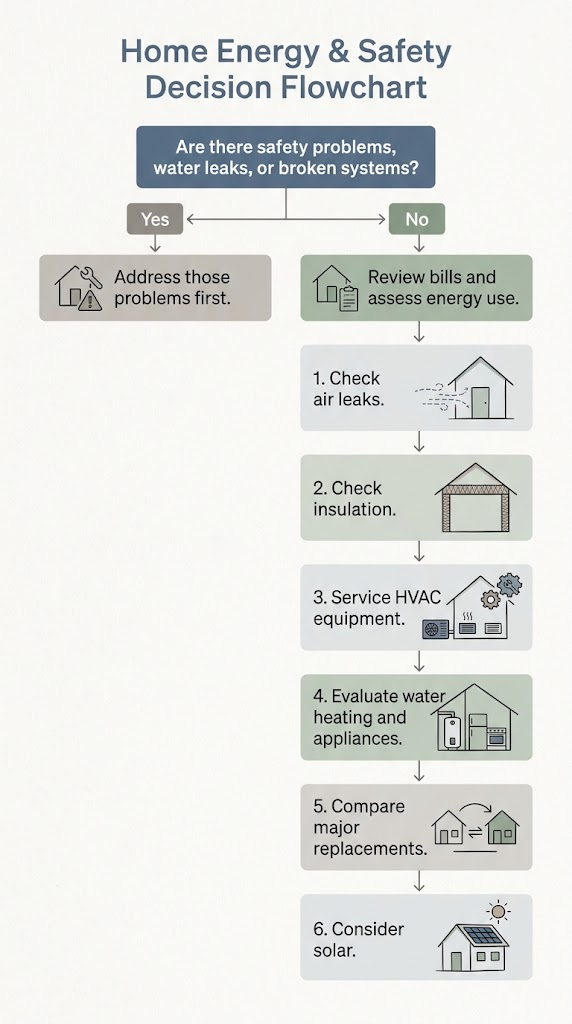
Quick Takeaways
Your Home Energy Upgrade Priority Guide
- Start with an energy assessment. Identify where your home wastes energy before purchasing expensive upgrades.
- Fix air leaks early. Weatherstripping and targeted air sealing are often affordable improvements.
- Check attic insulation. Improving inadequate insulation may provide better value than replacing functional windows.
- Maintain HVAC equipment. Dirty filters, neglected maintenance, and control problems can increase energy consumption.
- Upgrade equipment strategically. Heat pumps, water heaters, and efficient appliances often make more sense when existing equipment needs replacement.
- Treat window replacement carefully. New windows can improve comfort, but energy savings alone may not justify their installation cost.
- Compare payback periods. Calculate potential annual savings against total installed cost before committing.
- Check local rebates. Utility and state incentives can change which upgrades offer the best value.
How to Decide Which Energy Upgrade Comes First
The smartest home efficiency priority depends on three factors:
- Where your home currently loses energy.
- How much an improvement will cost.
- How much energy that improvement could reasonably save.
Two homes with identical square footage may need completely different upgrades.
Read Also: Window Replacement Cost: Is It Worth It for Energy Savings?
A 2,000-square-foot house in Minnesota with inadequate attic insulation might benefit substantially from insulation improvements.
Meanwhile, a similar home in Arizona with excellent insulation but an aging air conditioner may have a stronger case for an HVAC upgrade.
Start With a Home Energy Assessment
A home energy assessment identifies problems affecting heating, cooling, and overall energy consumption.
According to the U.S. Department of Energy (DOE), a professional assessment can help homeowners understand how energy moves through their homes and which improvements deserve attention.
An assessment may examine:
- Attic and wall insulation
- Air leakage around doors and windows
- HVAC equipment and ductwork
- Water heating
- Lighting and appliances
- Ventilation and moisture conditions
Some professionals use a blower door test.
A blower door is a temporary fan installed in an exterior doorway. It creates a pressure difference that helps measure air leakage through the home’s exterior surfaces.
Other assessments may include infrared imaging to identify temperature differences associated with insulation gaps or air leaks.
These tools don’t automatically identify every problem, but they can provide useful evidence when combined with an inspection.
Read Also: Spray Foam vs Fiberglass vs Cellulose: Which Insulation Is Best for Your Home?
Check Your Utility Bills Before Spending Money
Look at 12 months of electricity and natural gas bills.
Record your monthly consumption rather than focusing only on the dollar amount.
Electricity consumption is measured in kilowatt-hours (kWh). One kWh equals using 1,000 watts of electricity for one hour.
Natural gas is often billed in therms. One therm represents approximately 100,000 British thermal units (Btu) of energy.
Compare summer and winter consumption.
Large summer increases may indicate substantial cooling demand. Large winter increases may reflect heating demand, although fuel type and weather matter.
This information helps you identify which energy systems deserve closer attention.
Important: High bills don’t automatically mean inefficient equipment. Weather, utility rates, household size, and daily habits also affect energy costs.
Home Energy Upgrade Priority Checklist
Before selecting an upgrade, inspect the areas most likely to affect comfort and energy use.
The following checklist provides a practical starting point.
| Area | What to Check | Possible Upgrade | Typical Priority |
|---|---|---|---|
| Attic | Missing or inadequate insulation | Add insulation | High |
| Doors | Noticeable drafts | Weatherstripping | High |
| Windows | Air leaks around frames | Caulking or sealing | High |
| HVAC | Dirty filters or poor performance | Maintenance or repairs | High |
| Ductwork | Disconnected or leaking ducts | Professional duct sealing | High when problems exist |
| Water heater | High energy use or aging equipment | Efficient replacement | Medium |
| Thermostat | Inefficient temperature schedules | Programmable or smart thermostat | Medium |
| Lighting | Frequently used incandescent bulbs | LED bulbs | Medium |
| Appliances | Aging or failing equipment | ENERGY STAR replacement | Situation-dependent |
| Windows | Failed seals, damage, or poor comfort | Repair or replacement | Situation-dependent |
| Solar | Suitable roof and significant electricity use | Rooftop solar evaluation | Usually later |
These priorities aren’t universal.
For example, a home with a failing heating system may need HVAC replacement immediately, even if attic insulation could otherwise provide a better financial return.
Likewise, moisture damage, electrical hazards, and combustion safety problems should be addressed before pursuing energy savings.
A Simple DIY Home Energy Walkthrough
You can complete a basic assessment without specialized equipment.
- Inspect accessible attic areas safely. From a safe access point, look for obvious insulation gaps or exposed ceiling surfaces. Don’t step onto drywall or enter an attic with unsafe access.
- Check doors and windows. Look for damaged weatherstripping, visible gaps, and drafts.
- Inspect HVAC filters. Check whether the filter needs cleaning or replacement according to the equipment manufacturer’s instructions.
- Review thermostat settings. Look for opportunities to reduce unnecessary heating or cooling while maintaining safe indoor temperatures.
- Check accessible ductwork visually. Look for disconnected sections or obvious damage without disturbing insulation or unfamiliar materials.
- Inspect lighting. Identify frequently used incandescent bulbs that could be replaced with LEDs.
- Review utility consumption. Compare seasonal usage and identify unusual changes.
Avoid opening electrical panels, disturbing suspected asbestos-containing materials, or handling gas and refrigerant connections.
This walkthrough won’t replace a professional assessment, but it can help you prepare better questions.
Read Also: Attic Insulation Cost Guide: R-Values, Types, and DIY vs. Pro
The Best Energy Efficient Home Upgrades, Ranked
The following ranking reflects a common starting order for homes with ordinary maintenance needs and no major equipment failures.
Actual priorities should follow the home’s condition.
1. Air Sealing: Often the First Improvement Worth Considering
Air sealing reduces uncontrolled airflow through gaps in a home’s exterior shell.
Common leakage locations include:
- Door frames
- Window trim
- Attic penetrations
- Plumbing openings
- Recessed fixtures
- Basement rim joists
- Gaps around accessible exterior penetrations
A draft may feel minor, but numerous small openings can contribute to heating and cooling losses.
DOE estimates that homeowners can potentially save an average of about 15% on heating and cooling costs by combining air sealing with insulation improvements in areas such as attics, floors over crawl spaces, and accessible basement rim joists.
That estimate applies to the combined measures, not air sealing alone, and actual results vary.
DIY-friendly improvements:
Apply appropriate weatherstripping to accessible doors and use suitable caulk around stationary gaps.
Avoid sealing intentional ventilation openings, appliance combustion-air supplies, or required drainage paths.
Larger projects involving attic penetrations or complicated assemblies are better handled by qualified contractors.
2. Attic Insulation: A Strong Candidate for Many Homes
Insulation slows heat transfer between indoor and outdoor spaces.
Its effectiveness is commonly expressed as R-value.
R-value measures resistance to heat flow. Higher R-values generally indicate greater insulating resistance.
The recommended insulation level depends on climate, existing insulation, and building construction.
Attics are often worth evaluating because they separate conditioned living space from areas that can become extremely hot or cold.
Common insulation materials include:
- Fiberglass batts
- Blown-in fiberglass
- Blown-in cellulose
- Spray foam
Each has different installation requirements, costs, and moisture considerations.
Blown-in insulation can be useful for covering irregular attic surfaces, while fiberglass batts may work well in accessible, unobstructed areas.
Spray foam requires particular attention to installation quality, ventilation strategy, and chemical safety.
Before adding insulation, address roof leaks, moisture problems, and significant air leakage.
Related reading: Attic Insulation Guide: R-Values, Costs, and Materials
3. HVAC Maintenance Before HVAC Replacement
Heating, ventilation, and air conditioning (HVAC) equipment can account for a substantial portion of household energy consumption.
However, replacing functioning equipment isn’t always the best first investment.
Start with basic maintenance.
Replace or clean filters as recommended, keep outdoor equipment clear of debris, and arrange professional servicing when appropriate.
Poor airflow, damaged ductwork, incorrect refrigerant charge, and control problems can reduce system performance.
Refrigerant work and internal equipment repairs require qualified technicians.
If your system is old, unreliable, or expensive to repair, replacement becomes a stronger option.
4. Smart Thermostats and Better Temperature Scheduling
A smart thermostat can automatically adjust heating and cooling temperatures based on schedules, occupancy, or user preferences.
Potential savings depend heavily on your existing habits.
A household already using efficient temperature schedules may see relatively little additional benefit.
Before buying, check:
- HVAC compatibility
- Wiring requirements
- Whether the system uses a heat pump
- Available ENERGY STAR certification
- Utility rebate eligibility
Some smart thermostats require additional wiring or equipment-specific configuration.
Hire a qualified professional when installation requires electrical modifications.
5. Water Heater Improvements
Water heating is another important household energy expense.
Lower-cost improvements may include adjusting excessive hot-water temperatures, repairing leaks, and installing suitable water-saving fixtures.
A heat pump water heater transfers heat from surrounding air into stored water rather than generating all its heat through electric resistance.
This can make it considerably more efficient than a conventional electric resistance water heater.
However, installation cost, available space, condensate drainage, noise, and surrounding air temperature matter.
Heat pump water heaters can cool the room around them, which may be beneficial in some climates and undesirable in others.
For many homeowners, replacement makes the most sense when the existing water heater approaches the end of its useful life.
6. LED Lighting and Efficient Appliances
LED lighting is one of the easiest upgrades to complete.
According to DOE, residential LEDs use at least 75% less energy and can last up to 25 times longer than incandescent lighting.
Savings depend on wattage, hours of use, and electricity prices.
For appliances, prioritize products with substantial annual energy consumption.
Refrigerators, dryers, and other frequently used equipment may offer meaningful differences between models.
ENERGY STAR labels help identify products meeting specific efficiency criteria.
However, replacing a functional appliance early solely for energy savings may not provide the best return.
Compare annual energy consumption and purchase price before deciding.
Insulation vs. Windows: Which Should You Upgrade First?
The insulation vs. windows decision is one of the most common home improvement questions.
Both can improve comfort, but their costs and potential savings differ considerably.
Why Insulation Often Comes First
Adding insulation to an underinsulated attic can reduce heat transfer across a large surface area.
If the attic currently has substantial deficiencies, improvements may reduce heating and cooling demand at a relatively moderate cost.
Window replacement, meanwhile, involves purchasing and installing multiple manufactured units.
That makes whole-home replacement expensive.
If existing windows are structurally sound, targeted air sealing, weatherstripping, interior storm windows, or other appropriate improvements may address certain problems without full replacement.
When New Windows Make More Sense
Window replacement may deserve higher priority when:
- Frames are rotting or structurally damaged.
- Windows cannot open or close safely.
- Water infiltration is damaging surrounding materials.
- Existing windows have major performance limitations.
- Comfort near windows remains poor despite reasonable repairs.
Modern efficient windows use several performance features.
U-factor measures how readily heat moves through a window. Lower U-factors generally indicate better insulating performance.
Solar heat gain coefficient (SHGC) measures how much solar heat passes through the window. Lower SHGC values reduce solar heat gain.
In hot climates, limiting unwanted solar heat may be particularly useful.
In colder climates, window selection should consider both insulation performance and beneficial winter sunlight.
Insulation vs. Windows Cost Comparison
| Upgrade | Illustrative Installed Cost | Main Benefit | Financial Consideration |
|---|---|---|---|
| DIY weatherstripping | $20–$150 | Reduces localized drafts | Often inexpensive |
| Professional attic air sealing | $500–$2,000 | Reduces uncontrolled airflow | Depends on leakage |
| Additional attic insulation | $1,500–$4,500 | Reduces heat transfer | Depends on existing R-value |
| Interior storm window improvements | $100–$500 per opening | Improves existing window performance | Lower-cost alternative in some homes |
| Replacement windows | $500–$1,500+ per window | Comfort, durability, appearance, efficiency | Long energy-only payback possible |
Costs are broad planning estimates, not national price guarantees. Labor, location, accessibility, materials, and project scope can change prices substantially.
For example, replacing 12 windows at $900 each would cost approximately $10,800.
If an attic insulation project costs $2,500 and addresses a major deficiency, insulation may offer a shorter energy savings payback period.
That doesn’t mean insulation always wins.
A home with excellent attic insulation and severely deteriorated windows has different priorities.
Related reading: Insulation vs. Window Replacement: Which Saves More?
When HVAC and Heat Pump Upgrades Make Sense
HVAC replacement deserves special consideration because heating and cooling systems are expensive and essential.
A new system may improve efficiency, comfort, humidity control, and reliability.
But buying the most efficient equipment available doesn’t automatically produce the best financial outcome.
Understand HVAC Efficiency Ratings
For air conditioners and heat pumps, one common cooling efficiency rating is SEER2.
SEER2 stands for Seasonal Energy Efficiency Ratio 2. It measures cooling output relative to electricity consumption under standardized testing conditions.
Higher SEER2 ratings generally indicate greater seasonal cooling efficiency.
Heating performance for heat pumps is commonly compared using HSPF2, or Heating Seasonal Performance Factor 2.
Heat pump efficiency can also be expressed through coefficient of performance (COP).
COP compares useful heating output with the energy consumed.
For example, a COP of 3 means the heat pump delivers three units of heat for each unit of energy it consumes under the measured conditions.
Actual performance changes with outdoor temperatures, equipment design, and installation quality.
Why Proper Sizing Matters
Oversized equipment isn’t necessarily better.
An oversized air conditioner may cycle on and off frequently, potentially affecting comfort and humidity control.
Undersized equipment may struggle during extreme weather.
Qualified HVAC contractors can perform a Manual J load calculation, a standardized method for estimating a home’s heating and cooling requirements.
Air sealing, insulation improvements, window characteristics, and other building features affect that calculation.
This is another reason to address major building-envelope problems before selecting replacement equipment when practical.
Heat Pumps vs. Traditional HVAC
Heat pumps transfer heat rather than generating it solely through electric resistance.
During summer, an air-source heat pump works similarly to an air conditioner.
During winter, it extracts heat from outdoor air and transfers it indoors.
Modern cold-climate models can operate in freezing temperatures, although efficiency and heating capacity vary.
A heat pump may be attractive when:
- Existing equipment needs replacement.
- The home uses expensive electric resistance heating.
- Both heating and cooling are needed.
- Appropriate equipment and qualified installers are available.
The financial case is more complicated when replacing an efficient natural gas furnace.
Electricity rates, gas prices, winter temperatures, and equipment performance all influence operating costs.
Request multiple detailed quotes and compare installed cost, system sizing, efficiency, warranty terms, and projected energy use.
Realistic Costs & Savings
Energy upgrade ROI, or return on investment, depends on how much an improvement costs compared with the financial benefit it delivers.
For household efficiency projects, a simple starting point is the payback period.
A payback period estimates how many years it takes for accumulated energy savings to equal the initial cost.
It doesn’t account for every factor, including maintenance, financing, changes in utility rates, or the time value of money.
Typical Home Energy Upgrade Costs
| Upgrade | Illustrative Cost Range | Savings Potential | General Payback Outlook |
|---|---|---|---|
| Weatherstripping and small air sealing projects | $20–$300 | Low to moderate | Often relatively short |
| Professional air sealing | $500–$2,000+ | Varies with leakage | Highly variable |
| Attic insulation | $1,500–$4,500+ | Moderate where insulation is inadequate | Often worth evaluating |
| Smart thermostat | $50–$300+ | Depends on existing habits | Variable |
| LED lighting | $2–$15 per bulb | Predictable per bulb | Often short for heavily used bulbs |
| Heat pump water heater | $1,500–$4,500+ installed | Potentially substantial versus electric resistance | Depends on hot-water use |
| Central HVAC replacement | $5,000–$15,000+ | Depends on existing system | Often longer if replacing functional equipment |
| Whole-home window replacement | $8,000–$25,000+ | Highly home-dependent | Often long based on energy savings alone |
| Rooftop solar | $15,000–$35,000+ before incentives | Depends on generation and billing rules | Highly location-dependent |
These are illustrative US project-planning ranges, not verified October 2026 national averages. Actual quotes may fall outside these ranges.
Worked Example: Attic Insulation Payback
Assume a homeowner has:
- A 2,000-square-foot house
- A mixed heating and cooling climate
- Electricity costing $0.17 per kWh
- Annual electricity consumption of 12,000 kWh
- Heating and cooling responsible for 45% of electricity consumption
- An attic insulation project costing $2,500
For simplicity, assume all heating and cooling energy in this example is electric.
First, calculate annual electricity costs.
12,000 kWh × $0.17 = $2,040 per year
Next, estimate heating and cooling electricity expenses.
$2,040 × 45% = $918 per year
Suppose the insulation project reduces heating and cooling electricity use by 10%.
This is a hypothetical project-specific assumption, not a guaranteed savings rate.
Annual savings would be:
$918 × 10% = $91.80
Now calculate simple payback.
Payback period = Installed cost ÷ Annual savings
$2,500 ÷ $91.80 = approximately 27.2 years
This example illustrates why project selection matters.
Even when an upgrade reduces energy use, its financial payback may be long if the affected energy expense is relatively small.
What If Savings Are Higher?
Suppose a different house has more severe insulation deficiencies.
If the same $2,500 project saves $200 annually:
$2,500 ÷ $200 = 12.5 years
If savings reach $300 annually:
$2,500 ÷ $300 = approximately 8.3 years
These examples demonstrate how the payback period changes with actual savings.
They aren’t predictions for a particular home.
How to Calculate Savings Using Your Utility Rate
Find the electricity supply and delivery charges on your bill.
For a simple estimate, divide the applicable usage-based electricity charges by the number of kWh consumed.
For example:
$180 in usage-based electricity charges ÷ 1,000 kWh = $0.18/kWh
Be careful with fixed monthly customer charges.
Those charges usually won’t disappear simply because you consume fewer kWh.
If your utility uses time-of-use pricing, electricity costs vary depending on when energy is consumed.
For natural gas, calculate the applicable cost per therm using your bill’s usage-based charges.
Then estimate annual savings:
Annual savings = Energy saved × Applicable energy rate
For projects affecting multiple fuels, calculate electricity and gas savings separately before adding them together.
Don’t Ignore Rebates
State governments, utilities, and local programs may offer incentives for qualifying upgrades.
Federal residential energy tax credits under sections 25C and 25D ended for expenditures after December 31, 2025.
Do not assume a federal residential energy tax credit is available for a new 2026 project.
Instead, check:
- ENERGY STAR Rebate Finder
- DSIRE Incentive Database
- Your state energy office
- Your electric or natural gas utility
Programs vary by state and change often. Check current eligibility, funding, installation requirements, and application deadlines before making a purchase.
How Climate Changes Your Upgrade Priorities
The same improvement can deliver different results depending on local weather.
Climate also affects moisture management and HVAC selection.
Cold Northern States
Homes in Minnesota, Wisconsin, Michigan, Maine, and similar climates often face substantial winter heating demand.
Common priorities include attic insulation, air sealing, basement insulation, and efficient heating equipment.
Cold-climate heat pumps may be worth evaluating when heating equipment needs replacement.
However, homes with natural gas heating should compare expected operating costs carefully.
Air sealing must also preserve safe ventilation and combustion appliance operation.
Hot-Humid Southern States
In states such as Florida, Louisiana, and much of the Gulf Coast, cooling and indoor humidity management are major considerations.
Useful upgrades may include:
- Attic insulation
- Duct sealing
- Efficient cooling equipment
- Appropriate window shading
- Humidity-aware HVAC controls
Moisture management is particularly important.
An oversized air conditioner may cool indoor air quickly without running long enough to remove sufficient humidity.
Sealing and insulation work should account for local moisture conditions and ventilation requirements.
Hot, Dry Western States
In Arizona, Nevada, and parts of California, strong sunlight and high daytime temperatures can create substantial cooling demand.
Solar heat gain through windows may be important.
Exterior shading, suitable window treatments, attic insulation, and efficient cooling can help.
In some dry climates, evaporative cooling may also be an option, although performance depends on local humidity and water availability.
Mixed-Climate Regions
Many homes in the Mid-Atlantic, Midwest, and Pacific Northwest need both heating and cooling.
Balanced improvements often make sense.
Air sealing, insulation, duct repairs, and efficient heating and cooling equipment can all contribute.
For these homes, annual utility consumption is especially useful because focusing exclusively on summer or winter may lead to the wrong priority.
Energy Upgrades for Renters
Renters can improve comfort and reduce energy consumption without making permanent changes.
However, the best options depend on lease terms, utility billing arrangements, and permission from the property owner.
Low-Cost Renter-Friendly Improvements
Consider these options:
- Replace frequently used incandescent bulbs with LEDs.
- Use removable draft stoppers at doors.
- Install temporary window insulation film where permitted.
- Use curtains or blinds to manage sunlight.
- Adjust thermostat schedules when you control the thermostat.
- Clean or replace accessible HVAC filters when your lease permits.
- Use smart power strips to reduce unnecessary standby consumption.
Avoid blocking supply vents, return-air grilles, or required ventilation openings.
Don’t install permanent weatherstripping, alter wiring, or modify HVAC equipment without authorization.
What If Utilities Are Included in Rent?
When utilities are included, direct financial savings may not appear on your bill.
However, reducing drafts and improving temperature control can still improve comfort.
For larger problems, document the symptoms and contact the landlord or property manager.
Examples include:
- Windows that won’t close properly
- Persistent water intrusion
- Heating or cooling failures
- Visible mold or recurring condensation
- Damaged ductwork
Local housing requirements may determine which repairs the property owner must complete.
When to Call a Professional
Some energy improvements are suitable for DIY work. Others involve serious safety risks or require specialized tools.
Professional assistance is appropriate when a project affects electrical systems, combustion appliances, structural components, moisture control, or complex HVAC equipment.
Hire a Qualified Contractor For:
Major attic insulation projects: Attics may contain electrical hazards, unsafe walking surfaces, contaminated insulation, or inadequate ventilation.
HVAC installation or refrigerant work: Hire a qualified HVAC technician for equipment replacement, refrigerant handling, or internal system repairs.
Electrical modifications: Hire a licensed electrician for new circuits, panel work, or wiring changes beyond ordinary plug-in devices.
Gas equipment: Gas lines, burners, vents, and combustion appliance modifications require qualified professionals.
Large air sealing projects: Extensive sealing can change ventilation and pressure conditions inside a home.
Carbon Monoxide and Ventilation Safety
Carbon monoxide (CO) is an odorless, poisonous gas produced by incomplete combustion.
Homes with fuel-burning furnaces, fireplaces, water heaters, or other combustion appliances require particular care when air leakage is reduced.
Improper sealing can contribute to dangerous venting conditions in some buildings.
Maintain working carbon monoxide alarms according to applicable codes and manufacturer instructions.
Professionals should evaluate combustion safety and ventilation when appropriate.
The Environmental Protection Agency also emphasizes that indoor air quality depends on controlling pollution sources and providing adequate ventilation.
Energy efficiency should never come at the expense of safe indoor air.
Be Careful With Space Heaters
Portable electric space heaters can provide localized heat but may increase electricity costs.
They also create fire risks if used improperly.
Keep heaters away from combustible materials, follow manufacturer clearance requirements, and never use extension cords or power strips unless the manufacturer explicitly permits them.
Do not use fuel-burning outdoor heaters indoors.
Common Mistakes to Avoid
Even well-intentioned energy improvements can disappoint when projects are selected in the wrong order.
1. Replacing Windows Before Investigating Air Leaks
Drafts near windows don’t always mean the entire window needs replacement.
Air may enter through trim gaps, deteriorated weatherstripping, or surrounding construction.
Identify the source before committing to expensive replacements.
2. Adding Insulation Without Fixing Moisture Problems
Insulation doesn’t repair roof leaks, condensation problems, or water intrusion.
Adding materials over wet or damaged areas may conceal existing problems.
Address moisture and appropriate air sealing before adding insulation.
3. Buying HVAC Equipment Without a Load Calculation
Replacing an old system with equipment of identical capacity isn’t always appropriate.
Previous equipment may have been incorrectly sized.
Building improvements can also change heating and cooling requirements.
4. Assuming ENERGY STAR Means Every Upgrade Pays for Itself
ENERGY STAR certification identifies products meeting applicable efficiency requirements.
It doesn’t guarantee that replacing a functional product will recover its full purchase and installation cost through utility savings.
Compare incremental cost, energy consumption, and expected service life.
5. Ignoring Installation Quality
Excellent materials cannot compensate for poor installation.
Insulation gaps, disconnected ducts, improper window flashing, and incorrectly configured HVAC equipment can undermine performance.
Ask contractors how they verify completed work.
6. Comparing Only Upfront Prices
The least expensive quote may exclude important work.
For example, one insulation contractor may include attic air sealing while another quotes only insulation installation.
Compare project scope, materials, specifications, warranties, and cleanup requirements.
7. Assuming Solar Should Always Come First
Solar panels generate electricity, but they don’t correct inefficient equipment or uncontrolled heat loss.
Improving efficiency first may reduce the solar system size needed to offset part of your consumption.
However, solar economics also depend on roof conditions, financing, local electricity prices, and utility compensation rules.
For homeowners considering solar, compare multiple quotes and read contracts carefully.
Frequently Asked Questions
1. What are the best energy efficient home upgrades for an older house?
For many older houses, air sealing, attic insulation, duct repairs, and HVAC maintenance are sensible starting points. Older homes may have substantial air leakage or incomplete insulation.
However, an energy assessment is especially valuable because construction methods and existing materials vary. Address moisture, electrical, and combustion safety concerns before starting major efficiency work.
2. Should I replace windows or add insulation first?
If your attic has inadequate insulation and your windows are structurally sound, insulation may offer better value.
Window replacement becomes more compelling when frames are damaged, water enters around windows, or repairs cannot resolve major problems.
Compare installed costs and likely savings rather than assuming either option is always superior.
3. What home energy upgrade has the fastest payback period?
Small, inexpensive improvements often have the shortest payback periods.
Examples include replacing heavily used incandescent bulbs with LEDs, correcting inefficient thermostat schedules, and sealing obvious door drafts.
However, payback depends on installation cost, energy prices, and actual energy use. A more expensive project may save more dollars annually while taking longer to recover its cost.
4. Is attic insulation worth the money?
Attic insulation can be worthwhile when existing insulation is substantially below recommended levels.
Its value depends on climate, current R-value, heating and cooling costs, and installation quality.
Homes with well-insulated attics may see relatively small additional benefits. A professional assessment can help estimate whether an improvement is justified.
5. Is a heat pump worth installing in 2026?
A heat pump may be an attractive option when existing heating or cooling equipment needs replacement.
It can be especially useful when replacing electric resistance heating.
However, installation costs, electricity prices, climate, and the existing heating fuel affect the financial comparison. Obtain multiple quotes and ask for estimates based on your home’s heating and cooling requirements.
6. How much can air sealing lower energy bills?
Savings vary considerably with the home’s existing leakage and the amount of work completed.
DOE estimates that combining air sealing with insulation improvements in key areas can produce average heating and cooling savings of about 15%.
That isn’t a prediction for air sealing alone or a guarantee for an individual home. Testing can help identify where sealing is most useful.
7. Are new energy-efficient windows worth the cost?
Energy-efficient windows can improve comfort, reduce drafts, and help manage heat transfer.
However, whole-home replacement is expensive, and energy savings alone may not recover the cost quickly.
Replacement may still make sense for damaged windows, persistent water intrusion, noise reduction, or planned renovations. Consider lower-cost repairs and storm-window options first when appropriate.
8. Should I install solar panels before upgrading insulation?
Usually, it’s worth identifying major efficiency problems before choosing a solar system size.
Reducing electricity consumption may allow a smaller solar installation.
However, solar financial performance depends on electricity rates, roof characteristics, equipment prices, and utility billing arrangements. Efficiency upgrades that primarily save natural gas may have little effect on the solar system size needed.
9. What is a good payback period for home energy improvements?
There isn’t one universally correct payback period.
A low-cost improvement may recover its expense within a few years, while insulation, windows, or HVAC equipment may take much longer.
Consider expected equipment life, comfort improvements, maintenance, and future repair needs. Simple payback is useful for comparisons but doesn’t capture every benefit or cost.
10. What energy upgrades can renters make without landlord approval?
Portable draft stoppers, LED bulbs, curtains, removable window coverings, and plug-in smart power strips are common options.
Permission requirements depend on the lease and the installation method.
Avoid permanent modifications or electrical and HVAC alterations without authorization. For malfunctioning heating, cooling, or ventilation systems, contact the property owner or manager.
11. Are there still energy efficiency rebates in 2026?
Some utilities, state agencies, and local programs continue to offer energy efficiency rebates.
Federal residential energy tax credits under sections 25C and 25D ended for expenditures after December 31, 2025.
Check ENERGY STAR’s Rebate Finder, DSIRE, your state energy office, and your utility for current programs. Eligibility, funding, and qualifying equipment requirements vary.
12. How do I know whether my home needs more insulation?
Check the depth, condition, and coverage of accessible insulation, then compare its estimated R-value with DOE recommendations for your climate.
Visible gaps, uneven coverage, and unusually hot or cold rooms may suggest problems, but they aren’t conclusive.
A professional assessment can evaluate insulation alongside air leakage, moisture, and HVAC performance.
Final Upgrade Priority Checklist
The best energy efficient home upgrades solve actual problems rather than simply adding newer equipment.
For most households, a practical sequence is:
- Review 12 months of utility bills.
- Complete a basic home energy walkthrough.
- Address safety, moisture, and equipment failures.
- Seal appropriate air leaks.
- Check attic insulation levels.
- Maintain HVAC equipment and inspect accessible ducts.
- Improve thermostat schedules and lighting efficiency.
- Evaluate water heater and appliance efficiency.
- Compare major HVAC and window replacement quotes.
- Check current utility and state rebates.
- Calculate estimated annual savings and payback periods.
- Consider solar after reviewing electricity consumption and roof suitability.
The most useful rule is simple: Fix problems before replacing functional equipment.
A relatively small investment in weatherstripping, air sealing, or insulation may deliver more immediate value than an expensive upgrade chosen without understanding the home’s needs.
And when major equipment does need replacement, comparing efficiency ratings, installation quality, and realistic operating costs can help you make a more informed decision.