A portable space heater can make a chilly bedroom or home office more comfortable without turning up the heat throughout your entire home. But how much does that extra warmth actually cost?
The space heater cost to run depends mainly on three things: the heater’s wattage, how many hours it operates, and your electricity rate.
Read Also: Heat Pump Cost Guide: Installation Prices, Running Costs, and Payback
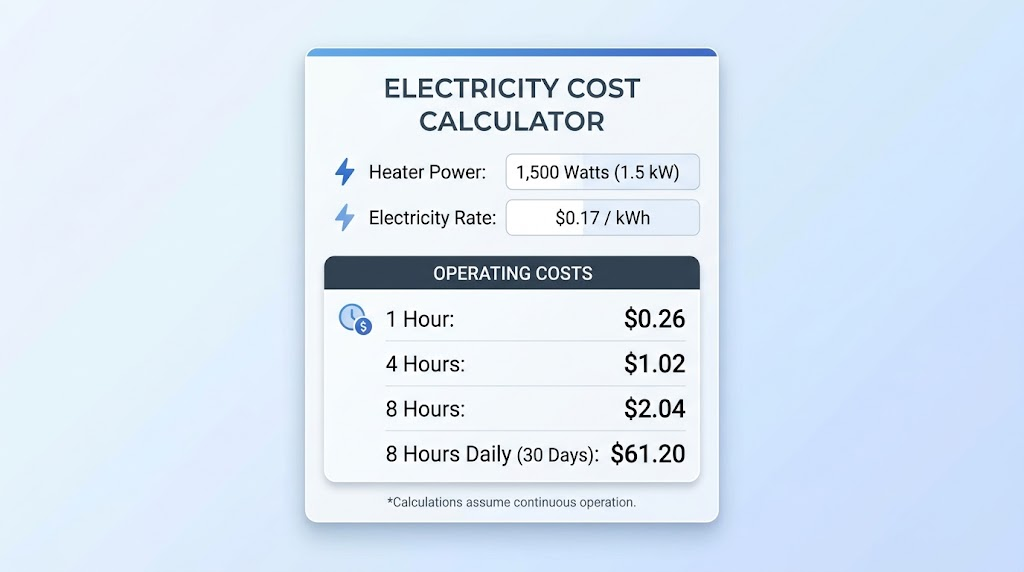
A typical 1,500-watt electric space heater can cost around $0.26 per hour at an electricity rate of $0.17 per kilowatt-hour. Run it eight hours daily, and that adds up to approximately $61 per month.
However, the real cost can be higher or lower depending on your location, thermostat settings, and heating habits.
This guide explains how to calculate your actual costs, compare portable heaters with central heating, choose safer equipment, and find alternatives that may keep you comfortable for less.
Quick Takeaways
- A 1,500-watt space heater costs approximately $0.26 per hour at $0.17 per kWh.
- Running that heater eight hours daily costs about $61 per month if it operates continuously.
- Most full-size electric space heaters use between 750 and 1,500 watts.
- Electric resistance heaters convert nearly all electricity they consume into heat, but that doesn’t make them the cheapest heating option.
- Heating one occupied room may cost less than heating an entire house, depending on your existing system.
- Heat pumps can deliver substantially more heat per unit of electricity than portable resistance heaters.
- Plug space heaters directly into appropriate wall outlets, never extension cords or power strips.
- Before buying another heater, consider draft sealing, thermostat adjustments, and other lower-cost comfort improvements.
How Much Does a Space Heater Cost to Run?
For most households, the easiest way to estimate operating costs is to start with a heater’s wattage.
Read Also: Ductless Mini-Split Guide: Costs, Pros, Cons, and Energy Savings
Wattage measures how quickly an electrical appliance uses energy. Higher-wattage heaters generally produce more heat but also consume more electricity while operating.
Many portable space heaters have two settings:
- Low: approximately 750 watts
- High: approximately 1,500 watts
Some compact personal heaters use only 200–500 watts, while other models offer adjustable power settings.
Space Heater Running Cost by Wattage
The following calculations assume an electricity rate of $0.17 per kilowatt-hour (kWh).
A kilowatt-hour is the amount of electricity consumed by a 1,000-watt appliance running for one hour.
| Heater wattage | Cost per hour | 4 hours/day, 30 days | 8 hours/day, 30 days |
|---|---|---|---|
| 500 watts | $0.09 | $10.20 | $20.40 |
| 750 watts | $0.13 | $15.30 | $30.60 |
| 1,000 watts | $0.17 | $20.40 | $40.80 |
| 1,200 watts | $0.20 | $24.48 | $48.96 |
| 1,500 watts | $0.26 | $30.60 | $61.20 |
Costs are rounded to the nearest cent for hourly estimates. Monthly figures use the unrounded calculations. These estimates assume continuous operation at the listed wattage.
Your actual electricity rate may differ significantly.
According to the U.S. Energy Information Administration (EIA), residential electricity prices vary by state, utility, and billing plan.
A heater that costs relatively little to operate in one region may be considerably more expensive elsewhere.
What if You Run a Heater All Night?
Suppose you operate a 1,500-watt heater for eight hours.
At $0.17 per kWh:
1.5 kW × 8 hours × $0.17 = $2.04 per night
Over 30 nights:
$2.04 × 30 = $61.20
This is a useful budgeting calculation, not a recommendation to leave a portable heater operating while sleeping.
The U.S. Consumer Product Safety Commission (CPSC) recommends turning portable heaters off when going to bed or leaving a room.
If your bedroom is consistently too cold, improving the room’s insulation, addressing drafts, or having the main heating system inspected may provide a safer long-term solution.
How Much Electricity Does a Space Heater Use?
Most plug-in electric space heaters use a heating element that converts electrical energy into heat.
Read Also: Heat Pump vs Furnace: Costs, Efficiency, and Which Is Right for Your Home
When electricity passes through the element, the element becomes warm. Some heaters use fans to distribute that warmth, while others rely primarily on natural air movement or radiant heat.
The basic electricity calculation is straightforward:
Electricity used (kWh) = Watts ÷ 1,000 × Hours operated
For example, a 1,500-watt heater running for three hours consumes:
1,500 ÷ 1,000 × 3 = 4.5 kWh
At $0.17 per kWh, that costs:
4.5 × $0.17 = $0.765, or about $0.77.
Does a Space Heater Use Electricity Constantly?
Not necessarily.
Many portable heaters contain thermostats that switch the heating element on and off as the room temperature changes.
A heater set to maintain 68°F might operate continuously in a poorly insulated room but cycle frequently in a well-insulated bedroom.
Consider two situations.
Situation A: Continuous operation
A 1,500-watt heater runs at full power for six hours.
1.5 kW × 6 = 9 kWh
At $0.17 per kWh:
9 × $0.17 = $1.53
Situation B: Thermostat-controlled operation
The same heater is plugged in for six hours, but its heating element operates for only three hours.
1.5 kW × 3 = 4.5 kWh
Cost:
4.5 × $0.17 = $0.77
The second example uses about half as much electricity.
However, the actual operating time depends on outdoor temperatures, room size, insulation, drafts, and thermostat settings.
Does Fan Speed Affect Electricity Consumption?
Usually, the heating element accounts for most of a space heater’s electricity consumption.
A fan adds some electrical demand, but changing fan speed generally has a much smaller effect than changing the heater’s wattage setting.
A 1,500-watt heater with a fan and a 1,500-watt heater without one will typically have similar electricity costs while operating at their rated power.
The difference is how they distribute heat.
That distinction becomes important when comparing heater types.
Realistic Costs & Savings
The most accurate way to estimate your space heater cost to run is to use your electricity price rather than relying on a national average.
Your power bill provides the information needed for a personalized calculation.
Step 1: Find Your Electricity Rate
Look for a line showing electricity usage in kilowatt-hours.
Your bill may separately list:
- Electricity supply charges
- Delivery or distribution charges
- Fuel adjustments
- Other usage-based charges
- Fixed monthly service fees
For a simple estimate, divide your total electricity bill by the number of kWh consumed.
For example:
Monthly electricity bill: $170
Electricity consumed: 1,000 kWh
$170 ÷ 1,000 = $0.17 per kWh
This provides a blended average rate.
For a more precise estimate of the additional cost of operating a heater, use the applicable per-kWh supply and delivery charges, including relevant variable fees.
Fixed monthly charges generally do not increase simply because you use a heater.
If your utility has time-of-use pricing, use the rate that applies during the hours you plan to operate it.
Step 2: Find the Heater’s Wattage
Check the manufacturer’s rating label, product manual, or specifications.
A typical full-size portable heater is rated at 1,500 watts on its highest setting.
If the heater has multiple settings, use the wattage corresponding to the setting you expect to use.
Step 3: Estimate Daily Operating Time
Distinguish between the hours the heater is plugged in and the hours its heating element actually operates.
For a conservative upper-end estimate, assume continuous operation.
For a thermostat-controlled heater, you can also calculate scenarios at different duty cycles.
A duty cycle is the percentage of time an appliance actively operates.
For example, a 50% duty cycle means the heating element runs for approximately half the total period.
Step 4: Calculate Monthly Costs
Use this formula:
Monthly cost = (Watts ÷ 1,000) × Operating hours per day × Days × Electricity rate
Consider a hypothetical 2,000-square-foot home in a mixed climate.
The household has central heating but uses a 1,500-watt portable heater in a home office.
Assumptions:
- Electricity price: $0.17/kWh
- Heater wattage: 1,500 watts
- Office occupancy: 6 hours daily
- Usage: 22 workdays monthly
- Heating element operating time: 50%–100% of occupied hours
At continuous operation:
1.5 × 6 × 22 × $0.17 = $33.66 per month
At a 50% duty cycle:
$33.66 × 0.5 = $16.83 per month
Under these assumptions, the heater adds approximately $17–$34 per month.
That is the additional heater electricity cost before accounting for any reduction in central heating.
Step 5: Calculate Whether You Actually Save Money
Suppose the household lowers its central thermostat while using the office heater.
In this hypothetical example:
| Monthly cost component | Central heating only | Central heat plus space heater |
|---|---|---|
| Central heating operating cost | $120 | $85 |
| Office space heater | $0 | $25 |
| Total heating cost | $120 | $110 |
The difference is:
$120 − $110 = $10 in monthly savings
These figures illustrate the calculation rather than predict what a particular home will save.
In another home, reducing central heating might save only $10 while the heater adds $25.
That would increase the total heating bill by $15.
The important question is not simply how much electricity the space heater consumes.
It is whether the reduction in whole-home heating costs exceeds the additional electricity expense.
For additional ways to improve room comfort without raising heating demand, see our guide to reducing heating bills without sacrificing comfort.
Space Heater vs Central Heat: Which Costs Less?
Comparing a portable heater with central heating requires looking beyond appliance wattage.
Different heating systems use different fuels and deliver different amounts of heat for each unit of purchased energy.
Electric Space Heater vs Electric Furnace
Both portable resistance heaters and electric resistance furnaces convert nearly all the electricity they consume into heat.
However, a central electric furnace also distributes heat through ducts, which can lose energy if they run through unconditioned spaces.
A portable heater avoids those duct losses because it produces heat directly inside the room.
That does not automatically make it cheaper.
A central system heats multiple rooms, while a portable heater usually warms a smaller area.
The cost comparison depends on how much of the house you need to heat.
Space Heater vs Heat Pump
A heat pump works differently.
Instead of generating heat primarily through electrical resistance, it transfers heat from outdoor air into the home.
Its efficiency is often described using the coefficient of performance, or COP.
COP measures how much heating energy a system delivers compared with the electrical energy it consumes.
For example:
- Electric resistance heater: approximately 1 unit of heat per unit of electricity
- Heat pump operating at COP 2: approximately 2 units of heat per unit of electricity
- Heat pump operating at COP 3: approximately 3 units of heat per unit of electricity
Heat pump performance changes with outdoor temperatures, equipment design, and operating conditions.
According to the Department of Energy, properly installed heat pumps can substantially reduce electricity consumption compared with electric resistance heating.
For the same heat output, a heat pump operating at COP 3 would use approximately one-third as much electricity as a resistance heater.
However, installation costs, maintenance, and whether you need to heat the whole home also matter.
Space Heater vs Natural Gas Furnace
Natural gas is usually billed in therms.
One therm represents 100,000 British thermal units (Btu) of energy.
A Btu is a standard unit used to measure heat.
To compare gas and electricity fairly, you need the local energy prices and the furnace’s efficiency.
Consider an illustrative comparison using:
- Electricity: $0.17/kWh
- Natural gas: $1.50/therm
- Gas furnace efficiency: 90%
- Heat pump COP: 3
A 1,500-watt resistance heater produces approximately 5,118 Btu of heat per hour.
Using that same heat output as the comparison point:
| Heating system | Approximate energy cost for 5,118 Btu of delivered heat |
|---|---|
| Electric resistance heater | $0.26 |
| Heat pump at COP 3 | $0.09 |
| Natural gas furnace at 90% efficiency | $0.09 |
These illustrative costs exclude fixed utility charges, installation costs, and distribution losses. Actual efficiency and fuel prices vary.
A gas furnace may deliver heat economically, but running an entire central system to warm one small room can still cost more than using localized heating.
Likewise, a central heat pump may be economical enough that supplementing it with a resistance heater increases electricity costs unnecessarily.
The best comparison uses your actual equipment and utility rates.
Are Energy Efficient Space Heaters Worth Buying?
You may see portable heaters marketed as energy-saving, low-cost, ceramic, infrared, or high-efficiency models.
Those descriptions can be useful for understanding how the heater operates, but they do not necessarily indicate lower electricity consumption.
Why Most Electric Space Heaters Have Similar Efficiency
Nearly all electricity consumed by an electric resistance heater eventually becomes heat inside the room.
That means two 1,500-watt resistance heaters generally consume similar amounts of electricity while operating continuously at full power.
A more expensive heater cannot bypass that basic relationship.
However, some features can improve comfort or help prevent unnecessary operation.
Ceramic Space Heaters
Ceramic heaters typically use electrically heated ceramic components and a fan to distribute warm air.
Potential advantages include:
- Compact designs
- Relatively quick warm-air delivery
- Adjustable thermostats
- Multiple power settings
Their electricity consumption still depends primarily on wattage and operating time.
Oil-Filled Radiator Heaters
Oil-filled electric radiators use an enclosed heat-transfer fluid.
The oil is sealed inside the heater and generally does not require replacement.
These units usually warm more slowly than fan heaters but can provide steady, quiet heat.
Their stored heat may continue warming the room briefly after the heating element switches off.
However, this does not create free energy or make them inherently cheaper to operate.
Infrared Space Heaters
Infrared heaters transfer some of their energy through radiant heat.
Radiant heat can warm people and nearby surfaces directly rather than relying entirely on warming the surrounding air first.
This may make an infrared heater comfortable in a specific seating area.
However, an infrared heater rated at 1,500 watts still consumes approximately 1.5 kWh during one hour of continuous full-power operation.
Features That Actually Matter
When choosing an energy efficient space heater, prioritize:
- An adjustable thermostat
- Multiple wattage settings
- Appropriate sizing for the room
- Automatic tip-over protection
- Overheat protection
- Certification from a recognized independent testing laboratory
- Clear manufacturer operating instructions
A timer can also help limit operating hours, provided its use follows the manufacturer’s instructions.
Avoid treating manufacturer claims about heating capacity as guarantees.
Room insulation, ceiling height, outdoor temperature, and air leakage strongly affect performance.
Space Heater Safety: What Every Household Should Know
Portable heaters can be useful, but their concentrated heat output creates important fire and electrical risks.
The Consumer Product Safety Commission provides guidance on preventing fires associated with portable heating equipment.
Keep a Clear Safety Zone
Maintain at least 3 feet of clearance between a portable space heater and combustible materials, unless the manufacturer requires more.
Combustible materials include:
- Curtains
- Bedding
- Upholstered furniture
- Clothing
- Paper
- Rugs and other nearby flammable items
Place the heater on a stable, level surface where it cannot easily tip over.
Avoid locations where children or pets could knock it down or touch hot surfaces.
Plug It Directly Into a Wall Outlet
Portable electric space heaters should be plugged directly into an appropriate wall outlet.
Do not use:
- Extension cords
- Power strips
- Plug adapters
- Multi-outlet expanders
These devices may overheat when supplying the sustained electrical load of a high-wattage heater.
A 1,500-watt heater operating at 120 volts draws approximately:
1,500 ÷ 120 = 12.5 amps
An ampere, or amp, measures electrical current.
That is a substantial load for a typical household outlet circuit.
Other appliances operating on the same circuit can contribute to overloading it.
If a breaker trips repeatedly, stop using the heater and contact a licensed electrician.
Do not replace a breaker with a higher-rated one or attempt wiring modifications yourself.
Never Leave Portable Heaters Running Unattended
Turn off the heater when leaving the room or going to sleep.
Automatic shutoff features provide additional protection, but they do not eliminate fire risk.
Avoid using portable heaters in bathrooms, laundry areas, or other damp locations unless the specific product is approved for that environment.
What About Carbon Monoxide?
Electric resistance space heaters do not burn fuel and therefore do not produce carbon monoxide during normal operation.
Fuel-burning portable heaters are different.
Propane, kerosene, and other combustion appliances can produce carbon monoxide, a dangerous gas that cannot be seen or smelled.
Never operate outdoor-only combustion heaters, grills, or generators indoors.
Follow applicable manufacturer instructions and local safety requirements for any fuel-burning heating equipment.
Homes with fuel-burning appliances should have properly installed and maintained carbon monoxide alarms.
Cheaper Alternatives to Running a Space Heater
If a room feels uncomfortable, adding another heater may not be the most economical first step.
Several improvements can reduce heat loss or make occupants feel warmer without significantly increasing energy consumption.
1. Seal Drafts Around Windows and Doors
Cold drafts can make a room uncomfortable even when the thermostat reads 68°F.
Common sources include:
- Gaps around window frames
- Worn door weatherstripping
- Unsealed baseboards
- Openings around plumbing penetrations
- Poorly sealed attic access points
For accessible indoor gaps, renters and homeowners can consider removable weatherstripping or other products appropriate for the surface.
Avoid blocking required ventilation openings.
The Department of Energy identifies air sealing as an important part of improving home energy performance.
Our guide to weatherstripping doors and windows explains where to look for common leaks and which repairs are renter-friendly.
2. Use Curtains and Window Coverings Strategically
Windows can contribute to heat loss, especially when they are older or poorly insulated.
During sunny winter days, opening curtains on sun-facing windows may provide useful solar warmth.
At night, closing properly fitted insulating window coverings can help reduce heat loss.
Keep curtains well away from portable heaters.
If windows are consistently cold or drafty, consider addressing air leakage before paying for replacement windows.
Window replacement can be expensive, and energy savings alone may not justify the full project cost.
3. Adjust the Central Thermostat Carefully
The Department of Energy recommends thermostat setbacks as one potential way to reduce heating and cooling energy use.
However, the best approach depends on the heating equipment.
For conventional furnaces, lowering the thermostat while sleeping or away from home can reduce heating demand.
Heat pumps may require a different strategy because large setbacks can trigger less-efficient auxiliary resistance heating on some systems.
Auxiliary heat is supplemental heating that helps a heat pump meet demand when necessary.
Check the equipment manufacturer’s guidance or consult an HVAC technician before making aggressive schedule changes.
4. Improve Attic Insulation
Insulation slows the movement of heat through building materials.
Its effectiveness is measured by R-value, which describes resistance to heat flow.
Higher R-values generally indicate greater insulating performance.
The appropriate insulation level depends on climate, existing insulation, and building characteristics.
Adding insulation may help a home maintain comfortable temperatures with less heating energy.
However, attic work can involve electrical hazards, fall risks, moisture problems, and potentially hazardous existing materials.
Homeowners should consider a qualified insulation contractor when those risks are present.
Never cover recessed fixtures or ventilation openings unless the installation is specifically designed to allow it.
5. Consider a Heated Throw or Electric Blanket
For someone sitting at a desk or watching television, warming the person rather than the entire room may use less electricity.
Many heated throws and blankets have much lower rated wattages than a full-size space heater.
For example, a hypothetical 100-watt heated product operating for four hours uses:
0.1 kW × 4 = 0.4 kWh
At $0.17 per kWh:
0.4 × $0.17 = $0.068, or about $0.07.
A 1,500-watt space heater operating continuously for the same period costs:
1.5 × 4 × $0.17 = $1.02
That is a substantial difference in energy consumption.
However, heated bedding provides localized warmth rather than heating the entire room.
Use only products with appropriate independent safety certification, follow manufacturer instructions, and observe restrictions involving sleeping, folding, damage, children, and people who may have difficulty sensing heat.
6. Explore a Ductless Mini-Split Heat Pump
For a consistently cold room, finished basement, or home addition, a ductless mini-split may be worth investigating.
A mini-split is a heat pump system that heats or cools an indoor area without requiring conventional ductwork.
Because it transfers heat rather than generating it through electric resistance, it can use less electricity than portable resistance heating.
The tradeoff is installation cost.
A mini-split is a permanent HVAC improvement requiring professional installation.
For renters, landlord approval is generally necessary.
For homeowners, it may make more sense when the room needs regular heating and cooling rather than occasional supplemental warmth.
Current incentives vary by state, utility, and program.
Check the ENERGY STAR Rebate Finder, DSIRE, and your utility for available programs and eligibility.
How Climate and Location Change Your Heating Costs
A space heater’s electrical consumption is predictable at a given wattage.
Its operating time and cost-effectiveness are not.
Climate, electricity rates, building construction, and the home’s primary heating system all influence the result.
Cold Northern States
In colder regions, a portable heater may operate for long periods to maintain a comfortable temperature.
Poorly insulated rooms can lose heat almost as quickly as the heater supplies it.
That means a 1,500-watt heater may run near continuously during very cold weather.
If your home already has a well-performing cold-climate heat pump or an economical natural gas furnace, supplemental resistance heating may increase total costs.
In these conditions, improving insulation and air sealing can be more valuable than buying a second heater.
Hot-Humid Southern States
Southern households may have relatively short heating seasons, but individual winter nights can still be chilly.
A portable heater might be convenient for occasional use in a bedroom or home office.
However, many homes in these regions already have heat pumps.
Running a resistance heater while the heat pump continues operating can increase electricity use.
Compare the cost of adjusting your existing system with the cost of adding a portable heater.
Dry Western States
Large day-to-night temperature swings can make targeted heating attractive.
A sunny room may feel comfortable during the afternoon but become chilly after sunset.
Draft sealing, window coverings, and thermostat scheduling can help manage those changes.
Electricity rates can also vary considerably across Western utilities.
If you have time-of-use pricing, heating during expensive evening periods may cost more than the simple examples in this guide suggest.
Homes With Solar Panels
Rooftop solar may offset some household electricity consumption, but it does not make space heating automatically free.
The financial effect depends on when the heater operates, how much solar electricity the system generates, and the utility’s compensation rules for exported electricity.
A heater used on winter evenings may draw electricity from the grid even if the home generates solar power during the day.
For accurate cost estimates, review your utility’s billing structure and solar compensation arrangement.
A Practical Space Heater Checklist
Before purchasing or operating a portable heater, evaluate the room, outlet, and intended usage.
This checklist can help identify whether a heater is appropriate.
| What to check | Why it matters | Practical action |
|---|---|---|
| Room size | Large rooms need more heating capacity | Match heater specifications to the intended area |
| Insulation | Heat loss increases operating time | Check accessible drafts and window gaps |
| Heater wattage | Determines electrical demand | Read the manufacturer’s rating label |
| Electricity rate | Determines operating cost | Check your latest utility bill |
| Outlet condition | Damaged outlets can overheat | Stop use if an outlet is loose, discolored, or unusually warm |
| Circuit load | Multiple appliances can overload a circuit | Avoid operating other high-wattage devices on the same circuit |
| Safety certification | Independent testing helps verify compliance with applicable standards | Look for a recognized laboratory certification mark |
| Clearance | Nearby materials can ignite | Maintain at least 3 feet from combustibles |
| Thermostat | Can reduce unnecessary operation | Choose an appropriate temperature setting |
| Occupancy | Unattended operation increases risk | Turn the heater off when leaving or sleeping |
Step-by-Step: Set Up a Space Heater Safely
- Read the manufacturer’s instructions. Confirm the heater is intended for indoor residential use and appropriate for the planned location.
- Inspect the power cord and plug. Do not use a heater with damaged insulation, exposed wires, loose connections, or other visible defects.
- Choose a stable location. Use a level surface that meets the manufacturer’s placement requirements and keeps the heater away from water and traffic paths.
- Clear nearby materials. Maintain the recommended clearance from curtains, furniture, bedding, and other combustible items.
- Plug directly into a suitable wall outlet. Do not use an extension cord, power strip, or plug adapter.
- Start with a moderate temperature setting. Use the thermostat rather than continuously running the heater at maximum output when possible.
- Monitor initial operation. If you notice unusual odors, smoke, sparking, or excessive heat at the outlet or plug, turn the heater off and discontinue use.
- Turn it off when unattended. Do not leave a portable heater operating while sleeping or away from the room.
Following these steps will not eliminate every risk, but they address several common problems associated with portable heater use.
When to Call a Professional
A space heater should not become a workaround for an unsafe electrical system or malfunctioning central heating equipment.
Some problems require professional diagnosis.
Call a Licensed Electrician When:
- A breaker repeatedly trips during heater operation.
- An outlet is discolored, loose, damaged, or unusually hot.
- You notice sparking, buzzing, or burning odors from an outlet.
- The heater causes persistent electrical problems.
- You suspect damaged wiring or an overloaded circuit.
Stop using the affected equipment until the issue has been evaluated.
Do not attempt electrical panel modifications, outlet rewiring, or circuit upgrades yourself.
Call a Licensed HVAC Technician When:
- Your central heating system cannot maintain the thermostat setting.
- Some rooms remain much colder than others.
- Your furnace or heat pump cycles abnormally.
- Heating bills rise unexpectedly without a clear explanation.
- Your heat pump frequently relies on auxiliary heating.
- You are considering a permanent mini-split installation.
A qualified HVAC technician can evaluate system operation, airflow, equipment sizing, and possible distribution problems.
Call an Insulation or Building-Performance Professional When:
- Rooms remain drafty despite basic weatherstripping.
- Attic insulation appears inadequate or uneven.
- You notice recurring condensation or moisture damage.
- Ice dams develop repeatedly in cold climates.
- You suspect significant hidden air leakage.
Moisture problems should be addressed before adding insulation or sealing building assemblies.
If you smell gas, leave the affected area and contact your gas utility or emergency services from a safe location.
If a carbon monoxide alarm sounds, follow its emergency instructions and seek help immediately.
Common Mistakes to Avoid
Small decisions can make portable heating more expensive, less comfortable, or less safe than expected.
1. Assuming a More Expensive Heater Uses Less Electricity
Premium styling and advanced controls do not change the basic energy consumption of electric resistance heating.
Two heaters operating continuously at 1,500 watts generally use about the same electricity.
Look for useful controls and appropriate safety features rather than unsupported efficiency claims.
2. Running Several Heaters at Once
Two 1,500-watt heaters operating simultaneously consume 3,000 watts.
At $0.17 per kWh, that costs approximately $0.51 per hour.
Over eight hours daily for 30 days, the cost reaches $122.40.
Multiple heaters also increase electrical demand and can overload circuits if used improperly.
3. Using Extension Cords
Extension cords and power strips are not appropriate substitutes for suitable wall outlets when operating portable heaters.
Follow the manufacturer’s instructions and plug the heater directly into an appropriate receptacle.
4. Ignoring Drafts
A heater may operate continuously because cold air is entering the room.
Sealing accessible leaks can sometimes improve comfort more effectively than increasing heater output.
5. Turning Up the Central Heat and Using a Space Heater
Supplemental heating may increase costs if the central thermostat remains unchanged.
If your goal is to save energy through room-by-room heating, you must evaluate whether reduced central heating offsets the added electricity consumption.
6. Leaving the Heater Running Overnight
Even heaters with automatic shutoff features require careful supervision.
Follow CPSC guidance and turn portable heaters off before sleeping.
7. Assuming Small Heaters Are Always Cheaper
A 500-watt heater uses less electricity per hour than a 1,500-watt model.
However, it also produces less heat.
If it cannot maintain the desired room temperature, the lower wattage may not provide the comfort you need.
A properly selected heater with a functioning thermostat may be more practical than choosing wattage alone.
Frequently Asked Questions
1. How much does a 1,500-watt space heater cost to run for 24 hours?
At $0.17 per kWh, a 1,500-watt heater running continuously for 24 hours consumes 36 kWh.
36 × $0.17 = $6.12 per day.
Over 30 days, that equals $183.60. Actual costs may be lower if the thermostat cycles the heating element off. Continuous operation is a cost scenario, not a recommendation to leave a portable heater unattended.
2. Is it cheaper to run a space heater or turn up the thermostat?
It depends on the central heating system, electricity prices, and how much space needs heating.
A portable heater may be economical for one occupied room if you can safely reduce whole-home heating demand.
However, a heat pump or efficient gas furnace may deliver heat at a lower energy cost. Compare the total heating bill rather than appliance wattage alone.
3. How much does a space heater add to an electric bill?
At $0.17 per kWh, a continuously operating 1,500-watt heater costs approximately $0.26 per hour.
Four hours daily adds about $30.60 over 30 days, while eight hours daily adds approximately $61.20.
Your actual increase depends on the utility rate and thermostat cycling. Any reduction in central heating use may offset part of the additional expense.
4. Are oil-filled space heaters cheaper to run?
Not necessarily.
An oil-filled heater rated at 1,500 watts generally consumes the same electricity as another 1,500-watt resistance heater while operating continuously.
Oil-filled models store heat temporarily and often operate quietly, which some people prefer.
A thermostat may reduce operating time, but the oil itself does not create additional energy or guarantee lower electricity bills.
5. Do ceramic heaters use less electricity?
Ceramic heaters are not inherently more electrically efficient than other resistance space heaters.
A 1,500-watt ceramic heater consumes approximately 1.5 kWh during one hour of continuous full-power operation.
Its fan, thermostat, and heat distribution characteristics may affect comfort and cycling. Compare wattage, controls, safety features, and room suitability rather than relying on the word “ceramic.”
6. What is the cheapest type of electric space heater to run?
For electric resistance heaters, operating cost primarily depends on wattage and runtime rather than heating technology.
A lower-wattage heater costs less per hour but produces less heat.
For heating an entire room, a heat pump can be substantially more efficient, although it requires a different installation and investment. For personal warmth, a properly used heated throw may consume much less electricity.
7. Can a space heater heat a 300-square-foot room?
A 1,500-watt heater may provide useful supplemental heating in some 300-square-foot rooms, but performance depends on insulation, ceiling height, outdoor temperature, and air leakage.
It may struggle in a poorly insulated room during severe cold weather.
Manufacturers sometimes provide recommended room sizes, but those ratings should be treated as general guidance rather than guaranteed performance.
8. Is it safe to leave a space heater on all night?
The CPSC recommends turning portable heaters off when going to bed.
Tip-over switches and overheating protection are useful safety features, but they do not eliminate every possible fire or electrical hazard.
For overnight comfort, consider improving bedding, reducing drafts, adjusting the primary heating system appropriately, or addressing persistent heating problems with a qualified professional.
9. Does a space heater save money in an apartment?
It may, particularly if you control and pay for your apartment’s central heating and can reduce heating demand elsewhere.
Savings are less likely if the main heating system continues operating at the same settings.
Renters should also consider whether the apartment’s electrical system can safely support the heater. Report damaged outlets, repeated breaker trips, and inadequate heating to property management.
10. Does a thermostat make a space heater more efficient?
A thermostat does not change how efficiently electric resistance converts electricity into heat.
Instead, it controls operating time.
By switching the heating element off when the desired temperature is reached, a thermostat can prevent unnecessary energy consumption.
The benefit depends on room conditions, thermostat accuracy, and temperature settings. A poorly insulated room may still require long operating periods.
11. Can I use a space heater with solar panels?
Yes, provided the heater is connected to a suitable household outlet and used according to its safety instructions.
However, solar panels do not guarantee that heating is free.
Electricity drawn from the grid may still create charges, especially during nighttime operation. Your actual cost depends on solar production, household demand, electricity rates, and utility export compensation rules.
12. How can I measure my space heater’s actual electricity use?
An appropriately rated plug-in electricity monitor can measure consumption in kilowatt-hours.
However, many consumer plug-in monitors are not suitable for sustained high-wattage heating loads. Use one only if its manufacturer explicitly approves that application and the heater’s instructions permit it.
Alternatively, estimate consumption using the heater’s rated wattage and operating time, or review changes in your utility’s usage data.
Conclusion
The space heater cost to run is easy to calculate, but determining whether portable heating saves money requires a broader comparison.
At $0.17 per kWh, a 1,500-watt heater costs approximately $0.26 per hour while operating at full power.
That may be reasonable for occasional supplemental heating, but costs can accumulate quickly with daily use.
Before relying on a portable heater, use this recap checklist:
- Check your electricity rate and heater wattage.
- Estimate realistic operating hours.
- Compare costs with your existing heating system.
- Seal accessible drafts and improve room comfort.
- Choose a heater with appropriate safety certification and controls.
- Plug directly into a suitable wall outlet.
- Keep combustible materials at least 3 feet away.
- Turn the heater off when leaving the room or sleeping.
- Consider professional HVAC or insulation improvements for persistent cold spots.
For occasional use, a well-chosen portable heater can be convenient.
For rooms that need heat every day throughout winter, improving the building envelope or upgrading to an efficient heating system may provide better long-term value.
Pingback: Air Sealing Guide: How to Find and Fix Air Leaks in Your Home – Energy Savings Perlon