If you’re considering heating and cooling for a new home, an aging system replacement, or an addition that lacks ductwork, understanding the heat pump installation cost is the first practical step.
A heat pump can deliver both winter heating and summer cooling from one outdoor unit, but prices vary widely based on system type, home size, climate, electrical needs, and whether you need duct modifications.
Read Also: Heat Pump vs Furnace: Costs, Efficiency, and Which Is Right for Your Home
This guide explains how heat pumps work, breaks down realistic price ranges, shows you how to calculate running costs with your own utility rates, and explains how to estimate payback.
You’ll also learn about sizing rules, current rebate rules, climate considerations, and when to hire a professional.
Quick Takeaways
What to Know Before You Price a Heat Pump
- Heat pump installation cost ranges widely, typically from roughly $3,500 for a basic ductless zone to $15,000 or more for a large cold-climate central system.
- Ductless mini split cost usually starts lower per zone but increases quickly with multiple indoor heads and electrical work.
- Heat pump replacement cost is often lower than converting from a furnace because refrigerant lines and electrical connections may already exist.
- Never size by square footage alone; demand a Manual J load calculation.
- Heat pump rebates vary by state, utility, and program; eligibility changes often.
- Heat pump payback period depends on your local electricity rates, gas prices, installation premium, and whether cooling is also needed.
- Cold-climate models work below freezing, but heating capacity and efficiency decrease as outdoor temperatures drop.
- Always hire a licensed electrician for panel work and a licensed HVAC technician for refrigerant, venting, or equipment installation.
What Is a Heat Pump and How Does It Work?
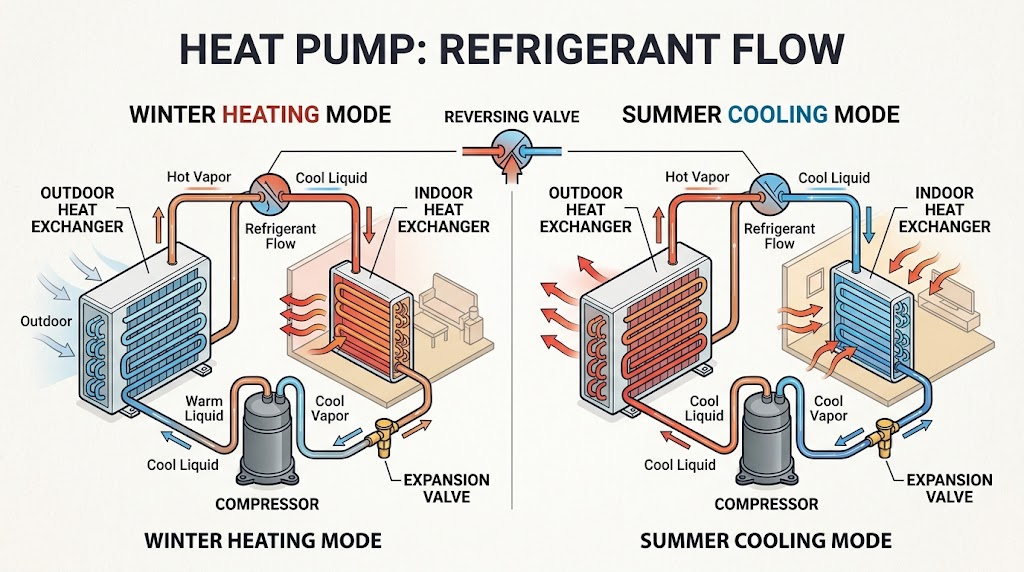
A heat pump is an electric heating and cooling system that moves heat rather than creating it by burning fuel. During winter, it extracts thermal energy from outdoor air even when temperatures fall well below freezing and delivers it inside.
Read Also: How to Lower Your AC Bill: 15 Fixes That Actually Work
During summer, the cycle reverses, pulling heat out of your indoor air and releasing it outdoors, functioning as an air conditioner.
Inside the outdoor cabinet sits a compressor that pressurizes refrigerant, a specialized fluid that absorbs and releases heat as it circulates through indoor and outdoor coils.
The system uses a heat exchanger to transfer heat between air streams without mixing them.
Because it transfers existing heat rather than generating it entirely from electricity, a well-installed heat pump can deliver multiple units of heating per unit of electricity consumed.
Efficiency is described by the COP, or coefficient of performance. A COP of 3.0 means the system delivers three parts of heat for every one part of electricity.
Seasonal heating performance is summarized by HSPF2 (Heating Seasonal Performance Factor 2), while cooling efficiency uses SEER2 (Seasonal Energy Efficiency Ratio 2).
These numbers help compare equipment, though real-world results depend on installation quality, climate, and maintenance.
Understanding this process explains why the heat pump installation cost includes not just a box outside, but a matched indoor air handler or ductless head, refrigerant lines, electrical connections, controls, and often new or modified ductwork.
Read Also: How to Read Your Electric Bill: kWh, Delivery Charges, and Rates Explained
Heat Pump Types and Their Typical Costs
Not all heat pumps use ducts, and not all are sized for the same climate. Choosing the right category is the first step toward an accurate budget.
Central Ducted Air-Source Heat Pump
This is the most common whole-house option for homes with existing forced-air ducts. The outdoor unit connects to an indoor air handler that distributes conditioned air through ducts. It replaces both a furnace and a central air conditioner.
Read Also: How to Lower Your Electric Bill: 35 Proven Ways (Room-by-Room Checklist)
Installed price ranges often fall between $6,000 and $15,000 or more. Factors pushing costs higher include cold-climate variable-speed equipment, larger capacities, duct repairs, new refrigerant lines, electrical upgrades, and difficult access.
Ductless Mini-Split Heat Pump
A ductless mini split uses an outdoor compressor connected to one or more indoor wall-mounted heads via refrigerant tubing and electrical wiring. No ducts are needed. This makes it useful for additions, older homes with no ducts, or rooms that need independent temperature control.
The ductless mini split cost for a single indoor zone may start in the $3,000 to $5,500 range installed, though prices vary by brand, efficiency, and whether the installer must run new electrical lines. Multi-zone systems serving an entire home can reach $8,000 to $22,000 depending on the number of heads, line-set lengths, and electrical requirements.
Because each indoor head serves a specific zone, you can heat or cool only the spaces you use. However, very cold climates may reduce headroom, and some models require significant wall space. Always verify that the outdoor unit is sized for the total connected capacity.
Cold-Climate Air-Source Heat Pump
These units include enhanced compressors, controls, and refrigerant management designed for low outdoor temperatures. If you live in an area where winter temperatures regularly fall near or below 5°F, this category deserves serious consideration.
Because of improved components and sometimes larger compressors, installed prices may be similar to or slightly above standard central systems—often in the $7,000 to $16,000 range.
Geothermal Heat Pump
A geothermal system uses ground loops to exchange heat with stable underground temperatures. It can be extremely efficient, but installation requires ground access and excavation or drilling.
Installed costs commonly range from $15,000 to $40,000 or more. For many homeowners, the upfront expense is substantial, though operating costs can be low and equipment life can be long.
Heat Pump Replacement Cost vs. New Installation
If you are replacing an existing heat pump with a similar unit, the heat pump replacement cost is usually lower than a new installation because refrigerant lines, electrical connections, and often duct connections are already present. A straightforward replacement might fall in the $4,000 to $9,000 range depending on capacity and efficiency.
Converting from a gas furnace to a heat pump is different. You may need new indoor equipment, electrical service adjustments, refrigerant lines, and sometimes duct modifications. If your existing central air conditioner is also aging, combining both into one heat pump can make the economics more favorable because you avoid a separate AC purchase.
If your air conditioner is relatively new and working, replacing only a failed furnace may be less expensive than a full conversion—at least upfront. Consider both the installation premium and the expected operating cost over your ownership period.
Comparison of System Types
| System Type | Approximate Installed Range | Best For | Notes |
|---|---|---|---|
| Central ducted air-source | $6,000 – $15,000+ | Homes with ducts; whole-house heating/cooling | Replaces furnace and AC |
| Ductless single-zone | $3,000 – $5,500 | Additions, no ducts, targeted comfort | Requires electrical circuit; check low-temp specs |
| Ductless multi-zone | $8,000 – $22,000 | Whole home without ducts | More heads = higher cost; verify outdoor capacity |
| Cold-climate air-source | $7,000 – $16,000+ | Cold northern regions | Check heating capacity at local design temperature |
| Geothermal | $15,000 – $40,000+ | Long-term owners; good yard access | High installation; low operating; long life |
These are broad planning ranges, not guaranteed quotes. Always request itemized, local estimates.
How Heat Pump Installation Cost Breaks Down
A quote should clearly separate the pieces that contribute to the total heat pump installation cost:
- Equipment: Outdoor unit, indoor air handler or ductless heads, controls, mounting hardware.
- Refrigerant lines and insulation: Tubing between indoor and outdoor units, often run inside or outside the home.
- Electrical work: New circuit, breaker, disconnect, and sometimes panel upgrades.
- Duct modifications: Sealing, resizing, or adding returns if airflow is poor.
- Permits and inspections: Often required for electrical and HVAC equipment.
- Labor: Installation, commissioning, refrigerant charging, and testing.
A licensed HVAC technician must handle refrigerant, which is a regulated substance. Do not attempt refrigerant work yourself. If the installation requires a new 240-volt circuit or a panel upgrade, hire a licensed electrician.
Also ask whether the quote includes startup and commissioning, which verifies refrigerant charge, airflow, and thermostat programming.
Heat Pump Sizing Basics
Over-sizing is one of the most expensive mistakes a homeowner can make. A heat pump that is too large for the home cools quickly but may not run long enough to remove humidity properly, leading to clammy comfort and unnecessary cycling. An undersized unit may run continuously yet struggle to keep up during extreme weather.
The proper method is a Manual J load calculation, which considers:
- Square footage and ceiling height
- Insulation levels (R-value) in walls, attic, and floors
- Window size, orientation, and glazing type
- Air leakage and infiltration rates
- Local climate design temperatures
- Internal heat gains from appliances and occupants
A contractor should provide the heat loss and heat gain numbers for your home. If a salesperson only asks for your square footage and picks a unit, ask for a written load calculation.
The right size is not necessarily the smallest available. It should match your calculated heating and cooling loads with appropriate reserve capacity for very cold or very hot days.
Heat Pump Rebates and Incentives
Current rebate and incentive rules are important, and they changed recently.
Federal residential energy tax credits under Internal Revenue Code Sections 25C and 25D ended for expenditures made after December 31, 2025. As of October 2026, those specific federal tax credits are no longer available for new installations.
That does not mean all incentives disappeared. Many states, utilities, and air-quality districts continue to offer rebates, low-interest loans, or time-of-use programs for efficient heat pumps, especially in regions with air-quality or electrification goals.
Programs vary by state and change often; check current eligibility before making any financial decision.
Useful resources include:
- ENERGY STAR Rebate Finder
- DSIRE Incentive Database
- Your state energy office
- Your local electric or gas utility
Some utilities offer rebates for equipment that meets specific efficiency standards, or for whole-home projects that include insulation and air sealing. Others provide demand-response incentives that can lower monthly bills if your system participates in grid programs.
When comparing quotes, ask whether any confirmed rebate is deducted from your price, applied after installation, or handled separately by you. Read the fine print.
Realistic Costs & Savings: A Worked Example
To understand heat pump payback period, you need to compare installation premiums against expected operating savings. The example below shows how to structure the math with your own numbers.
Assumptions for This Example
- Home: 2,000 sq ft, mixed climate
- Annual space-heating demand: 30,000,000 Btu (approximate; your home may differ)
- Electricity rate: $0.16 per kWh (use your actual variable supply/delivery rate from your bill)
- Heat pump seasonal COP: 2.8
- Alternative system: 95% AFUE gas furnace + separate central AC
- Gas price: $1.30 per therm
- Installed heat pump: $9,500 (includes cooling)
- Installed furnace + AC: $9,000
- Net installation premium for heat pump: $500 (in this case, because AC is included)
These figures are hypothetical examples, not national averages or predictions for your property.
Step 1: Calculate Annual Heating Energy Use
Formula:
kWh needed = Annual heating demand (Btu) ÷ (3,412 Btu per kWh × seasonal COP)
For our example:
30,000,000 ÷ (3,412 × 2.8) = 30,000,000 ÷ 9,553.6 ≈ 3,140 kWh
Annual heating cost at $0.16/kWh:
3,140 × $0.16 = approximately $502 per year
Step 2: Calculate Alternative Gas Furnace Heating Cost
Formula:
Therms needed = Annual heating demand (Btu) ÷ (100,000 Btu per therm × AFUE)
30,000,000 ÷ (100,000 × 0.95) = 30,000,000 ÷ 95,000 ≈ 316 therms
Annual heating cost at $1.30/therm:
316 × $1.30 = approximately $411 per year
In this particular rate environment, the heat pump costs about $90 more per year for heating alone. However, the heat pump also provides central air conditioning, which the furnace does not.
Step 3: Factor in Cooling and Installation Differences
If replacing both a failing furnace and aging AC, a combined heat pump may avoid a separate AC cost of roughly $2,500 or more. If the installation premium is $500 instead of $2,500, the effective install cost may actually be lower.
A simple payback formula:
Payback (years) = (Heat Pump Installed Cost − Alternative Installed Cost) ÷ Annual Operating Savings
If the heat pump saves $200 per year in combined heating and cooling operation and costs $1,000 more to install, the simple payback is approximately 5 years. If savings are $400 per year, payback may be closer to 2.5 years.
But if your local electricity is expensive and gas is cheap, operating savings may be minimal. The only way to know is to run your own numbers.
How to Plug in Your Own Utility Rate
- Find a recent electric bill.
- Divide total variable electricity charges (supply + delivery, excluding fixed monthly customer charges if you want incremental costs) by total kWh used.
- Use that rate in the formula above.
- Repeat for natural gas using therms.
- Request a contractor’s estimate of your home’s approximate annual heating and cooling load.
If you are comparing only heating, remember that heat pumps provide cooling at essentially no extra equipment cost beyond the heat pump itself, which can change the calculation when a separate AC replacement is needed.
Climate and Region Notes
Your climate shapes both performance and economics.
Hot-Humid South
In much of the Southeast and Gulf Coast, cooling dominates household energy use. A heat pump can be a practical whole-house choice because it handles both seasons. Focus on humidity control: oversized units cool quickly but may not remove moisture effectively. Variable-speed equipment can help maintain longer, lower-output cycles.
Cold North and Upper Midwest
In northern states, heating loads are substantial. Modern cold-climate heat pumps can perform well below freezing, but you must verify heating capacity at low temperatures. Ask contractors to confirm equipment output at your local winter design temperature—often 5°F or lower in the Upper Midwest.
If electricity rates are high relative to local natural gas, a dual-fuel configuration (heat pump plus gas backup) may make economic sense, but installation costs rise.
Dry West and Mountain Regions
The Intermountain West sees large daily temperature swings. Heat pumps work well during mild conditions but need careful sizing for cold nights. Dust and wildfire smoke can clog outdoor coils; plan for regular cleaning and proper filtration.
Pacific Northwest
Coastal areas have relatively mild winters, making heat pumps well-suited. Inland and high-elevation areas experience colder conditions, so check low-temperature capacity closely.
For all climates, the building envelope matters more than equipment brand. Improving insulation and reducing air leaks lowers the heating load and allows smaller, less expensive equipment.
DIY-Safe Steps Before You Install
You can prepare your home safely without touching refrigerant, gas lines, or electrical panels.
- Gather 12 months of utility bills. Note total electricity and gas use, seasonal patterns, and your effective per-kWh and per-therm rates.
- Check your electrical panel. Determine whether there is capacity for a new 240V circuit. If not, note that a licensed electrician must evaluate panel upgrades—do not open the panel yourself.
- Inspect accessible ducts. Look for disconnected sections in attics, crawl spaces, or basements. Seal obvious leaks with UL-rated foil tape, not duct tape.
- Measure outdoor space. Heat pumps need several feet of clearance around the outdoor unit and overhead space for airflow. Confirm that the proposed location meets manufacturer requirements.
- Change filters and clean vents. Good airflow supports accurate load calculations and avoids misleading measurements during contractor visits.
- Document your current temperature complaints. Note which rooms are too hot, too cold, or humid. This helps size equipment and design zoning.
For internal link context, our related guide, How to Lower Your Heating Bill Without Replacing Your HVAC System, covers insulation, thermostat settings, and air-sealing improvements that can reduce your heating load.
Options for Renters
Most renters cannot replace central heating or install new outdoor equipment without the property owner’s approval. However, there are practical ways to improve comfort and reduce unnecessary energy use.
- Request maintenance: If a heat pump or furnace is performing poorly, report it. Poor airflow, frozen coils, or malfunctioning defrost cycles are maintenance issues.
- Use programmable or smart thermostats if permitted: Some landlords allow thermostat swaps that can reduce heating and cooling waste.
- Weatherstrip doors and windows: Removable weatherstripping and draft stoppers can reduce heat loss without altering the building.
- Keep vents clear: Blocking supply or return vents can create temperature imbalances and force equipment to work harder.
- Consider portable options cautiously: Some portable heat pumps provide both heating and cooling for a single room. Review manufacturer specifications, especially low-temperature heating performance.
- Space heater safety: If using portable electric heaters, keep them at least 3 feet from combustible materials, plug them directly into a wall outlet—not an extension cord or power strip—never leave them operating unattended, and never use them while sleeping. Space heaters can cause fires and should never be used to warm an entire home continuously.
If your building has inadequate heating, review local housing codes and contact your landlord or property manager promptly. Some jurisdictions require minimum temperatures during cold periods.
When to Call a Professional
Safety and compliance lines are clear.
Hire a licensed HVAC contractor when:
- Selecting, sizing, and installing a heat pump
- Performing refrigerant work, charging, or leak repair
- Evaluating duct design, airflow, or static pressure
- Assessing combustion venting (if converting from a fuel-burning system)
- Installing new indoor air handlers or ductless heads
Hire a licensed electrician when:
- Running new 240V circuits
- Upgrading electrical panels
- Installing disconnects or controls requiring wiring changes
Safety reminders:
- Refrigerant: It is illegal for unlicensed individuals to handle refrigerants in many contexts, and improper handling can damage equipment, void warranties, and harm the environment.
- Carbon monoxide: If you are removing or altering a gas furnace, ensure proper venting and combustion testing by a qualified professional. Install and test carbon monoxide alarms according to manufacturer instructions.
- Attic hazards: Do not enter attics with damaged flooring, exposed electrical, or insulation suspected to contain asbestos or rodent waste. Hire a professional for attic work.
- Moisture and ventilation: Improper installation can cause condensation or humidity issues. Ensure condensate lines drain properly and that indoor humidity stays in a healthy range.
Never attempt to open sealed electrical panels, modify gas piping, or handle refrigerants yourself.
Common Mistakes to Avoid
- Choosing based only on price. The lowest quote may omit ductwork, electrical, or proper commissioning. Compare itemized proposals.
- Skipping the load calculation. Square footage alone cannot determine the right system size.
- Ignoring low-temperature performance. A standard heat pump may lose capacity faster in cold weather than a cold-climate model.
- Assuming rebates are guaranteed. Check current status; they change.
- Oversizing “to be safe.” Higher capacity can reduce comfort and efficiency.
- Attempting DIY refrigerant or electrical work. This can be dangerous and violate warranties or regulations.
- Neglecting maintenance. Dirty filters, blocked outdoor coils, and uninspected refrigerant levels reduce performance.
- Ignoring the cooling side. If you need air conditioning, a heat pump can replace two systems with one.
Frequently Asked Questions
1. What is the average heat pump installation cost?
There is no single national average that applies everywhere. For planning, a central ducted replacement or conversion may fall between $6,000 and $15,000, while ductless installations vary widely by zone count. The best approach is to request three itemized quotes in your area.
2. Are ductless mini splits cheaper?
A ductless mini split cost can be lower than a full central system if you need only one or two zones. As zone count increases and line-set distances grow, multi-zone installations can become comparable to or more expensive than ducted options.
3. How much is a heat pump replacement cost?
If you are replacing an existing heat pump with a similar system, the heat pump replacement cost is often lower than a full new installation—sometimes in the $4,000 to $9,000 range—because outdoor and indoor connections may already exist. The final price depends on capacity, efficiency, and whether new refrigerant lines are needed.
4. How do I find heat pump rebates?
Programs vary by state and change often; check current eligibility. Start with ENERGY STAR Rebate Finder and DSIRE, then contact your state energy office and electric or gas utility.
5. What is heat pump payback period?
Heat pump payback period depends on your installation premium, operating savings, and whether cooling is needed. In some cases, if a heat pump replaces both a furnace and AC, the installation may not carry a premium at all, making payback immediate. In other cases, it may take several years to recover a higher upfront cost through lower combined billing.
6. How do I know if my home is ready for heat pump sizing?
Request a Manual J load calculation. It accounts for insulation, windows, infiltration, and climate—not just square footage.
7. Do heat pumps work in cold weather?
Yes. Modern cold-climate models operate at low outdoor temperatures, but heating capacity and efficiency decline. Verify the manufacturer’s performance at your local winter design temperature before selecting equipment.
8. Can renters install a heat pump?
Not usually the central kind without landlord approval. Renters can explore portable heat pump units, request maintenance, weatherstrip, and follow safe space-heater practices.
9. Is heat pump running cost lower than gas?
Not automatically. If your electricity rate is high and gas is inexpensive, operating costs may favor gas. Use the formula in this guide with your actual utility rates.
10. Should I replace a working furnace with a heat pump?
Only if there is a compelling reason, such as a failing AC that also needs replacement, significant incentives, or a clear long-term cost advantage. Replacing functioning equipment solely for efficiency may not provide favorable returns.
11. Do I need ductwork?
Ducted heat pumps require ducts. If you lack them, ductless mini splits are an alternative. Poor ducts can be repaired or sealed.
12. What’s the difference between HSPF2 and SEER2?
HSPF2 measures seasonal heating efficiency, while SEER2 measures seasonal cooling efficiency under updated federal testing conditions. Both help compare equipment, though real-world performance depends on installation and climate.
Conclusion
Understanding heat pump installation cost is not just about comparing price tags. It involves system type, sizing, climate, electrical readiness, installation quality, available rebates, and the total cost of heating and cooling over time.
Before committing:
- Request a Manual J load calculation from a qualified contractor.
- Confirm whether cooling is also needed.
- Check your actual electricity and gas rates from your bills.
- Compare at least three itemized quotes including equipment, labor, electrical, permits, and commissioning.
- Verify low-temperature performance if winters are cold.
- Check current rebate and incentive eligibility.
- Confirm that electrical and ductwork needs are clearly included.
No single system is best for every home. The right choice is one that is properly sized, installed by licensed professionals, maintained well, and matched to your climate and budget.
For related guidance within this site, see our comparison of heating systems in Heat Pump vs Furnace: Costs, Efficiency, and Which Is Right for Your Home.
Pingback: Space Heater Cost to Run: Real Calculations + Safer, Cheaper Alternatives – Energy Savings Perlon