Your electric bill arrives every month, but understanding exactly what you’re paying for isn’t always straightforward.
You might see charges for electricity supply, delivery, distribution, transmission, and fuel adjustments—all alongside a number labeled “kWh.” Even when your electricity use stays about the same, your total bill can change.
Learning how to read electric bill charges helps you understand where your money goes, recognize billing mistakes, compare electricity plans, and make smarter decisions about reducing energy costs.
This guide is for US homeowners and renters who want a clear explanation without complicated electrical terminology.
You’ll learn what each major charge means, how to calculate your actual electricity rate, why bills fluctuate, and which changes may genuinely reduce your costs.
We’ll also walk through a realistic $170 electric bill so you can follow the math using your own statement.
Quick Takeaways
- kWh (kilowatt-hour) measures how much electricity you use, not how quickly you use it.
- Your bill typically includes electricity supply charges, delivery charges, and sometimes taxes or additional fees.
- Your advertised electricity rate may be lower than your actual all-in cost per kWh.
- Fixed monthly charges generally remain even when you reduce electricity consumption.
- Your billing period, weather, and utility rate structure can affect monthly costs.
- Comparing total kWh—not just the dollar amount—is the best starting point for understanding bill changes.
- Smart thermostats, efficient appliances, and better insulation may reduce electricity consumption.
- Checking your meter readings, rate plan, and billing adjustments can help identify unexpected charges.
Table of Contents
- Understanding Your Electric Bill
- What Is kWh on an Electric Bill?
- Supply vs. Delivery Charges Explained
- Fixed Charges, Taxes, and Other Fees
- How to Calculate Your Electric Rate per kWh
- How to Read Your Electric Bill Step by Step
- Why Your Electric Bill Changes Every Month
- Understanding Different Electricity Rate Plans
- Realistic Costs & Savings
- Practical Ways to Lower Your Electric Bill
- Regional Differences in Electricity Bills
- Electric Bill Tips for Renters
- When to Call a Professional
- Common Mistakes to Avoid
- Frequently Asked Questions
Understanding Your Electric Bill
An electric bill is a statement showing how much electricity your household used during a billing period and how much your utility or electricity provider charges for that service.
Although bills look different across the United States, most contain similar information.
The Main Parts of an Electric Bill
| Bill Section | What It Means | Why It Matters |
|---|---|---|
| Account information | Your name, service address, and account number | Confirms the bill belongs to your household |
| Billing period | Dates covered by the statement | Helps explain differences between months |
| Electricity usage | Energy consumed in kilowatt-hours (kWh) | Shows how much electricity you used |
| Supply charges | Cost of producing or purchasing electricity | May vary with your electricity supplier or rate |
| Delivery charges | Cost of transporting electricity to your home | Often includes both fixed and usage-based fees |
| Customer charge | Fixed monthly account or service fee | Usually does not decrease with lower usage |
| Taxes and adjustments | Government charges and utility-approved adjustments | Can change your final total |
| Amount due | Total payment requested | May include previous balances or credits |
Some utilities combine several charges into one line.
Others provide detailed breakdowns covering generation, transmission, distribution, fuel costs, and regulatory adjustments.
Neither format necessarily means you’re paying more.
The important thing is understanding which charges depend on electricity consumption and which remain relatively fixed.
Why Your Total Bill Doesn’t Tell the Whole Story
Imagine two electric bills:
- January: $150 for 900 kWh
- February: $150 for 750 kWh
The bills cost the same, but February’s electricity usage was lower.
The effective cost per kWh increased.
That difference could result from higher electricity rates, fixed fees, seasonal pricing, or billing adjustments.
It could also reflect changes in the billing period.
This is why comparing monthly dollar amounts alone can be misleading.
To understand what’s happening, start with the measurement used on nearly every residential electricity statement: kWh.
What Is kWh on an Electric Bill?
A kilowatt-hour (kWh) is a unit of electrical energy.
It measures how much electricity a device consumes over time.
Understanding what is kWh is essential because electricity providers commonly use it to calculate consumption-based charges.
Kilowatts vs. Kilowatt-Hours
A kilowatt (kW) measures electrical power, or the rate at which electricity is used.
One kilowatt equals 1,000 watts.
A kilowatt-hour measures energy consumption.
For example:
A 1,000-watt electric heater operating for one hour consumes:
1,000 watts ÷ 1,000 × 1 hour = 1 kWh
If the same heater operates for five hours:
1 kW × 5 hours = 5 kWh
At an assumed electricity rate of $0.17 per kWh:
5 kWh × $0.17 = $0.85
That is the consumption-based electricity cost before any applicable additional charges.
How Much Electricity Do Household Devices Use?
The following examples are illustrations, not measured appliance performance.
| Device | Assumed Power | Daily Use | Estimated Daily kWh |
|---|---|---|---|
| LED light bulb | 10 watts | 5 hours | 0.05 |
| Laptop | 60 watts | 6 hours | 0.36 |
| Television | 100 watts | 4 hours | 0.40 |
| Portable electric heater | 1,500 watts | 4 hours | 6.00 |
| Window air conditioner | 900 watts | 6 hours | 5.40 |
| Electric clothes dryer | 3,000 watts | 1 hour | 3.00 |
Actual consumption varies with appliance settings, operating cycles, efficiency, and household conditions.
For example, an air conditioner may cycle on and off rather than draw its rated running power continuously.
Likewise, an electric dryer may use different amounts of power during different parts of its cycle.
Why HVAC Equipment Matters So Much
Heating, ventilation, and air conditioning (HVAC) equipment can account for a substantial portion of household energy consumption.
In warm weather, air conditioners may run for hours each day.
In cold weather, electric resistance heating can substantially increase electricity use.
Heat pumps operate differently.
Instead of generating most of their heat through electrical resistance, they move heat between indoor and outdoor air or another heat source.
This can make them more energy-efficient than conventional electric resistance heating under suitable conditions.
However, actual operating costs depend on equipment efficiency, local weather, electricity rates, and installation quality.
For additional context, see the Department of Energy’s guide to home heating systems.
Now that you understand how electricity consumption is measured, the next question is why your utility may charge several different prices for that electricity.
Supply vs. Delivery Charges Explained
One of the most confusing parts of a utility bill breakdown is the distinction between electricity supply and electricity delivery.
Both can contribute to your total bill, but they pay for different parts of the electricity system.
What Is an Electricity Supply Charge?
The electricity supply charge covers the cost of generating or purchasing the electricity your household consumes.
Electricity may come from sources such as:
- Natural gas power plants
- Nuclear power plants
- Hydroelectric facilities
- Wind turbines
- Solar facilities
- Other electricity generators
You are generally paying for electricity supplied through the grid, not for electricity from a particular power plant.
Depending on your state and utility, your supply rate may be fixed, variable, seasonal, or tied to another pricing structure.
What Is an Electricity Delivery Charge?
The electricity delivery charge generally covers the infrastructure and services needed to transport electricity to your property.
This can include:
- High-voltage transmission lines
- Local distribution lines
- Transformers
- Utility meters
- Grid maintenance
- Related customer service and system operations
Delivery charges may include both a fixed monthly component and a variable charge based on electricity usage.
That means using fewer kWh can sometimes reduce part of your delivery bill.
However, fixed delivery or customer charges may remain unchanged.
Example: Supply vs. Delivery Charge
Consider a household using 1,000 kWh in a month.
Assume the following illustrative rates:
| Charge | Rate | Monthly Cost |
|---|---|---|
| Electricity supply | $0.10/kWh | $100 |
| Electricity delivery | $0.05/kWh | $50 |
| Fixed customer charge | $15/month | $15 |
| Taxes and adjustments | Assumed total | $5 |
| Total | $170 |
The household’s total bill is $170.
However, the electricity supply portion is only $100.
This distinction matters when comparing electricity suppliers.
Can You Choose Your Electricity Supplier?
In some states, eligible residential customers can select a competitive electricity supplier.
The local utility typically continues delivering electricity and maintaining its distribution infrastructure.
In other states or utility territories, residential customers generally cannot choose an alternative supplier.
Electricity choice rules vary by location and sometimes by utility.
If supplier choice is available, compare the complete contract rather than focusing only on the advertised supply rate.
Check for monthly fees, variable-rate provisions, contract length, cancellation terms, and what happens when an introductory price expires.
The Federal Trade Commission provides consumer information about recognizing misleading offers and reviewing contracts.
Choosing a different supplier does not automatically eliminate delivery charges.
Fixed Charges, Taxes, and Other Fees
Not every dollar on your electric bill changes when you use less electricity.
Understanding fixed charges on electric bill statements helps explain why reducing consumption doesn’t always produce an equally large reduction in your total payment.
Monthly Customer Charges
Many utilities charge a basic monthly fee for maintaining your electric account and providing access to service.
It may appear as:
- Customer charge
- Basic service charge
- Monthly service fee
- Facilities charge
- Minimum charge
A fixed customer charge typically applies regardless of how many kWh you consume.
For example, if your utility charges $15 per month, reducing your usage from 1,000 kWh to 700 kWh generally does not remove that $15 fee.
Some utilities also have minimum-bill provisions.
These can affect how much your payment decreases when consumption is very low.
Fuel Adjustment Charges
Utilities may use fuel adjustment mechanisms to account for changes in the cost of fuels used to generate electricity or electricity purchased from other providers.
These charges may change periodically.
The exact calculation depends on utility regulations and the applicable rate schedule.
A fuel adjustment might increase or decrease your bill without a corresponding change in your household’s electricity use.
Transmission and Distribution Adjustments
Some utilities list transmission and distribution costs separately.
Others include these costs within larger delivery charges.
Additional adjustments may support utility programs, grid infrastructure, or costs approved by state regulators.
The names and calculations vary.
Taxes and Government Fees
Depending on your location, an electric bill may include applicable taxes or government-imposed fees.
Examples can include state or local utility taxes, municipal charges, or other assessments.
Not every jurisdiction applies the same charges.
Previous Balances and Credits
Your amount due may also include items unrelated to current electricity consumption.
Examples include:
- Unpaid balances from earlier bills
- Late-payment charges
- Deposits
- Payment-plan installments
- Utility rebates or account credits
- Corrections to previous estimated bills
If your bill suddenly increases, check these items before assuming your home used more electricity.
The next calculation helps separate actual electricity costs from other billing activity.
How to Calculate Your Electric Rate per kWh
Your electric rate per kWh tells you how much you pay for each unit of electricity.
However, there is an important difference between your utility’s energy rate and your effective all-in electricity cost.
Method 1: Calculate Your Supply Rate
If your bill lists electricity supply charges separately, use:
Supply rate = Supply charges ÷ Total kWh used
Example:
Supply charges: $100
Electricity used: 1,000 kWh
$100 ÷ 1,000 = $0.10/kWh
Your supply rate is 10 cents per kWh.
This calculation excludes delivery charges and other fees.
Method 2: Calculate Your Effective Electricity Cost
For a broader picture, divide your current electricity-service charges by the electricity consumed.
Effective rate = Current electricity charges ÷ Total kWh used
Using the earlier example:
Total current charges: $170
Electricity used: 1,000 kWh
$170 ÷ 1,000 = $0.17/kWh
Your effective electricity cost is 17 cents per kWh.
This includes the assumed supply, delivery, fixed fees, and taxes.
For the most useful comparison, exclude previous balances, late fees, deposits, and unrelated account adjustments.
Which Rate Should You Use for Savings Calculations?
This is where many homeowners make mistakes.
Your all-in effective rate is useful for understanding your overall electricity spending.
But it may not accurately represent how much money you save by using one fewer kWh.
For savings estimates, use the marginal electricity rate when possible.
The marginal rate is the amount your bill changes when you consume one additional kWh, assuming your rate tier, time period, and other conditions remain the same.
For a simple residential rate, this may include:
- Variable supply charges
- Variable delivery charges
- Other usage-based fees or taxes
It generally excludes fixed monthly fees.
For example, suppose your bill includes:
Supply: $0.10/kWh
Variable delivery: $0.05/kWh
Fixed customer charge: $15/month
Your marginal rate is approximately $0.15/kWh before any other variable charges.
If you save 100 kWh:
100 × $0.15 = $15 in estimated savings
Using the $0.17 effective rate would overestimate savings because the fixed customer charge remains.
Time-of-use pricing, tiered rates, and minimum bills can make the calculation more complicated.
How to Read Your Electric Bill Step by Step
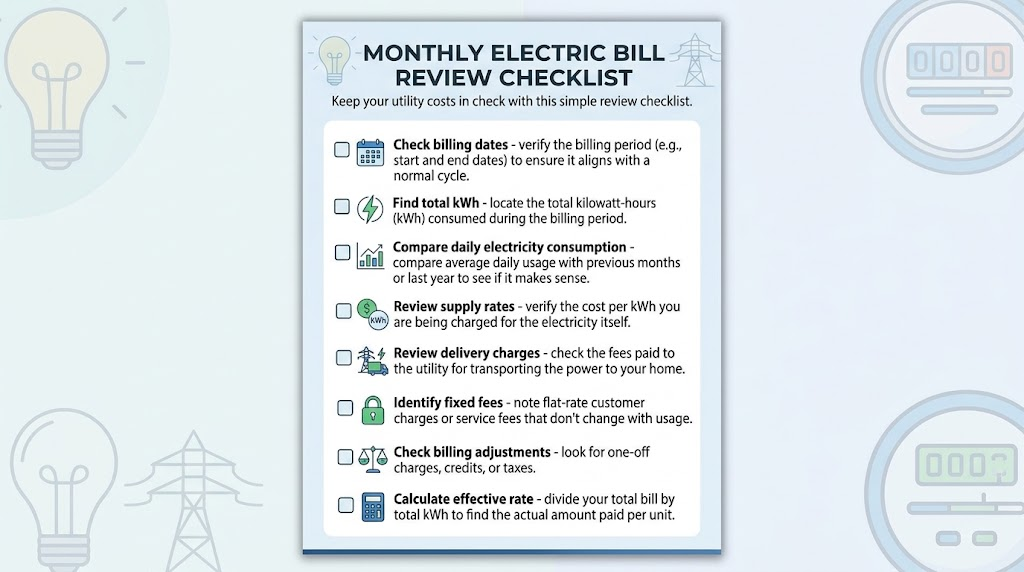
You don’t need special equipment to review your bill.
A recent statement, your previous bill, and a calculator are enough to get started.
Step-by-Step Bill Review
- Confirm the service address. Make sure the statement covers your home or apartment and the correct electric account.
- Check the billing dates. Count the number of days included. A 35-day statement can naturally show more electricity use than a 28-day statement.
- Find total electricity consumption. Look for a figure labeled “kWh used,” “energy usage,” or something similar.
- Check the meter readings. See whether the bill uses actual meter readings or estimated readings. Smart meters may automatically report consumption.
- Locate the supply charges. Identify the electricity supply rate and whether it is fixed, variable, or part of a more complex pricing schedule.
- Review delivery charges. Separate usage-based delivery costs from fixed service charges where possible.
- Check additional fees and adjustments. Look for fuel adjustments, taxes, credits, previous balances, and other account activity.
- Calculate your effective rate. Divide current electricity charges by total kWh consumed.
- Compare with previous months. Look at electricity use, billing days, and rates rather than comparing only the total dollar amount.
- Flag unexplained differences. If something still doesn’t make sense, contact your utility or electricity provider for clarification.
Electric Bill Review Checklist
| What to Check | What to Look For | Action |
|---|---|---|
| Billing dates | Unusually long or short billing period | Compare daily usage |
| Total kWh | Large change from previous months | Review weather and appliance use |
| Meter reading | Estimated rather than actual reading | Ask when readings will be reconciled |
| Supply rate | Increase or contract change | Review your rate plan |
| Delivery charges | New or higher variable fees | Check the applicable tariff |
| Fixed charges | Basic customer or service fee | Include in budget calculations |
| Taxes and adjustments | New or unexplained line items | Request an explanation |
| Previous balance | Unpaid amounts or corrections | Reconcile account history |
| Solar credits | Export credits or net billing adjustments | Compare with your solar agreement |
| Total amount due | Charges that don’t match current usage | Contact the billing department |
How to Compare Bills with Different Billing Periods
A useful calculation is average daily electricity consumption.
Daily kWh = Total monthly kWh ÷ Billing days
Example:
Bill A: 900 kWh over 30 days
900 ÷ 30 = 30 kWh per day
Bill B: 980 kWh over 35 days
980 ÷ 35 = 28 kWh per day
Although Bill B shows more total consumption, average daily electricity use actually decreased.
That distinction can prevent unnecessary concern about normal billing-period differences.
Once you know how to check your bill, you’re better equipped to identify the reasons costs change.
Why Your Electric Bill Changes Every Month
A higher electric bill doesn’t always mean something is wrong.
Electricity consumption and electricity prices can change independently.
Weather and Seasonal HVAC Use
Heating and cooling needs vary throughout the year.
During summer, high outdoor temperatures and humidity can increase air-conditioning runtime.
During winter, electrically heated homes may consume significantly more electricity.
Heat pumps can also use supplemental electric resistance heat under certain operating conditions, increasing consumption.
Even if your thermostat settings remain unchanged, unusually hot or cold weather can affect usage.
Changes in Household Activity
Electricity use can increase when:
- More people spend time at home
- Guests stay overnight
- Laundry loads increase
- Cooking habits change
- A new appliance is installed
- An electric vehicle is charged at home
Small changes add up, especially when they involve high-power equipment.
Aging or Poorly Performing Equipment
An air conditioner with a dirty filter or restricted airflow may operate less efficiently.
Likewise, a malfunctioning refrigerator, water heater, or heating system can consume more electricity than expected.
However, a higher bill alone does not prove that an appliance needs replacement.
Start with basic maintenance and usage comparisons before making an expensive decision.
For more information, see our related guide: Why Is My Electric Bill So High? Common Causes and Fixes.
Rate Changes
Your utility may adjust rates due to approved changes in operating costs, fuel prices, or other factors.
If you’re enrolled with a competitive electricity supplier, your contract terms may also affect pricing.
Always check both consumption and the applicable rate when investigating an increase.
Estimated Meter Readings
Some bills use estimated consumption when an actual meter reading is unavailable.
Later bills may contain adjustments when actual readings become available.
This can produce a sudden increase or decrease that doesn’t reflect electricity used entirely within that billing period.
Your utility can explain how the adjustment was calculated.
Understanding Different Electricity Rate Plans
Not every household pays the same electricity price at every hour or consumption level.
Knowing your rate structure helps you decide whether changing when you use electricity could affect your bill.
Flat Electricity Rates
A flat-rate plan generally charges the same energy price per kWh regardless of the time of day.
However, fixed fees and adjustments may still apply.
This structure is relatively easy to understand.
Your usage-based cost rises approximately in proportion to electricity consumption.
Tiered Electricity Rates
Tiered pricing uses different rates for different amounts of electricity consumption.
For example, a hypothetical plan might charge:
- First 500 kWh: $0.12/kWh
- Additional consumption: $0.18/kWh
At 800 kWh:
500 × $0.12 = $60
300 × $0.18 = $54
Total energy charge = $114
Delivery charges and other fees may apply separately.
Some utilities use seasonal or baseline allowances that affect tier calculations.
Time-of-Use Rates
Time-of-use (TOU) pricing charges different electricity rates during different periods.
Higher-priced periods often coincide with times when electricity demand is greater.
For example, a hypothetical plan might charge:
| Pricing Period | Example Rate |
|---|---|
| Off-peak | $0.12/kWh |
| Peak | $0.25/kWh |
These are illustrative prices, not national averages or utility quotes.
Under this type of plan, running a dishwasher or charging an electric vehicle during off-peak hours may cost less.
However, actual savings depend on how much electricity you can shift and whether the plan has higher fixed fees or other conditions.
Demand Charges
Some residential rate plans include demand charges.
A demand charge is based on a customer’s highest measured power use, usually expressed in kilowatts, during a specified interval.
Unlike kWh charges, which measure energy over time, demand charges measure how much power is drawn during a relatively short period.
These charges are more common for commercial customers but also appear in some residential tariffs.
If your bill includes one, ask your utility how the demand interval is calculated.
How to Compare Plans
Compare annual estimated costs using your own consumption history.
Look beyond the headline rate.
Consider seasonal prices, peak-hour definitions, fixed fees, contract terms, and whether your household can realistically change electricity-use patterns.
A plan with a lower advertised rate isn’t necessarily cheaper for your home.
Realistic Costs & Savings
Understanding electricity costs becomes easier when you work through a complete example.
The following calculations show how household consumption, electricity rates, and efficiency improvements affect a bill.
Example Household
Assume a household with these characteristics:
| Factor | Assumption |
|---|---|
| Home size | 2,000 sq ft |
| Climate | Mixed heating and cooling climate |
| Monthly electricity use | 1,000 kWh |
| Electricity supply rate | $0.10/kWh |
| Variable delivery rate | $0.05/kWh |
| Fixed monthly charge | $15 |
| Taxes and adjustments | $5 |
| Total monthly bill | $170 |
These are illustrative assumptions, not national averages.
Actual household electricity consumption depends on climate, heating fuel, occupants, building efficiency, and appliance use.
Calculate the Monthly Bill
Supply:
1,000 kWh × $0.10 = $100
Delivery:
1,000 kWh × $0.05 = $50
Fixed monthly charge:
$15
Taxes and adjustments:
$5
Total:
$100 + $50 + $15 + $5 = $170
The effective rate is:
$170 ÷ 1,000 kWh = $0.17/kWh
But the assumed marginal rate is:
$0.10 + $0.05 = $0.15/kWh
This distinction matters when estimating savings.
What Happens If Electricity Use Falls by 10%?
Suppose the household reduces consumption from 1,000 kWh to 900 kWh.
That’s a reduction of 100 kWh.
At the assumed marginal rate:
100 × $0.15 = $15 saved
The new bill would be approximately:
$170 − $15 = $155
This calculation assumes fixed charges and the $5 adjustment remain unchanged.
It also assumes a simple rate structure without minimum-bill complications.
Potential Savings at Different Usage Reductions
| Monthly kWh Reduction | Savings at $0.12/kWh | Savings at $0.15/kWh | Savings at $0.25/kWh |
|---|---|---|---|
| 25 kWh | $3 | $3.75 | $6.25 |
| 50 kWh | $6 | $7.50 | $12.50 |
| 100 kWh | $12 | $15 | $25 |
| 150 kWh | $18 | $22.50 | $37.50 |
| 200 kWh | $24 | $30 | $50 |
These figures illustrate possible savings under constant marginal rates.
They are not predictions of what a particular upgrade or behavioral change will achieve.
Actual savings depend on the electricity reduction achieved and your utility’s rate structure.
How to Use Your Own Electricity Rate
Start with your latest electric bill.
Find the per-kWh supply charge and any usage-based delivery charges.
Add those rates together.
For example:
Supply: $0.13/kWh
Variable delivery: $0.07/kWh
Estimated marginal rate: $0.20/kWh
If you reduce consumption by 75 kWh:
75 × $0.20 = $15
For tiered or time-of-use plans, calculate savings using the rates that apply to the electricity you’re actually avoiding.
If your utility provides an online rate calculator, that may produce a more accurate estimate.
How Much Can Efficiency Improvements Really Save?
Savings vary substantially by home.
An LED lighting upgrade may reduce lighting electricity consumption.
A smart thermostat may reduce heating and cooling energy use when it successfully limits unnecessary equipment operation.
Air sealing and insulation improvements may reduce heating and cooling loads, particularly in homes with significant air leakage or insufficient insulation.
But a home that is already efficient may have less room for improvement.
Major upgrades should be evaluated using realistic energy estimates and installation costs.
The Department of Energy’s Energy Saver program provides guidance on evaluating household efficiency opportunities.
Practical Ways to Lower Your Electric Bill
After learning how to read electric bill charges, the next step is identifying changes that reduce the electricity you purchase—or, where possible, its cost.
Not every improvement requires buying new equipment.
Start with Heating and Cooling
Heating and cooling are often among the largest household energy uses.
Begin with relatively simple actions.
Check your HVAC filter according to manufacturer recommendations.
Keep supply and return vents unobstructed.
Use thermostat settings that balance comfort and energy consumption.
If your home is frequently unoccupied, an appropriate thermostat schedule may reduce unnecessary heating or cooling.
A smart thermostat can make scheduling easier and may provide helpful usage information.
However, compatibility matters.
Some heating systems, including certain heat pumps, require specific thermostat controls to operate efficiently.
For a deeper explanation, see Do Smart Thermostats Save Money? Costs and Realistic Savings.
Reduce Unnecessary Appliance Consumption
Older appliances can sometimes use substantially more electricity than efficient replacements.
However, replacing a functioning appliance solely for energy savings isn’t always cost-effective.
Before buying, compare the appliance’s estimated annual energy consumption and purchase price.
ENERGY STAR-certified models meet energy-efficiency criteria for their product categories.
You can also reduce electricity use by:
- Washing full laundry loads when practical
- Using appropriate cold-water wash settings
- Cleaning dryer lint filters after each load
- Avoiding unnecessary heated-dry dishwasher cycles
- Turning off unused lighting
- Using suitable LED bulbs
These actions may produce modest savings individually, but they can contribute to lower overall consumption.
Check Electric Water Heating
Electric water heaters can be significant electricity users.
Hot-water consumption depends on household size, shower duration, laundry habits, and equipment efficiency.
A heat pump water heater uses electricity to move heat into stored water rather than relying entirely on conventional electric resistance heating.
It can reduce electricity consumption under suitable conditions.
However, installation location, airflow, noise, climate, hot-water demand, and upfront cost all matter.
A qualified installer can assess whether the equipment is appropriate.
Consider Air Sealing and Insulation
Air leaks can increase heating and cooling demand.
Common leakage locations include accessible areas around windows, doors, and some building penetrations.
Weatherstripping and suitable caulking can help address minor accessible gaps.
Larger building-envelope projects may require professional assessment.
Avoid sealing intentional ventilation openings or altering combustion-air provisions.
Attic insulation and air sealing may also improve comfort, but attic work involves potential fall, electrical, moisture, and ventilation hazards.
For major work, consider a qualified insulation contractor.
Evaluate Solar Carefully
Rooftop solar may reduce electricity purchased from the grid.
However, the economics depend on local electricity rates, solar production, installation costs, available incentives, and how your utility compensates exported electricity.
Solar customers may still pay fixed service charges and other utility fees.
If you’re considering solar, request multiple written quotes.
Compare equipment specifications, expected production, financing terms, warranties, and the utility’s current compensation rules.
Federal residential energy tax credits under Sections 25C and 25D ended for qualifying expenditures after December 31, 2025.
State, utility, and local incentive programs may still be available.
Check current programs through DSIRE, your state energy office, and your utility.
Programs vary by location and can change.
Regional Differences in Electricity Bills
Electric bills vary across the United States because of differences in climate, electricity generation, utility regulation, and rate structures.
Your neighbor in another state may have a very different bill even with similar electricity consumption.
Hot-Humid South
In states such as Florida, Louisiana, and parts of Texas, air conditioning and humidity control can drive substantial summer electricity use.
A home’s cooling demand depends on insulation, air leakage, shading, thermostat settings, and HVAC performance.
Humidity also matters.
An improperly sized or poorly functioning cooling system may struggle to maintain comfortable indoor humidity.
Focus on appropriate HVAC maintenance, moisture control, and building-envelope improvements.
Cold Northern States
In colder regions, winter electricity bills depend heavily on the heating system.
Homes heated with natural gas, oil, or propane may have lower winter electricity consumption than homes using electric resistance heating.
However, those households still pay for heating fuel separately.
Cold-climate heat pumps may offer efficient electric heating, but performance and operating costs depend on equipment and weather conditions.
Compare total household energy costs rather than electricity bills alone.
Dry Western States
In hot, dry areas, cooling demand can be significant during summer.
Some homes use evaporative coolers, which cool air through water evaporation.
These systems can be effective in suitable dry conditions but are generally less appropriate in humid climates.
Water availability, maintenance, and local operating conditions matter.
Some Western utilities also use tiered or time-of-use electricity rates.
This makes the timing of electricity consumption particularly important.
Hawaii, Alaska, and Other High-Cost Areas
Electricity prices can differ substantially in geographically isolated regions.
Local generation resources, fuel transportation, grid infrastructure, and other factors influence rates.
For current state-level comparisons, consult the US Energy Information Administration’s electricity data.
Because prices change, use current utility tariffs rather than relying on an old national average.
Electric Bill Tips for Renters
Renters can often reduce electricity consumption without making permanent changes to a property.
However, the first step is understanding how electricity is billed.
Check Whether You Have an Individual Meter
Some apartments have separate utility meters for each unit.
Others use master-metered systems or landlord-administered billing arrangements.
In certain properties, electricity costs may be allocated using a ratio utility billing system, sometimes called RUBS.
This arrangement can distribute utility costs using factors such as unit size or occupancy rather than measuring each apartment’s exact electricity use.
Billing rules vary by state and locality.
If charges are unclear, review your lease and request an explanation of the billing method.
Low-Cost Renter-Friendly Improvements
Several changes generally don’t require permanent modifications.
Examples include using LED bulbs in compatible fixtures, setting practical thermostat schedules, and operating appliances efficiently.
Removable draft-control products may help with certain doors or windows, provided they don’t block required ventilation or emergency exits.
Plug-in electricity monitors can measure consumption from compatible appliances.
Choose devices with appropriate electrical ratings and recognized safety certification.
Never overload outlets or use plug-in monitors with equipment that exceeds their rated capacity.
Ask About Maintenance Problems
If your apartment’s cooling system runs constantly, produces weak airflow, or fails to maintain reasonable comfort, report the issue to your landlord or property manager.
The same applies to malfunctioning appliances supplied with the unit.
Document the problem and follow the maintenance-request process in your lease.
Renters should not attempt HVAC electrical repairs or modifications.
Look for Utility Assistance and Efficiency Programs
Some utilities offer energy assessments, efficiency kits, appliance programs, or income-qualified assistance.
Availability and eligibility vary.
You can check your utility’s website, your state energy office, and the ENERGY STAR Rebate Finder.
Ask whether participation requires landlord approval before arranging property modifications.
When to Call a Professional
Most electric bill reviews are safe DIY tasks.
Reading statements, comparing rates, checking appliance labels, and adjusting normal thermostat settings generally don’t require professional assistance.
However, certain situations call for qualified help.
Call Your Utility or Electricity Provider When:
- Your bill contains unexplained fees.
- Meter readings appear incorrect.
- An estimated bill is unexpectedly high.
- Your rate plan changes without a clear explanation.
- You suspect a billing or account error.
- Solar credits or supplier charges don’t match your agreement.
Your utility can explain meter-reading procedures, billing adjustments, and applicable tariffs.
Hire a Licensed Electrician When:
- Breakers trip repeatedly.
- Outlets or switches become unusually hot.
- You notice buzzing, sparking, or burning smells.
- Lights flicker persistently without an obvious explanation.
- You suspect unsafe wiring or electrical equipment.
Do not open an electrical panel, remove utility meter equipment, or attempt electrical repairs.
If you notice smoke, active sparking, or signs of an electrical fire, keep clear of the hazard and contact emergency services.
Contact a Qualified HVAC Technician When:
- Your system runs unusually long without maintaining temperature.
- Heating or cooling performance suddenly declines.
- Equipment makes abnormal noises.
- You suspect a malfunctioning heat pump or air conditioner.
- Your electricity consumption increases sharply alongside HVAC problems.
Refrigerant handling, electrical repairs, and internal HVAC servicing should be performed by qualified professionals.
If your home uses fuel-burning equipment, maintain appropriate carbon monoxide alarms and follow manufacturer safety requirements.
Never use ovens, grills, or outdoor combustion appliances to heat indoor spaces.
Portable electric space heaters also require care: keep them away from combustible materials, follow manufacturer clearance instructions, and plug them directly into suitable wall outlets rather than extension cords or power strips.
Common Mistakes to Avoid
Understanding your electric bill is easier when you know which assumptions can lead to incorrect conclusions.
1. Comparing Only the Total Dollar Amount
A $200 bill doesn’t automatically mean you used more electricity than during a $170 month.
Compare kWh, billing days, and rates before drawing conclusions.
2. Confusing kW with kWh
Kilowatts measure power.
Kilowatt-hours measure energy consumed over time.
Electricity bills commonly use kWh to calculate residential consumption charges.
3. Assuming Delivery Charges Are Optional
Even if your state allows electricity supplier choice, the local utility generally continues providing delivery service.
Switching suppliers usually doesn’t eliminate distribution charges.
4. Using the All-In Rate for Every Savings Estimate
Your effective rate includes fixed costs that may remain unchanged when usage falls.
For simple savings calculations, use your applicable marginal rate instead.
5. Ignoring Billing Period Length
A longer billing period can produce a higher total even when daily electricity consumption decreases.
Compare average daily kWh when billing periods differ.
6. Assuming Every High Bill Means an Appliance Is Broken
Weather, household activity, pricing changes, and estimated readings can all affect your bill.
Investigate the likely causes before replacing equipment.
7. Choosing an Electricity Plan Based Only on Advertised Rates
A low introductory supply rate may not represent your total cost.
Read the contract and account for delivery charges, monthly fees, pricing changes, and cancellation terms.
8. Expecting Energy Upgrades to Eliminate Fixed Fees
Efficient appliances, insulation, and solar can reduce electricity consumption or grid purchases.
They generally don’t eliminate every fixed utility charge.
FAQ
1. What does kWh mean on my electric bill?
A kilowatt-hour (kWh) measures electrical energy consumption. One kWh equals using 1,000 watts of power for one hour. Utilities commonly multiply your electricity consumption by applicable per-kWh rates to calculate usage-based charges. Your bill may also include fixed fees, taxes, and adjustments that are not directly proportional to kWh consumption.
2. How do I know how much I’m paying per kWh?
Divide your current electricity-service charges by the total kWh used to calculate your effective rate. For example, a $180 current electricity bill covering 1,000 kWh produces an effective rate of $0.18/kWh. For estimating savings, identify the variable supply and delivery rates separately because fixed monthly charges usually remain even when consumption falls.
3. What is the difference between supply and delivery charges?
Supply charges generally cover the cost of generating or purchasing electricity. Delivery charges cover transporting electricity through transmission and distribution infrastructure to your property, along with certain related services. Depending on your utility, delivery charges may include both fixed and usage-based components. Some states allow customers to choose electricity suppliers, but local utility delivery charges typically still apply.
4. Why is my delivery charge higher than my supply charge?
Delivery charges reflect infrastructure, maintenance, system operations, and other costs included in your utility’s approved rate structure. In some locations, these charges can exceed electricity supply costs. The comparison also depends on whether fixed customer fees are included in delivery. Review the individual line items and your utility’s rate schedule to understand the difference.
5. Is 1,000 kWh a month a lot of electricity?
It depends on your home, climate, heating system, and household size. A 1,000-kWh month may be reasonable for one household and unusually high for another. Electrically heated homes, large air-conditioning loads, and electric vehicle charging can increase usage. Compare your consumption with previous months and similar seasons rather than relying on one universal benchmark.
6. Why did my electric bill go up when I used less electricity?
Your bill can increase even when kWh consumption decreases if electricity rates, fixed charges, taxes, or adjustments rise. Previous balances or corrections to estimated meter readings can also affect the amount due. Check your current usage, applicable rates, billing dates, and account adjustments to identify the cause.
7. What is a fixed customer charge on an electric bill?
A fixed customer charge is a recurring fee associated with maintaining electric service and your utility account. It may cover certain metering, billing, or service-related costs. Unlike per-kWh charges, it generally doesn’t decrease when you use less electricity. The amount and exact purpose depend on your utility’s approved rate schedule.
8. Can I avoid electricity delivery charges?
Usually, you cannot eliminate all delivery-related charges while remaining connected to the utility grid. Reducing electricity consumption may lower usage-based delivery charges, but fixed fees typically remain. If you have solar panels, your bill may still include customer charges and other utility fees. The exact rules depend on your utility and rate plan.
9. Is electricity cheaper at night?
Sometimes. Households enrolled in time-of-use electricity plans may pay lower rates during designated off-peak periods, which can include nighttime hours. However, not every utility uses this structure, and peak periods vary. Check your electricity rate schedule before changing appliance routines or assuming nighttime electricity is cheaper.
10. How can I tell if my electric meter reading is wrong?
Start by comparing the meter readings and dates printed on your bill. Check whether the readings are labeled actual or estimated. If your utility provides online interval-usage data, review it for unusual patterns. If the numbers still appear inconsistent, contact your utility and ask about its meter verification or dispute process. Do not remove or tamper with the meter.
11. Does unplugging appliances lower your electric bill?
Unplugging certain devices can reduce standby electricity consumption, sometimes called vampire or phantom power. However, the savings depend on how much power those devices draw while idle. Modern electronics vary considerably. A suitable plug-in electricity monitor can help identify worthwhile opportunities, but avoid disconnecting equipment that requires continuous operation.
12. Can solar panels make my electric bill zero?
Solar panels may substantially reduce electricity purchased from the grid, but they don’t necessarily eliminate your bill. Fixed customer fees, minimum charges, usage patterns, solar production, and utility compensation rules all matter. Some households also pay for electricity consumed when their panels aren’t producing enough power. Review your utility’s current solar billing rules before estimating financial benefits.
Conclusion: Your Electric Bill Doesn’t Have to Be Confusing
Once you understand kWh, supply charges, delivery charges, and fixed fees, your electric bill becomes much easier to interpret.
The most useful habit is comparing electricity consumption and rates—not just monthly payment amounts.
You can use this short checklist whenever a new statement arrives:
- Confirm the billing dates and service address.
- Find your total electricity use in kWh.
- Compare average daily consumption with previous bills.
- Identify supply, delivery, and fixed charges.
- Calculate your effective electricity rate.
- Check for unexpected fees or billing adjustments.
- Review seasonal heating and cooling consumption.
- Use your marginal rate when estimating potential savings.
If your bill increases unexpectedly, investigate the numbers before investing in new equipment.
Sometimes the answer is a rate adjustment or longer billing period. Other times, a maintenance issue or change in household energy use may explain the difference.
Understanding those details helps you make better decisions about electricity plans, efficiency improvements, and long-term household energy costs.
Pingback: Energy-Saving Myths: 12 Mistakes That Cost You Money (What Actually Works) – Energy Savings Perlon
Pingback: Best Thermostat Settings for Summer and Winter (Save Money, Stay Comfortable) – Energy Savings Perlon