If you’ve opened your electric bill and wondered, “Why is my electric bill so high?” you’re not alone. Whether your bill increased gradually or jumped unexpectedly, figuring out what changed can be frustrating.
The good news is that a higher bill doesn’t always mean something is wrong with your home’s electrical system. Sometimes the cause is seasonal weather, a change in electricity rates, or an appliance working harder than usual.
Other times, hidden energy waste, an inefficient heating or cooling system, or a billing adjustment may be responsible.
This guide explains 12 common reasons electric bills increase, how to identify the likely cause, and which fixes are worth trying first.
You’ll also learn how to read your electric bill, estimate potential savings, and recognize problems that need professional attention.
QUICK TAKEAWAYS
- Heating and cooling are often major contributors to household electricity use, especially during extreme temperatures.
- A sudden increase in your electric bill may come from higher electricity rates, increased usage, or billing adjustments.
- Compare electricity consumption in kilowatt-hours (kWh), not just the dollar amount.
- Water heaters, refrigerators, dryers, and electric heating equipment can contribute significantly to monthly costs.
- Air leaks, inadequate insulation, and thermostat settings can increase heating and cooling demand.
- Smart thermostats and plug-in electricity monitors can help identify some sources of energy waste.
- Renters can reduce electricity use without making permanent modifications.
- Start with free checks before paying for expensive equipment or home improvements.
Table of Contents
- How to Tell Why Your Electric Bill Increased
- 12 Common Reasons Your Electric Bill Is So High
- How to Check for Energy Waste at Home
- Why Electric Bills Increase in Summer and Winter
- Realistic Costs & Savings
- Which Energy-Saving Upgrades Are Worth Considering?
- What Renters Can Do About High Electric Bills
- When to Call a Professional
- Common Mistakes to Avoid
- Frequently Asked Questions
- Final Checklist
- Keep Reading
- Sources & Further Reading
How to Tell Why Your Electric Bill Increased
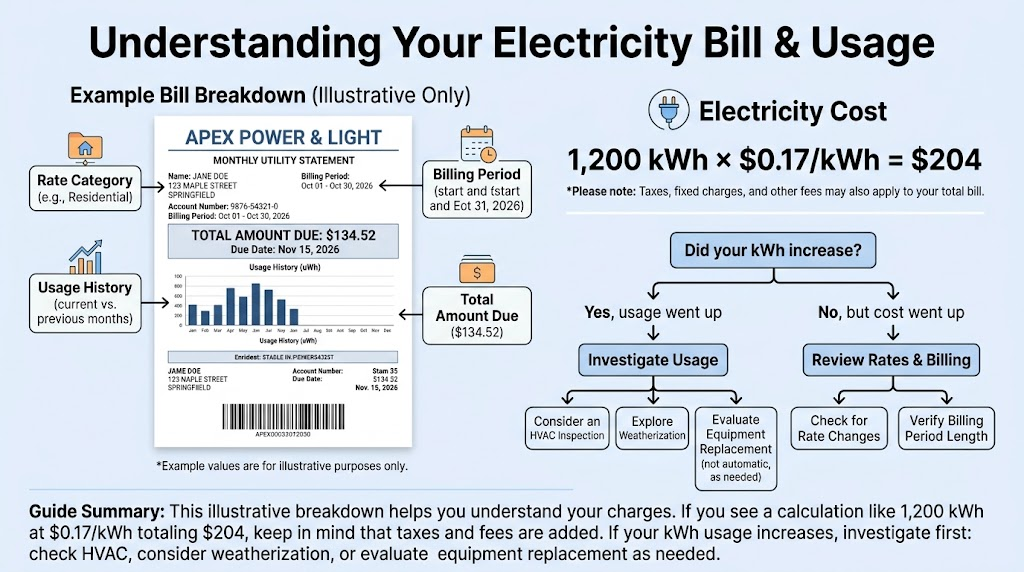
Before changing your thermostat or replacing an appliance, look at your electricity bill.
A bill can increase for several reasons, and identifying the right one helps you avoid spending money on unnecessary fixes.
Understand Kilowatt-Hours and Electricity Rates
Electricity consumption is measured in kilowatt-hours, abbreviated kWh.
One kWh represents using 1,000 watts of electricity for one hour.
For example:
- A 100-watt light bulb operating for 10 hours uses 1 kWh.
- A 1,500-watt space heater operating for one hour uses 1.5 kWh.
- A 2,000-watt appliance operating for five hours uses 10 kWh.
Your electricity supplier charges for the electricity you consume, although your bill may also include delivery charges, fixed fees, taxes, and other adjustments.
The basic calculation is:
Electricity cost = kWh consumed × electricity rate
Suppose your household uses 1,000 kWh during a billing period.
At $0.15 per kWh:
1,000 × $0.15 = $150
At $0.20 per kWh:
1,000 × $0.20 = $200
Your electricity usage hasn’t changed, but your energy charge increased by $50.
Actual bills may be more complicated because some utilities use tiered pricing, time-of-use rates, or separate delivery charges.
Compare These Four Numbers
When investigating a higher bill, check the following information.
| What to Check | What It Tells You | What to Do |
|---|---|---|
| Total kWh used | Whether electricity consumption increased | Compare with previous months |
| Electricity rate | Whether each kWh became more expensive | Review supply and delivery charges |
| Billing period | Whether the bill covers more days | Compare average daily usage |
| Meter reading | Whether usage was measured or estimated | Check for adjustments or corrections |
| Previous-year usage | Whether the increase is seasonal | Compare similar weather periods |
| Additional fees | Whether non-usage charges increased | Review the detailed bill |
One particularly useful number is your average daily electricity consumption.
Average daily kWh = Total kWh ÷ Number of billing days
For example:
A 30-day bill showing 900 kWh represents:
900 ÷ 30 = 30 kWh per day
A 35-day bill showing 1,050 kWh also represents:
1,050 ÷ 35 = 30 kWh per day
Your total usage appears higher, but your daily consumption is unchanged.
This distinction matters when investigating an unexpectedly expensive bill.
12 Common Reasons Your Electric Bill Is So High
The following causes cover many of the most common household electricity problems.
Some can be checked in minutes. Others may require a utility representative, HVAC technician, or licensed electrician.
1. Your Heating or Cooling System Is Working Harder
Heating and cooling can account for a substantial share of residential energy use.
According to the U.S. Department of Energy, space heating and cooling are among the largest energy expenses in a typical American home.
During unusually hot or cold weather, your HVAC system may run much longer to maintain the same indoor temperature.
For example, an air conditioner that normally operates four hours daily might run eight hours during a heat wave.
If it draws an average of 3 kW while operating:
Normal day:
3 kW × 4 hours = 12 kWh
Hot day:
3 kW × 8 hours = 24 kWh
At $0.17 per kWh, the difference is approximately $2.04 per day.
Over 30 days, that would equal about $61 in additional electricity charges.
These figures are illustrative. Actual HVAC electricity consumption depends on system capacity, efficiency, weather, and operating conditions.
What to do:
- Check whether your thermostat settings changed.
- Replace or clean HVAC filters according to manufacturer instructions.
- Keep supply and return vents unobstructed.
- Close windows and exterior doors while conditioning the home.
- Use ceiling fans for comfort when rooms are occupied.
A ceiling fan cools people through air movement. It does not lower the room’s actual air temperature.
If your HVAC system suddenly runs continuously without maintaining the set temperature, professional service may be necessary.
2. Your Electricity Rate Increased
Sometimes your electric bill rises even though you haven’t changed your habits.
Utilities may adjust rates because of fuel costs, generation expenses, transmission charges, or approved rate changes.
Customers with variable-rate electricity plans may experience additional price fluctuations.
If your electric bill doubled but your kWh consumption stayed similar, examine your rates before assuming an appliance is malfunctioning.
What to do:
Compare the effective cost of electricity across two bills.
Divide applicable electricity charges by the kWh consumed.
For example:
Previous bill:
$150 ÷ 1,000 kWh = $0.15/kWh
Current bill:
$200 ÷ 1,000 kWh = $0.20/kWh
This indicates an increase in your average electricity cost.
Your utility’s published rate schedule can help explain the change.
In states with retail electricity choice, you may also be able to compare electricity suppliers.
Read contracts carefully, including variable-rate terms, cancellation fees, introductory pricing, and contract expiration dates.
3. Your Air Conditioner Is Running Constantly
A high electric bill in summer often points toward air conditioning.
An AC system may run excessively because of:
- Dirty air filters
- Blocked airflow
- Poor insulation
- Air leaks
- Extreme outdoor temperatures
- An incorrectly sized system
- Equipment that needs maintenance
Long operating periods are not always a malfunction. Properly sized equipment may run for extended periods during very hot weather.
The warning sign is a noticeable change in performance or electricity consumption.
What to do:
First, inspect your thermostat settings and accessible air filter.
Next, make sure furniture, curtains, and rugs aren’t blocking vents.
Keep the outdoor unit clear of leaves and vegetation, following manufacturer clearance recommendations. Do not open electrical compartments or attempt refrigerant repairs.
If cooling performance remains poor, hire a qualified HVAC technician.
An inspection can determine whether airflow problems, equipment faults, or other conditions are increasing electricity consumption.
For more details, see our guide to why your AC runs constantly.
4. Your Electric Heater or Heat Pump Is Using More Power
A high electric bill in winter may result from electric resistance heating.
Electric resistance heaters convert electricity directly into heat. Examples include electric furnaces, baseboard heaters, and portable space heaters.
Heat pumps operate differently.
They move heat between indoor and outdoor environments rather than producing all their heat through electrical resistance.
Their efficiency is often described using the coefficient of performance, or COP.
A COP of 3 means the system delivers approximately three units of heat for each unit of electricity consumed under the specified operating conditions.
Actual performance varies with outdoor temperatures and equipment design.
Some heat pumps include supplemental electric resistance heating.
When supplemental heating operates frequently, electricity consumption can increase substantially.
What to do:
Check whether your thermostat displays an auxiliary heat or emergency heat indicator.
Auxiliary heat may be normal during cold weather or certain defrost cycles.
Emergency heat is generally intended for situations when the heat pump cannot operate normally.
Avoid selecting emergency heat unnecessarily.
If supplemental heating seems to operate constantly, have an HVAC technician inspect the system.
For electric furnaces and baseboard heating, improving insulation and reducing air leakage may help lower heating demand.
5. Your Home Has Air Leaks or Poor Insulation
Your heating and cooling equipment may be working correctly while your home loses conditioned air.
Common leakage locations include:
- Exterior doors
- Window frames
- Attic access openings
- Plumbing penetrations
- Recessed lighting assemblies
- Gaps around utility penetrations
Insulation also matters.
Insulation performance is commonly measured using R-value, which describes resistance to heat flow.
Higher R-values generally provide greater resistance to heat transfer, although recommended levels depend on climate, location, and existing insulation.
The Department of Energy provides climate-specific insulation guidance.
What to do:
Start with accessible gaps around doors and windows.
Weatherstripping and appropriate caulking can help reduce unwanted air leakage.
However, avoid sealing intentional ventilation openings, combustion-air supplies, or other components that require airflow.
Attic work deserves particular caution.
Attics may contain exposed wiring, inadequate walking surfaces, extreme temperatures, or potentially hazardous insulation materials.
For substantial insulation improvements, an energy auditor or insulation contractor can assess conditions and recommend appropriate work.
Learn more in our home insulation guide.
6. Your Water Heater Is Consuming More Electricity
Electric water heating can contribute significantly to household electricity consumption.
A traditional electric storage water heater uses resistance heating elements to warm water and maintain tank temperature.
Electricity consumption may increase when:
- More people use hot water.
- Showers become longer.
- Hot-water leaks develop.
- The tank temperature is set unnecessarily high.
- Equipment becomes less efficient or develops faults.
The Department of Energy identifies water heating as a major household energy expense.
What to do:
Check for dripping hot-water faucets and visible plumbing leaks.
Consider shorter showers and efficient showerheads.
DOE generally recommends a water heater temperature of 120°F for many households, while noting that some homes may need different settings because of health, appliance, or other requirements.
Follow manufacturer guidance and consider scalding and bacterial-growth risks when adjusting temperatures.
Don’t remove water heater covers or access electrical components.
If your water heater is leaking, making unusual noises, or failing to provide normal hot water, contact a qualified professional.
For an aging electric tank, a heat pump water heater may be worth comparing.
These systems transfer heat from surrounding air into water and can use considerably less electricity under suitable conditions.
However, installation requirements, climate, available space, and upfront costs matter.
7. An Older Refrigerator or Freezer Is Using Excess Electricity
Refrigerators operate throughout the day.
Although their compressors cycle on and off, inefficient operation can add to monthly energy use.
Possible causes include:
- Damaged door seals
- Dirty condenser coils
- Poor ventilation
- Incorrect temperature settings
- Aging components
- An extra refrigerator in a garage or basement
A second refrigerator can be easy to overlook because it operates continuously without much attention.
Garage refrigerators may consume additional electricity when exposed to high ambient temperatures.
What to do:
Check that refrigerator doors close completely.
Inspect seals for cracks or gaps.
Follow manufacturer instructions for cleaning accessible condenser coils.
ENERGY STAR recommends refrigerator temperatures around 35°F to 38°F and freezer temperatures around 0°F.
If you’re considering replacement, compare models using their EnergyGuide labels.
These labels provide estimated annual electricity consumption and operating costs based on standardized assumptions.
Your actual costs will depend on usage and electricity rates.
8. Laundry Equipment Is Running More Frequently
Electric clothes dryers can use substantial amounts of electricity because they generate heat.
If your household recently started washing more loads, drying heavier fabrics, or running repeated drying cycles, electricity use may increase.
Overloading a dryer can also interfere with proper airflow and drying.
What to do:
- Clean the lint filter before each load.
- Use appropriate moisture-sensing cycles when available.
- Avoid unnecessarily long drying cycles.
- Wash clothes in cold water when suitable.
- Air-dry items when practical.
A blocked dryer vent can increase drying time and create a fire hazard.
If clothes take much longer than normal to dry, arrange appropriate vent inspection and cleaning.
Do not ignore overheating, burning smells, or repeated dryer shutdowns.
When purchasing a replacement, compare conventional electric dryers with heat pump dryers.
Heat pump dryers generally use less electricity but may cost more upfront and have different drying times and maintenance requirements.
9. Devices Are Using Electricity While You’re Not Using Them
Some electronics continue drawing electricity while turned off or in standby mode.
This is sometimes called standby power or a phantom load.
Examples include televisions, gaming consoles, printers, cable boxes, entertainment systems, and computer equipment.
A single small standby load may have little impact.
Several devices operating continuously can add up over time.
For example, a combined 30-watt standby load operating continuously uses:
0.03 kW × 24 hours × 30 days = 21.6 kWh
At $0.17 per kWh:
21.6 × $0.17 = $3.67 per month
Actual standby consumption varies widely by device.
What to do:
Use a plug-in electricity monitor to measure compatible appliances.
Consider switching off unnecessary electronics at a power strip.
Smart plugs with energy monitoring can help track certain devices.
However, don’t disconnect equipment that needs continuous power for safety, security, medical use, or essential functions.
Also, avoid using ordinary smart plugs or power strips with high-wattage heaters or other equipment unless the manufacturer explicitly approves that application.
10. Your Electricity Use Changed Without You Noticing
Small changes in household routines can increase electricity consumption.
Examples include:
- Working from home more frequently
- Hosting additional household members
- Installing a hot tub
- Charging an electric vehicle
- Using a portable dehumidifier
- Running a pool pump longer
- Adding a second freezer
These changes aren’t necessarily wasteful.
They simply increase electricity demand.
An electric vehicle, for instance, shifts some transportation energy spending from gasoline to your electricity bill.
Suppose an EV adds 300 kWh to monthly household usage.
At $0.17 per kWh:
300 × $0.17 = $51
That is an additional electricity expense, but it doesn’t represent the vehicle’s total transportation cost.
What to do:
Review any equipment or routine changes during the last one to three months.
For large loads, estimate electricity consumption using equipment labels, manufacturer specifications, or monitoring tools.
If your utility offers hourly usage information, look for patterns corresponding to charging, pool operation, or other activities.
Some utilities offer time-of-use electricity plans with different prices depending on when electricity is consumed.
Moving flexible loads to lower-priced periods may reduce costs, but compare the entire rate schedule before switching.
11. Your Utility Estimated Your Meter Reading
Not every electricity bill is based on a newly collected meter reading.
Sometimes utilities estimate usage because they cannot obtain an actual reading.
An estimated bill may be higher or lower than your actual consumption.
When the utility later collects a reading, it may adjust the account.
This can create an unexpected increase or decrease.
What to do:
Look for wording such as:
- Estimated reading
- Actual reading
- Adjusted usage
- Billing correction
If your bill includes an unusual adjustment, contact your utility and request an explanation.
You can also ask whether your meter data and billing period are correct.
Do not open, modify, or interfere with utility metering equipment.
If you suspect a meter problem, request the utility’s approved testing or investigation process.
12. An Appliance or Electrical Component Is Malfunctioning
Occasionally, unusually high electricity consumption is caused by faulty equipment.
Examples include:
- A water heater with a control problem
- HVAC equipment operating abnormally
- A well pump running excessively
- A sump pump cycling frequently
- A refrigerator compressor running unusually long
- Electric heating equipment failing to regulate properly
A malfunction does not always produce obvious noise or visible damage.
However, unusual equipment behavior combined with a sudden usage increase deserves attention.
What to do:
Compare your utility’s daily or hourly electricity data with normal household activity.
Listen for equipment running unusually often.
Check accessible appliance displays for error messages.
Do not remove electrical covers, test live wiring, or attempt repairs inside an electrical panel.
If you notice burning odors, sparking, damaged wiring, or repeatedly tripping breakers, stop using the affected equipment and contact a licensed electrician.
How to Check for Energy Waste at Home
You don’t need expensive equipment to begin investigating high electricity consumption.
A systematic approach can help narrow down the likely cause.
Step-by-Step Home Electricity Audit
Step 1: Compare your latest bills.
Collect at least three recent electricity bills.
If possible, also find the bill from the same month last year.
Record total kWh, billing days, electricity rates, and total charges.
Step 2: Calculate average daily usage.
Divide each bill’s kWh by its number of billing days.
This removes distortions caused by different billing-period lengths.
Step 3: Review your utility’s online usage dashboard.
Many utilities provide daily or hourly electricity data.
Look for unusually high overnight usage or increases that coincide with heating, cooling, or appliance operation.
Step 4: Inspect obvious energy users.
Check your thermostat, water heater, refrigerator, laundry equipment, and any recently added devices.
Look for changes in operating schedules or performance.
Step 5: Measure suitable plug-in appliances.
A plug-in electricity monitor can measure electricity used by compatible devices.
Follow the monitor’s electrical rating and operating instructions.
Do not use these devices on hardwired equipment or unsuitable high-power appliances.
Step 6: Check for accessible air leaks.
Inspect doors and windows for drafts.
Make sure weatherstripping is intact and windows close properly.
Step 7: Track changes for two weeks.
Record daily electricity use where data is available.
Note weather conditions, thermostat settings, and major appliance use.
This can help identify patterns without relying on guesses.
Home Energy Waste Checklist
| Area | What to Look For | DIY Action | Professional Help Needed? |
|---|---|---|---|
| Thermostat | Unexpected settings | Review schedule | Usually no |
| HVAC filter | Visible dirt or blockage | Replace approved filter | Usually no |
| Doors | Drafts or damaged seals | Install weatherstripping | Sometimes |
| Windows | Gaps around accessible frames | Apply suitable caulk | Sometimes |
| Refrigerator | Poor door seal | Inspect and clean | For mechanical faults |
| Water heater | Visible leaks | Report or arrange repair | Often |
| Dryer | Longer drying times | Clean lint filter | For vent problems |
| Attic | Inadequate insulation | Visual inspection from safe access | Recommended for major work |
| Electrical system | Burning smell or repeated breaker trips | Stop using affected equipment | Yes |
| Utility meter | Unexpected readings | Contact utility | Utility handles testing |
For a more detailed assessment, consider a professional home energy audit.
An auditor may use diagnostic equipment to identify air leakage, insulation problems, and other energy-efficiency issues.
The Department of Energy recommends home energy assessments as a way to prioritize improvements.
Why Electric Bills Increase in Summer and Winter
Seasonal electricity use depends heavily on climate, heating fuel, equipment efficiency, and household habits.
The same home may have very different electricity patterns throughout the year.
Why Your Electric Bill Is High in Summer
In hot climates, air conditioning is often the main reason for increased summer electricity consumption.
High outdoor temperatures increase cooling demand.
Humidity adds another challenge.
In the hot-humid South, air conditioners must remove both heat and moisture to maintain comfort.
Dehumidifiers may also contribute to electricity use.
In the dry West and Southwest, extremely high daytime temperatures can keep cooling systems operating for long periods.
Summer actions worth trying:
- Use blinds or shades to reduce unwanted solar heat gain.
- Seal obvious gaps around conditioned spaces.
- Maintain HVAC filters and airflow.
- Use ceiling fans when rooms are occupied.
- Avoid unnecessary heat-producing activities during the hottest hours.
A programmable or smart thermostat may help reduce cooling use when the home is unoccupied.
However, savings depend on your schedule, equipment, climate, and existing thermostat habits.
Why Your Electric Bill Is High in Winter
Winter electricity bills can rise sharply in homes heated with electricity.
Resistance heating is especially sensitive to prolonged cold weather.
Heat pumps are generally more efficient than resistance heating, but their performance varies with temperature.
Some systems rely more heavily on supplemental heating during cold conditions.
In the cold North and Upper Midwest, insulation and air sealing may have a particularly strong effect on heating demand.
In milder regions, a cold snap can still cause a substantial increase because heating equipment operates more frequently than usual.
Winter actions worth trying:
- Check thermostat schedules.
- Replace dirty HVAC filters.
- Seal accessible drafts.
- Close fireplace dampers when appropriate and safe.
- Keep heating vents clear.
- Use window coverings to reduce nighttime heat loss.
If you have a heat pump, avoid large thermostat setbacks unless your equipment and controls are designed to manage them efficiently.
Large temperature increases can sometimes trigger supplemental resistance heating.
Regional Electricity Considerations
| Region | Common Electricity Drivers | Useful Priorities |
|---|---|---|
| Hot-humid South | Air conditioning, humidity control | HVAC maintenance, air sealing, moisture management |
| Desert Southwest | Extended cooling demand | Solar shading, insulation, efficient cooling |
| Cold North | Electric heating, heat pump backup | Attic insulation, air sealing, heating controls |
| Pacific Northwest | Electric heating, water heating | Heat pump performance, insulation |
| Coastal California | Cooling during heat events, rate structures | Time-of-use review, shading, efficient appliances |
| Mixed-climate regions | Both heating and cooling | Year-round weatherization |
Your utility’s rate structure can matter as much as the climate.
Some households face higher prices during peak electricity demand periods.
Others pay a fixed rate per kWh throughout the day.
Understanding both usage and pricing is essential.
Realistic Costs & Savings
Electricity-saving improvements should be evaluated using actual energy consumption and local electricity prices.
The following examples use transparent assumptions rather than guaranteed results.
Example Household
Assume a household has:
- A 2,000 sq ft home
- A mixed climate with hot summers and cool winters
- Electric heating and cooling
- Monthly electricity usage of 1,200 kWh
- An electricity rate of $0.17 per kWh
For simplicity, the examples exclude fixed utility fees and assume each kWh costs the same amount.
Actual utility bills may include additional charges.
Current Monthly Electricity Cost
Formula:
Monthly electricity cost = Monthly kWh × Electricity rate
Calculation:
1,200 kWh × $0.17 = $204
Estimated energy charges: $204 per month
Now suppose the household reduces monthly electricity use by 100 kWh.
100 × $0.17 = $17
New estimated energy charges:
1,100 × $0.17 = $187
This example produces a $17 reduction in monthly energy charges.
Actual savings depend on which equipment uses less electricity and how the utility calculates charges.
Example 1: Reducing Air Conditioner Runtime
Assume an air conditioner draws an average of 3 kW while operating.
If changes reduce operation by 30 minutes per day:
3 kW × 0.5 hours × 30 days = 45 kWh
At $0.17 per kWh:
45 × $0.17 = $7.65
Estimated monthly reduction: $7.65
If runtime falls by one hour daily, the calculated reduction would be approximately $15.30.
These examples assume the same average operating power. Variable-speed equipment and changing weather can produce different results.
Example 2: Reducing Space Heater Usage
A 1,500-watt space heater draws 1.5 kW when operating at full power.
If it runs four hours daily:
1.5 × 4 × 30 = 180 kWh
At $0.17 per kWh:
180 × $0.17 = $30.60
If its full-power operation falls to two hours daily:
1.5 × 2 × 30 = 90 kWh
90 × $0.17 = $15.30
Difference: $15.30 per month
However, this is only a reduction in the heater’s electricity use.
If your central heating system must provide the same amount of heat instead, the household’s net savings may be smaller.
Portable space heaters also carry fire and electrical safety risks.
Keep them away from combustible materials, plug them directly into appropriate wall outlets, and follow manufacturer instructions.
Never use extension cords or ordinary power strips with portable space heaters.
Example 3: Eliminating a Continuous Standby Load
Suppose monitoring identifies 40 watts of unnecessary continuous electricity use.
Convert watts to kilowatts:
40 ÷ 1,000 = 0.04 kW
Monthly usage:
0.04 × 24 × 30 = 28.8 kWh
Monthly cost:
28.8 × $0.17 = $4.90
Eliminating that load would reduce energy charges by approximately $4.90 monthly under these assumptions.
Potential Savings Comparison
These are illustrative scenarios, not predicted household savings.
| Action | Assumed Monthly Reduction | Value at $0.17/kWh | Important Limitation |
|---|---|---|---|
| Reduce AC runtime by 30 minutes daily | 45 kWh | $7.65 | Weather and system behavior vary |
| Reduce 1,500W heater operation by 2 hours daily | 90 kWh | $15.30 | Other heating may replace the load |
| Eliminate a continuous 40W standby load | 28.8 kWh | $4.90 | Requires a real, removable load |
| Reduce monthly use by 100 kWh | 100 kWh | $17.00 | Depends on household equipment |
| Reduce monthly use by 200 kWh | 200 kWh | $34.00 | Not achievable through every improvement |
How to Calculate Savings Using Your Own Bill
Find the electricity rate listed on your bill.
If your bill separates supply and delivery charges, include the applicable variable charges when estimating how much you save by reducing usage.
For a simple estimate:
Monthly savings = kWh avoided × Applicable rate per kWh
Suppose your electricity rate is $0.24 per kWh and an improvement avoids 75 kWh.
75 × $0.24 = $18
Estimated monthly savings: $18.
If your utility uses time-of-use pricing, calculate savings using the rate that applies when electricity would have been consumed.
Fixed monthly charges generally remain even when electricity consumption decreases.
For current electricity price data by state, consult the U.S. Energy Information Administration.
Which Energy-Saving Upgrades Are Worth Considering?
Not every high electric bill requires a major investment.
The most useful upgrade depends on the source of your electricity consumption.
Smart Thermostats
A smart thermostat can automate temperature schedules and may provide usage reports or remote controls.
Some models use occupancy sensing or learning features.
These capabilities may help reduce unnecessary heating or cooling.
However, compatibility matters.
Before purchasing, verify compatibility with your HVAC system, particularly if you have a heat pump, electric baseboard heating, or specialized controls.
ENERGY STAR maintains information about certified smart thermostats.
Attic Insulation and Air Sealing
Insulation and air sealing can reduce heating and cooling demand.
For many homes, improving attic conditions may offer better value than replacing functional windows.
However, results depend on existing insulation, climate, leakage conditions, and installation quality.
Air sealing should be planned with proper ventilation and moisture control.
Homes with combustion appliances may need additional safety evaluation to avoid backdrafting, a condition in which combustion gases enter indoor living spaces.
A qualified energy auditor can help identify these concerns.
High-Efficiency HVAC Equipment
If your heating or cooling equipment is aging, unreliable, or expensive to operate, compare replacement options.
Air conditioner efficiency is commonly expressed using SEER2, or Seasonal Energy Efficiency Ratio 2.
SEER2 measures seasonal cooling efficiency under updated standardized testing conditions.
Higher SEER2 values generally indicate greater cooling efficiency when comparing suitable equipment.
For heat pumps, also examine heating efficiency and performance in your climate.
Equipment sizing and installation quality are critical.
An oversized or poorly installed system may fail to deliver expected comfort and efficiency.
Get multiple contractor quotes and ask for a proper heating and cooling load calculation.
Heat Pump Water Heaters
Heat pump water heaters can reduce electricity needed for water heating compared with conventional electric resistance models.
However, they typically have higher upfront costs.
They also need suitable installation conditions, including adequate air volume or ventilation arrangements, drainage, and service clearance.
Some models may cool the surrounding space while operating.
Compare total installed costs, expected electricity use, maintenance requirements, and available rebates.
Energy-Efficient Windows
Replacing windows solely to reduce electricity bills may not be the most cost-effective first improvement.
Window replacement can make sense when existing windows are damaged, difficult to operate, or otherwise need replacement.
Before investing, consider lower-cost options such as:
- Weatherstripping
- Interior window treatments
- Appropriate caulking
- Exterior shading
- Storm windows where suitable
ENERGY STAR window guidance can help explain performance ratings and climate-specific recommendations.
Solar Panels
Solar panels may reduce purchased grid electricity, but their financial value depends on several factors.
These include:
- Local electricity rates
- Roof orientation and shading
- System installation cost
- Utility compensation for exported electricity
- Household consumption patterns
- Financing terms
Solar panels do not automatically eliminate an electric bill.
Many utilities continue charging fixed fees, and homes may still purchase electricity from the grid.
If considering solar, obtain multiple quotes and compare total costs, production estimates, warranties, and contract terms.
Be particularly careful with leases and power purchase agreements, which involve different ownership and payment arrangements.
Rebate reminder: Federal residential energy tax credits under Sections 25C and 25D ended for expenditures after December 31, 2025. State, local, and utility incentive programs may still be available.
Programs vary by location and change frequently.
Check current eligibility through the ENERGY STAR Rebate Finder, DSIRE, your state energy office, and your utility.
What Renters Can Do About High Electric Bills
Renters often have fewer options for permanent home improvements.
However, several effective troubleshooting steps don’t require property modifications.
Start With Your Utility Account
If electricity is billed directly to you, review your consumption and rate information.
Compare your latest bill with previous months.
If your apartment uses a shared or allocated billing system, ask the property manager how charges are calculated.
Check your lease and utility billing documents before assuming every increase reflects your individual electricity use.
Use Reversible Energy-Saving Measures
Renter-friendly options include:
- Removable weatherstripping where permitted
- Window shades or curtains
- Efficient LED lighting
- Smart power strips
- Plug-in electricity monitors
- Adjusting thermostat schedules
- Cleaning accessible HVAC filters when allowed
Avoid modifications that could damage surfaces, block required ventilation, or violate your lease.
Report Maintenance Problems Promptly
A malfunctioning HVAC system can raise electricity use while reducing comfort.
Report problems such as:
- AC running without adequate cooling
- Heating that cannot maintain temperature
- Hot-water leaks
- Refrigerator door seals that don’t close
- Excessive moisture or mold
- Unusual electrical odors or sounds
Document the issue and communicate through your landlord’s normal maintenance process.
For electrical hazards, stop using affected equipment and seek appropriate assistance immediately.
Ask About Energy Assistance
Households struggling to pay electricity bills may have access to utility payment arrangements or energy assistance programs.
The federally supported Low Income Home Energy Assistance Program, commonly called LIHEAP, helps eligible households with certain home energy costs.
Eligibility and available services vary by state and funding.
Contact your state program or local administering agency for current information.
When to Call a Professional
Many causes of high electricity bills can be investigated safely through billing records, appliance observations, and basic maintenance.
Others require specialized equipment or training.
Call an HVAC Technician When:
- Your heating or cooling system runs excessively without maintaining temperature.
- A heat pump appears to rely on supplemental heating unusually often.
- Cooling performance suddenly decreases.
- Equipment repeatedly shuts down or displays fault codes.
- You suspect refrigerant, compressor, or internal electrical problems.
Do not handle refrigerant or open HVAC electrical compartments.
Call a Licensed Electrician When:
- Breakers repeatedly trip.
- Outlets or switches feel unusually hot.
- You notice sparking or burning odors.
- Wiring appears damaged.
- You suspect an electrical fault is contributing to abnormal usage.
Do not attempt electrical panel repairs or live-wire testing.
For immediate fire danger, leave the area and contact emergency services.
Call a Plumber or Water Heater Technician When:
- A water heater leaks.
- Hot-water pressure or temperature changes unexpectedly.
- The unit repeatedly trips a breaker.
- There are signs of water damage around the equipment.
If you have fuel-burning appliances, take carbon monoxide concerns seriously.
Carbon monoxide is an odorless, poisonous gas produced by incomplete combustion.
Maintain working carbon monoxide alarms where recommended or required, and have qualified professionals inspect suspected combustion or ventilation problems.
If a carbon monoxide alarm sounds, follow its emergency instructions and contact emergency services.
Contact Your Utility When:
- Your bill includes unexplained adjustments.
- Meter readings appear inconsistent.
- Your electricity rate changed unexpectedly.
- Usage data shows unexplained spikes.
- You suspect a billing or metering error.
A professional home energy auditor may be useful when bills remain unusually high despite normal appliance operation.
Common Mistakes to Avoid
1. Comparing Only Dollar Amounts
A higher total bill doesn’t necessarily mean higher electricity consumption.
Compare kWh, billing days, rates, and additional charges before drawing conclusions.
2. Replacing Appliances Without Measuring Their Consumption
An older appliance isn’t automatically responsible for a sudden bill increase.
Review its EnergyGuide information or measure compatible plug-in equipment before replacing it solely for energy savings.
3. Turning Off HVAC Equipment Too Aggressively
Extreme thermostat changes can reduce comfort and sometimes create other problems.
For heat pumps, large temperature recoveries may activate supplemental electric resistance heating.
Use settings appropriate for your equipment and climate.
4. Blocking Ventilation to Stop Drafts
Not every opening should be sealed.
Combustion appliances, mechanical ventilation systems, and certain building assemblies require appropriate airflow.
Improper sealing can create indoor air quality, moisture, or combustion safety problems.
5. Using Space Heaters as an Automatic Money-Saving Strategy
Portable electric resistance heaters are not inherently more efficient than other electric resistance heating systems.
Heating one occupied room may reduce overall energy consumption in some circumstances, but the result depends on how the main heating system is operated.
Space heater fire safety must always come first.
6. Assuming Smart Devices Guarantee Savings
A smart thermostat or energy-monitoring plug is a tool.
Its value depends on correct installation, compatible equipment, useful settings, and actual behavior changes.
Buying technology without identifying the source of excess electricity consumption may accomplish little.
7. Overlooking Electricity Rate Plans
Households with time-of-use pricing may pay considerably different prices depending on when electricity is consumed.
Review peak periods and other rate terms before shifting usage.
Don’t assume a different rate plan will lower costs without comparing your actual consumption pattern.
8. Making Expensive Upgrades Before Addressing Basic Problems
Replacing windows, installing solar panels, or purchasing new HVAC equipment can involve substantial costs.
Start by checking billing accuracy, maintenance issues, air leakage, and actual energy consumption.
These steps can help identify which larger investments deserve consideration.
Frequently Asked Questions
1. Why is my electric bill so high all of a sudden?
A sudden increase in your electric bill may result from unusually hot or cold weather, increased HVAC operation, a new appliance, higher electricity rates, or a billing adjustment. Start by comparing kWh consumption with previous bills. If usage increased sharply, review heating, cooling, water heating, and other major electricity loads. If usage stayed similar, investigate rates and fees.
2. Why did my electric bill double when nothing changed?
If your electric bill doubled, compare the total kWh, electricity rate, billing period, and any adjustments. A utility rate increase or correction to previously estimated readings can raise charges without an obvious lifestyle change. If kWh consumption doubled, investigate major equipment such as electric heating, air conditioning, water heaters, and pumps. Contact your utility about unexplained readings.
3. What uses the most electricity in a house?
The largest electricity users depend on your home’s equipment and fuel sources. Electric heating, air conditioning, and electric water heating can be major contributors. Clothes dryers, refrigerators, pool pumps, and electric vehicle charging may also use substantial amounts. Homes heated with natural gas often have different electricity patterns from all-electric homes. Utility usage data can help identify your biggest loads.
4. Why is my electric bill so high in winter?
A high winter electric bill often comes from electric space heating. Resistance heaters and supplemental heat pump heating can consume significant electricity during cold weather. Drafts, insufficient insulation, and thermostat settings may increase heating demand. Compare winter kWh with the same period last year, considering differences in outdoor temperatures. If heating equipment behaves abnormally, schedule professional service.
5. Why is my electric bill so high in summer?
Air conditioning is a common reason for high summer electricity consumption. During heat waves, cooling systems may operate for much longer periods. Humidity, poor insulation, solar heat gain, and airflow problems can add to the load. Check thermostat settings, HVAC filters, and accessible vents. If your AC cannot maintain the desired temperature, an HVAC technician can assess its performance.
6. Can a bad thermostat cause a high electric bill?
Yes. A malfunctioning or incorrectly configured thermostat may cause unnecessary heating or cooling operation. Incorrect schedules, temperature readings, or heat pump settings can also affect electricity use. First, check the displayed temperature, operating mode, and schedule. If the system behaves unexpectedly, consult the equipment instructions or an HVAC professional rather than attempting electrical repairs.
7. Can an old refrigerator make my electric bill high?
An older refrigerator may use more electricity than a comparable efficient newer model, especially if its door seals, controls, or cooling components are deteriorating. However, age alone doesn’t prove it caused a bill increase. Check temperatures, seals, ventilation, and operating behavior. Compare the refrigerator’s estimated annual consumption with replacement models before deciding whether the potential savings justify purchasing a new one.
8. How can I find out which appliance is using too much electricity?
Start with your utility’s daily or hourly usage information. Look for patterns that coincide with appliance operation. For compatible plug-in equipment, an electricity monitor can measure energy consumption over several days. Major hardwired equipment, including central HVAC systems and water heaters, may require professional assessment. Never open electrical panels or modify wiring to measure appliance electricity use yourself.
9. Does unplugging appliances really lower electric bills?
Unplugging devices can reduce standby electricity use, but the savings depend on how much power those devices consume when idle. Modern electronics vary considerably. A plug-in electricity monitor can help identify meaningful standby loads. Focus on unnecessary devices with measurable consumption rather than unplugging essential equipment or expecting every charger to make a noticeable difference.
10. How much electricity does a 1,500-watt space heater use?
A 1,500-watt space heater consumes 1.5 kWh for each hour it operates at full power. At $0.17 per kWh, that costs approximately $0.26 per hour. Running it eight hours daily for 30 days would consume 360 kWh, costing about $61.20. Actual consumption may be lower if the thermostat cycles the heating element off periodically.
11. Can my electric company tell me why my bill is high?
Your utility can generally explain billing calculations, rate changes, meter readings, and available electricity usage data. Some utilities offer detailed hourly consumption reports that help identify when increases occurred. However, they may not be able to identify the exact appliance responsible. Ask about unusual adjustments, estimated readings, rate changes, and whether a meter investigation is appropriate.
12. Is a $300 electric bill normal for a house?
A $300 electric bill may be typical for some households and unusually high for others. Home size, climate, electricity prices, heating fuel, cooling demand, and occupancy all matter. At $0.17 per kWh, $300 represents approximately 1,765 kWh in energy charges before considering fixed fees. Compare your usage with previous years and your utility’s available household comparisons.
Final Checklist
If you’re trying to understand why your electric bill is so high, focus on finding the cause before investing in a solution.
Use this checklist to get started:
- Compare kWh consumption with previous months.
- Check whether electricity rates or fees increased.
- Verify the number of billing days.
- Look for estimated meter readings or adjustments.
- Review heating and cooling operation.
- Inspect accessible HVAC filters and vents.
- Check water heating and major appliances.
- Look for obvious drafts around doors and windows.
- Measure suitable plug-in devices if necessary.
- Review your utility’s daily or hourly usage data.
- Contact your utility about unexplained billing changes.
- Call a qualified professional for equipment faults or electrical hazards.
The most useful first step is comparing electricity consumption, not just the amount due.
Once you know whether the increase comes from higher usage, higher rates, or a billing adjustment, you can prioritize practical improvements.
Some fixes cost almost nothing. Others, such as insulation improvements or HVAC replacement, require more careful evaluation.
The goal is to make informed decisions that improve comfort, reduce unnecessary energy use, and keep electricity expenses more predictable.
Keep Reading
1. Why Your AC Runs Constantly: Causes and Solutions
Learn how to distinguish normal summer AC operation from airflow problems, maintenance issues, and equipment faults.
2. Home Insulation Guide: Where to Insulate First
Understand attic insulation, R-values, air sealing, and how to prioritize improvements for your climate.
3. Are Smart Thermostats Worth It? Costs and Savings
Compare smart thermostat features, HVAC compatibility, installation considerations, and realistic energy-saving opportunities.
Sources & Further Reading
The following government and energy-efficiency resources provide additional guidance on residential electricity consumption, efficiency, and utility costs.
- U.S. Department of Energy — Energy Saver
Guidance on heating, cooling, insulation, water heating, and household energy efficiency.
https://www.energy.gov/energysaver - U.S. Energy Information Administration — Residential Energy Consumption Survey
National information about household energy use, equipment, and energy consumption patterns.
https://www.eia.gov/consumption/residential/ - U.S. Energy Information Administration — Electricity Monthly
Electricity pricing and consumption statistics, including state-level information.
https://www.eia.gov/electricity/monthly/ - ENERGY STAR — Products
Information about energy-efficient appliances, heating and cooling equipment, and product certification.
https://www.energystar.gov/products - U.S. Department of Energy — Home Energy Assessments
Information about evaluating home energy performance and identifying potential improvements.
https://www.energy.gov/energysaver/home-energy-assessments - U.S. Department of Energy — Insulation
Guidance on insulation performance, recommended applications, and climate considerations.
https://www.energy.gov/energysaver/insulation - U.S. Department of Energy — Water Heating
Information about water heater efficiency, operating costs, and equipment choices.
https://www.energy.gov/energysaver/water-heating - ENERGY STAR — Rebate Finder
Search for participating rebate programs associated with eligible energy-efficient products.
https://www.energystar.gov/rebate-finder - DSIRE — Database of State Incentives for Renewables & Efficiency
Information about state, local, and utility energy incentive programs.
https://www.dsireusa.org/ - U.S. Department of Energy — Low Income Home Energy Assistance Program
Federal information about assistance with household energy expenses.
https://www.energy.gov/scep/low-income-home-energy-assistance-program
5. Internal Link Plan
The supplied article inputs did not include an existing internal-link inventory. The following targets are proposed slugs and should be checked against published URLs before implementation.
| # | Exact Anchor Text | Target Slug | Recommended Placement | Purpose |
|---|---|---|---|---|
| 1 | why your AC runs constantly | /why-ac-runs-constantly | Cause #3: AC running constantly | Relevant HVAC troubleshooting |
| 2 | home insulation guide | /home-insulation-guide | Cause #5: Poor insulation | Connects air leakage with insulation improvements |
| 3 | how to read your electric bill | /how-to-read-electric-bill | First H2, after rate explanation | Helps readers understand charges |
| 4 | how much electricity appliances use | /how-much-electricity-do-appliances-use | Cause #9: Standby electricity | Supports appliance-level troubleshooting |
| 5 | heat pump vs electric furnace | /heat-pump-vs-electric-furnace | Cause #4: Electric heating | Explains heating efficiency differences |
| 6 | how to do a home energy audit | /home-energy-audit-checklist | Home Energy Waste Checklist | Supports deeper DIY investigation |
| 7 | are smart thermostats worth it | /are-smart-thermostats-worth-it | Energy-saving upgrades section | Helps with purchase decisions |
| 8 | heat pump water heater cost | /heat-pump-water-heater-cost | Water heater upgrades | Supports equipment cost comparisons |
| 9 | how to lower your summer electric bill | /lower-summer-electric-bill | Seasonal electricity section | Provides summer-specific guidance |
| 10 | solar panels worth it | /are-solar-panels-worth-it | Solar panels section | Helps evaluate a major investment |
Internal Linking Implementation Notes
Use approximately six to eight contextual internal links in the article body, with additional links in the Keep Reading section.
Prioritize links that help readers solve the immediate problem rather than sending them to loosely related articles.
The HVAC, insulation, electricity billing, and home energy audit links are especially relevant because they address the most likely next questions.
Avoid forcing every proposed link into the article if it disrupts readability.
6. Image Plan
Use original photography, custom illustrations, or independently created diagrams.
The images below are designed to clarify important concepts rather than serve as decoration.
| # | Image Filename | Image Type | Alt Text | Placement |
|---|---|---|---|---|
| 1 | why-is-my-electric-bill-so-high.webp | Original lifestyle photograph | Homeowner reviewing an electricity bill beside a laptop and calculator | Featured image |
| 2 | electric-bill-kwh-rate-breakdown.webp | Custom annotated diagram | Example electric bill highlighting total kWh, electricity rate, billing days, and charges | How to Tell Why Your Electric Bill Increased |
| 3 | common-causes-high-electric-bill.webp | Custom infographic | Illustration of common electricity users including HVAC, water heater, refrigerator, dryer, and space heater | 12 Common Reasons |
| 4 | home-energy-waste-checklist.webp | Original illustrated checklist | Home energy inspection checklist showing thermostat, air filter, windows, doors, and appliances | How to Check for Energy Waste |
| 5 | summer-vs-winter-electricity-use.webp | Custom comparison diagram | Comparison of common summer cooling and winter electric heating loads | Seasonal Electricity Section |
| 6 | electricity-cost-calculator-example.webp | Custom educational graphic | Example calculation multiplying electricity consumption in kWh by a rate of 17 cents per kWh | Realistic Costs & Savings |
| 7 | home-energy-upgrade-priorities.webp | Custom decision-flow diagram | Flowchart showing when to investigate billing, maintain HVAC, improve insulation, or consider equipment replacement | Energy-Saving Upgrades Section |
Image Production Recommendations
Featured image: Use a realistic residential setting with a clearly visible but fictional electricity statement. Avoid displaying real account numbers or personal information.
Bill breakdown diagram: Clearly label example values as illustrative. A fictional bill avoids creating the impression of affiliation with a real utility.
Electricity cost graphic: Show the calculation:
1,200 kWh × $0.17/kWh = $204
Include a small note that taxes, fixed charges, and other fees may apply.
Upgrade decision diagram: Begin with the question, “Did your kWh increase?”
Branch toward usage investigation or rate and billing review. Show HVAC inspection, weatherization, and equipment replacement as subsequent decisions rather than automatic recommendations.
Accessibility: Include important numerical information in nearby article text, not only inside images. Keep diagram labels readable on mobile screens.
Suggested technical specifications:
- Featured image: 1,200 × 675 pixels.
- Inline illustrations: approximately 1,000–1,400 pixels wide.
- Format: WebP.
- Use responsive image sizing.
- Compress files while retaining legible text.
- Lazy-load below-the-fold images.
7. FAQ Schema-Ready List
The following plain-text question-and-answer pairs match the article FAQ and can be used to generate structured data.
For implementation, ensure the FAQ content remains visible on the page. Google currently restricts FAQ rich results primarily to well-known, authoritative government and health websites, so FAQ structured data should not be expected to generate a rich result for a typical home energy site.
FAQ 1
Question: Why is my electric bill so high all of a sudden?
Answer: A sudden increase in your electric bill may result from unusually hot or cold weather, increased HVAC operation, a new appliance, higher electricity rates, or a billing adjustment. Start by comparing kWh consumption with previous bills. If usage increased sharply, review heating, cooling, water heating, and other major electricity loads. If usage stayed similar, investigate rates and fees.
FAQ 2
Question: Why did my electric bill double when nothing changed?
Answer: If your electric bill doubled, compare the total kWh, electricity rate, billing period, and any adjustments. A utility rate increase or correction to previously estimated readings can raise charges without an obvious lifestyle change. If kWh consumption doubled, investigate major equipment such as electric heating, air conditioning, water heaters, and pumps. Contact your utility about unexplained readings.
FAQ 3
Question: What uses the most electricity in a house?
Answer: The largest electricity users depend on your home’s equipment and fuel sources. Electric heating, air conditioning, and electric water heating can be major contributors. Clothes dryers, refrigerators, pool pumps, and electric vehicle charging may also use substantial amounts. Homes heated with natural gas often have different electricity patterns from all-electric homes. Utility usage data can help identify your biggest loads.
FAQ 4
Question: Why is my electric bill so high in winter?
Answer: A high winter electric bill often comes from electric space heating. Resistance heaters and supplemental heat pump heating can consume significant electricity during cold weather. Drafts, insufficient insulation, and thermostat settings may increase heating demand. Compare winter kWh with the same period last year, considering differences in outdoor temperatures. If heating equipment behaves abnormally, schedule professional service.
FAQ 5
Question: Why is my electric bill so high in summer?
Answer: Air conditioning is a common reason for high summer electricity consumption. During heat waves, cooling systems may operate for much longer periods. Humidity, poor insulation, solar heat gain, and airflow problems can add to the load. Check thermostat settings, HVAC filters, and accessible vents. If your AC cannot maintain the desired temperature, an HVAC technician can assess its performance.
FAQ 6
Question: Can a bad thermostat cause a high electric bill?
Answer: Yes. A malfunctioning or incorrectly configured thermostat may cause unnecessary heating or cooling operation. Incorrect schedules, temperature readings, or heat pump settings can also affect electricity use. First, check the displayed temperature, operating mode, and schedule. If the system behaves unexpectedly, consult the equipment instructions or an HVAC professional rather than attempting electrical repairs.
FAQ 7
Question: Can an old refrigerator make my electric bill high?
Answer: An older refrigerator may use more electricity than a comparable efficient newer model, especially if its door seals, controls, or cooling components are deteriorating. However, age alone doesn’t prove it caused a bill increase. Check temperatures, seals, ventilation, and operating behavior. Compare the refrigerator’s estimated annual consumption with replacement models before deciding whether the potential savings justify purchasing a new one.
FAQ 8
Question: How can I find out which appliance is using too much electricity?
Answer: Start with your utility’s daily or hourly usage information. Look for patterns that coincide with appliance operation. For compatible plug-in equipment, an electricity monitor can measure energy consumption over several days. Major hardwired equipment, including central HVAC systems and water heaters, may require professional assessment. Never open electrical panels or modify wiring to measure appliance electricity use yourself.
FAQ 9
Question: Does unplugging appliances really lower electric bills?
Answer: Unplugging devices can reduce standby electricity use, but the savings depend on how much power those devices consume when idle. Modern electronics vary considerably. A plug-in electricity monitor can help identify meaningful standby loads. Focus on unnecessary devices with measurable consumption rather than unplugging essential equipment or expecting every charger to make a noticeable difference.
FAQ 10
Question: How much electricity does a 1,500-watt space heater use?
Answer: A 1,500-watt space heater consumes 1.5 kWh for each hour it operates at full power. At $0.17 per kWh, that costs approximately $0.26 per hour. Running it eight hours daily for 30 days would consume 360 kWh, costing about $61.20. Actual consumption may be lower if the thermostat cycles the heating element off periodically.
FAQ 11
Question: Can my electric company tell me why my bill is high?
Answer: Your utility can generally explain billing calculations, rate changes, meter readings, and available electricity usage data. Some utilities offer detailed hourly consumption reports that help identify when increases occurred. However, they may not be able to identify the exact appliance responsible. Ask about unusual adjustments, estimated readings, rate changes, and whether a meter investigation is appropriate.
FAQ 12
Question: Is a $300 electric bill normal for a house?
Answer: A $300 electric bill may be typical for some households and unusually high for others. Home size, climate, electricity prices, heating fuel, cooling demand, and occupancy all matter. At $0.17 per kWh, $300 represents approximately 1,765 kWh in energy charges before considering fixed fees. Compare your usage with previous years and your utility’s available household comparisons.