Replacing old windows can make your home more comfortable, reduce drafts, and potentially lower heating and cooling bills. But with whole-home projects often costing thousands of dollars, the financial decision isn’t always straightforward.
The biggest question is whether the energy savings will justify the window replacement cost over time.
Read Also: Spray Foam vs Fiberglass vs Cellulose: Which Insulation Is Best for Your Home?
For some homeowners, replacing deteriorating single-pane windows with modern, energy-efficient models makes sense. For others, sealing air leaks, adding storm windows, or improving attic insulation may deliver better savings for less money.
This guide explains what replacement windows typically cost, how much energy they may save, and how to calculate a realistic payback period. You’ll also learn which window features matter most, when repairs are the smarter option, and what renters can do without replacing windows.
Quick Takeaways
What to know before replacing your windows
- Typical installed cost: Budget roughly $400–$1,500 per window for many standard residential projects, with premium or complex installations costing more.
- Whole-home projects: Replacing 10–15 windows might cost approximately $4,000–$22,500 or more.
- Energy savings: According to ENERGY STAR, replacing old single-pane windows with ENERGY STAR certified models can reduce household energy bills, although savings vary significantly.
- Payback periods: Energy savings alone may take decades to recover the installation cost.
- Best candidates: Homes with single-pane glass, deteriorating frames, or major air leaks often have the strongest reasons to upgrade.
- Important specifications: Window U-factor, solar heat gain coefficient, air leakage, and installation quality matter more than appearance alone.
- Lower-cost alternatives: Weatherstripping, caulking, storm windows, and insulating window coverings may offer better short-term value.
- Rebates: Check current state and utility programs before purchasing. Federal residential energy tax credits ended for expenditures after December 31, 2025.
How Much Does Window Replacement Cost?
The price of replacing a window depends on its dimensions, frame material, glass package, installation method, and local labor rates.
A standard double-hung window installed in an accessible opening generally costs less than a large picture window or a custom-shaped unit.
Read Also: Attic Insulation Cost Guide: R-Values, Types, and DIY vs. Pro
The following figures are broad planning estimates for US residential projects, not national averages or contractor quotes.
Average Window Replacement Costs by Type
| Window type | Estimated installed cost |
|---|---|
| Single-hung window | $400–$900 |
| Double-hung window | $450–$1,200 |
| Sliding window | $400–$1,100 |
| Casement window | $500–$1,400 |
| Picture window | $500–$1,500 |
| Bay or bow window | $1,800–$5,000+ |
| Premium triple-pane window | $700–$2,000+ |
Actual costs may fall outside these ranges, particularly for custom products or difficult installations.
What Does It Cost to Replace Every Window?
Consider a home with 12 standard windows.
If each replacement costs $750 installed:
12 windows × $750 = $9,000
At $1,200 per window:
12 windows × $1,200 = $14,400
These examples assume straightforward installations without extensive structural repairs.
Your final quote could also include removal and disposal, interior trim repairs, exterior finishing, permits, and replacement of damaged framing.
Frame Material Makes a Difference
Vinyl frames are frequently among the more affordable options and generally require little maintenance.
Fiberglass frames often offer good dimensional stability and durability but may cost more upfront.
Wood frames provide a traditional appearance and can be appropriate for historic homes, although maintenance requirements are usually higher.
Read Also: Air Sealing Guide: How to Find and Fix Air Leaks in Your Home
Aluminum frames are durable, but their thermal performance depends heavily on whether they include a thermal break—a feature that reduces heat transfer through the metal.
Practical tip: Compare complete installed prices rather than window prices alone.
An inexpensive window installed poorly can create drafts, moisture problems, and disappointing energy performance.
That leads to an important distinction: the window’s construction matters, but its energy specifications matter just as much.
How Energy-Efficient Windows Actually Save Energy
Windows affect your home’s temperature in several ways.
Heat moves through the glass and frame, sunlight enters through the window, and outdoor air can leak through gaps.
Modern energy efficient windows are designed to reduce one or more of these effects.
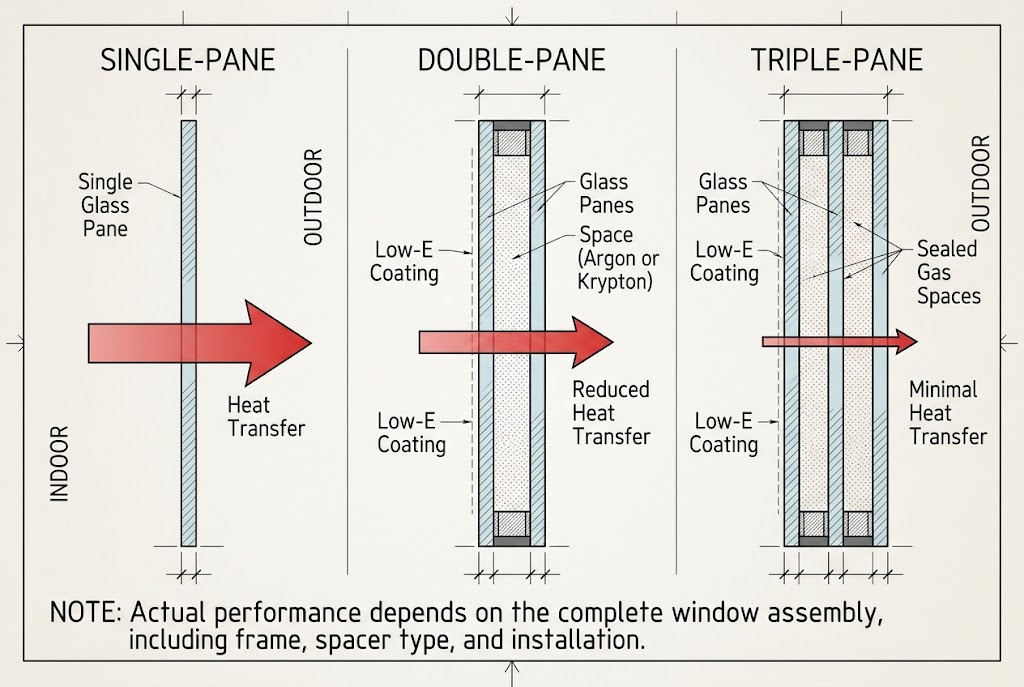
1. Insulating Glass Reduces Heat Transfer
Older single-pane windows contain one sheet of glass.
Modern double-pane windows use two sheets separated by a sealed space, often containing air or an insulating gas such as argon.
This construction slows heat movement between indoors and outdoors.
During winter, less indoor heat escapes through the glass. During summer, less outdoor heat enters by conduction.
2. Low-E Windows Manage Radiant Heat
Low-emissivity, or low-E, windows have a thin coating designed to reduce radiant heat transfer.
The coating can help retain indoor warmth in winter and reduce unwanted heat gain in summer.
Different low-E coatings are designed for different climates and solar conditions.
For example, a homeowner in Arizona may prioritize limiting solar heat entering west-facing windows, while someone in Minnesota may prioritize winter insulation.
3. Window U-Factor Measures Insulation
The window U-factor describes how readily heat passes through a window assembly.
Lower numbers indicate better insulating performance.
For example:
- U-factor 0.50: More heat transfer
- U-factor 0.30: Less heat transfer
- U-factor 0.20: Even less heat transfer
These values are illustrative. Always compare ratings for the complete window, including the frame and glass.
4. Solar Heat Gain Matters Too
Solar heat gain coefficient, abbreviated SHGC, measures how much solar radiation passes through a window and becomes heat indoors.
The rating ranges from 0 to 1.
A lower SHGC generally blocks more solar heat, which can help reduce cooling demand.
Read Also: Space Heater Cost to Run: Real Calculations + Safer, Cheaper Alternatives
A higher SHGC allows more solar heat inside, which may be beneficial in some heating-dominated climates.
Neither specification should be considered in isolation.
ENERGY STAR uses climate-specific performance requirements to help consumers select suitable windows.
You can learn more from the US Department of Energy’s window guidance.
Double-Pane vs. Triple-Pane Windows
One of the most common buying decisions involves double pane vs triple pane windows.
Both can provide significantly better insulation than old single-pane glass, but triple-pane windows are not automatically the best financial choice.
| Feature | Double-pane | Triple-pane |
|---|---|---|
| Glass layers | 2 | 3 |
| Upfront price | Generally lower | Generally higher |
| Insulation potential | Good | Often better |
| Weight | Lighter | Heavier |
| Noise reduction | Can be effective | May improve performance |
| Cold-climate suitability | Good | Often especially attractive |
| Energy payback | Depends on existing windows | Depends on added cost and climate |
When Double-Pane Windows Make Sense
For many US homes, quality double-pane windows with appropriate low-E coatings offer a practical balance of cost and performance.
They can be particularly attractive when replacing old single-pane units.
In moderate climates, the additional energy savings from triple-pane glass may not justify the higher purchase price.
When Triple-Pane Windows May Be Worth It
Triple-pane windows deserve consideration in very cold climates, especially where winters are long and heating demand is high.
Their warmer interior glass surfaces may also improve comfort near windows.
However, installation quality, frame construction, gas fills, and coatings still matter.
A well-designed double-pane window can outperform a poorly specified triple-pane product.
For an accurate comparison, request the National Fenestration Rating Council (NFRC) performance label for each option.
The NFRC label provides independently rated information about window energy performance.
Realistic Costs & Savings
Energy savings are where window replacement decisions become more complicated.
A new window can improve comfort immediately, but the financial payback may be much slower.
According to ENERGY STAR’s residential window guidance, savings depend on factors such as existing window performance, climate, and the replacement product.
Replacing single-pane windows generally offers greater potential savings than replacing reasonably efficient double-pane windows.
Worked Example: Replacing 12 Windows
Assume a homeowner has:
- A 2,000 sq ft house
- A mixed heating and cooling climate
- 12 older single-pane windows
- An installed replacement price of $9,000
- An electricity price of $0.17 per kilowatt-hour
- An assumed annual HVAC electricity reduction of 600–1,200 kWh
A kilowatt-hour (kWh) is the unit utilities use to measure electrical energy consumption.
The 600–1,200 kWh range is an illustrative modeling assumption, not a prediction or published national average.
Actual results could be lower or higher.
Step 1: Calculate Annual Savings
Use this formula:
Annual savings = Electricity saved (kWh) × Electricity rate ($/kWh)
Lower estimate:
600 kWh × $0.17 = $102 per year
Higher estimate:
1,200 kWh × $0.17 = $204 per year
In this hypothetical example, the homeowner saves approximately $102–$204 annually.
Step 2: Calculate Simple Payback
The simple payback formula is:
Installation cost ÷ Annual energy savings = Payback period
At $102 per year:
$9,000 ÷ $102 = 88.2 years
At $204 per year:
$9,000 ÷ $204 = 44.1 years
That produces an estimated simple payback of approximately 44–88 years.
This calculation ignores future energy price changes, financing, maintenance, inflation, and the time value of money.
It also excludes benefits such as improved comfort and reduced drafts.
What If Your Home Uses Natural Gas?
Many homes use natural gas for heating and electricity for cooling.
Gas consumption is commonly measured in therms, with one therm representing 100,000 British thermal units (Btu) of energy.
Suppose window upgrades reduce annual gas consumption by 40 therms.
At an assumed gas price of $1.50 per therm:
40 × $1.50 = $60 in annual gas savings
If electricity savings are another $100:
Total annual savings = $160
At a $9,000 project cost:
$9,000 ÷ $160 = 56.25 years
How to Use Your Actual Utility Rates
Find your recent electricity and natural gas bills.
For electricity, divide the relevant usage-based charges by total kWh consumed to estimate your effective energy rate.
For natural gas, divide usage-based charges by the therms billed.
Avoid including fixed monthly customer charges when calculating savings from reduced consumption, because those charges generally remain even when usage decreases.
You can compare local electricity prices with data from the US Energy Information Administration.
Important: Your actual savings depend on window area, existing window condition, HVAC efficiency, thermostat settings, local weather, and installation quality.
For a major project, an independent home energy assessment can help establish whether windows are the best investment.
Are New Windows Worth It?
Whether replacement windows make financial sense depends on why you’re replacing them.
If your existing windows are structurally sound and already have insulated glass, replacing them solely for lower utility bills may offer limited financial returns.
If your windows are deteriorating, difficult to operate, or allowing water into the building, replacement may be worthwhile for reasons beyond energy efficiency.
Signs Replacement May Be Justified
| Existing window condition | Recommended first step | Replacement priority |
|---|---|---|
| Single-pane glass with frequent drafts | Check air sealing and storm window options | Moderate to high |
| Broken glass | Ask about glass or insulated-unit replacement | Depends on damage |
| Condensation between glass panes | Evaluate insulated glass unit replacement | Moderate |
| Rotting or severely damaged frames | Professional inspection | High |
| Functional modern double-pane windows | Improve air sealing elsewhere | Usually low |
| Windows that will not close or lock | Repair or replacement assessment | High |
| Minor drafts around trim | Inspect weatherstripping and caulking | Usually low |
Comfort Can Matter More Than Payback
A window replacement project may reduce cold drafts near seating areas and improve comfort during extreme temperatures.
It may also reduce outside noise, depending on the window’s construction and the type of sound.
However, energy savings should not be confused with resale value.
A project may improve a home’s appeal without recovering its full cost at resale.
Likewise, replacing windows as part of a larger renovation may be more practical than undertaking the same work solely to reduce heating bills.
Consider Insulation Before Windows
Many homes lose significant heat through poorly insulated attics and uncontrolled air leakage.
Improving attic insulation and sealing accessible air leaks can sometimes deliver substantial savings at a lower cost.
The best approach depends on the house.
See our related guide: Attic Insulation Cost: Is It Worth the Upgrade?.
If your heating and cooling equipment is aging, compare potential improvements carefully. New windows may lower heating and cooling loads, but they do not automatically justify replacing a functioning HVAC system.
A home energy assessment can help prioritize these projects before you commit to an expensive upgrade.
Cheaper Alternatives to Window Replacement
Before spending thousands on new windows, consider whether simpler improvements can address the actual problem.
The US Department of Energy recommends evaluating existing windows and considering improvements that reduce heat loss and air leakage.
1. Replace Worn Weatherstripping
Weatherstripping seals moving joints around operable windows.
Common materials include adhesive-backed foam, rubber, vinyl, and compression seals.
Products vary in durability and suitability for different window designs.
2. Seal Gaps Around Stationary Trim
Caulk can help seal small gaps where stationary window trim meets adjacent materials.
Use a product appropriate for the location and follow manufacturer instructions.
Do not block drainage openings, known as weep holes, or seal components designed to release trapped water.
3. Consider Storm Windows
Storm windows add another protective layer over an existing window.
They may improve comfort and energy performance without requiring complete replacement.
ENERGY STAR certified low-E storm windows can be particularly useful when existing windows are otherwise in reasonable condition.
4. Use Insulating Window Coverings
Cellular shades, insulated curtains, and appropriately fitted window treatments can reduce heat transfer.
Their benefits depend on fit, installation, and how consistently they are used.
During winter, opening coverings on sunny windows may provide useful passive solar warmth.
During hot afternoons, closing coverings on sun-exposed windows can reduce cooling demand.
5. Try Removable Interior Window Film
Some removable films create an insulating air space over existing windows.
These products may help reduce drafts during winter.
Check compatibility before applying adhesive films directly to glass. Certain films can increase thermal stress or affect insulated-glass warranties.
DIY Window Efficiency Checklist
Homeowners and renters can perform a basic inspection without removing windows.
- Check for drafts. On a windy day, feel for moving air around closed windows.
- Inspect weatherstripping. Look for compressed, missing, or cracked seals.
- Check visible caulk. Identify gaps around stationary trim.
- Look for moisture. Note water stains, condensation patterns, or deteriorating wood.
- Inspect window operation. Confirm that windows open, close, and lock properly.
- Review window coverings. Consider insulating shades for uncomfortable rooms.
- Document problem areas. Photograph damage before requesting repairs or quotes.
Avoid standing on unstable ladders, leaning outside upper-story windows, or removing heavy glass assemblies.
For more inexpensive improvements, read How to Find and Seal Air Leaks in Your Home.
What Renters Can Do
Renters usually cannot authorize permanent window replacement.
However, removable weatherstripping, draft blockers, insulated curtains, and landlord-approved window film may help.
Request permission before applying products that could damage finishes or glass.
Report broken locks, significant water intrusion, rotting frames, or windows that cannot close securely to the property manager.
These are maintenance concerns, not simply energy-efficiency issues.
Choosing Windows for Your Climate
The best window specifications depend partly on your region.
ENERGY STAR divides the United States into climate zones and provides window performance criteria tailored to each zone.
Cold Northern Climates
In places such as Minnesota, Wisconsin, and northern New England, winter heat loss is an important concern.
Look for windows with low U-factors and suitable solar heat gain characteristics.
Triple-pane windows may deserve closer consideration, particularly in homes with large window areas.
Hot-Humid Southern Climates
In Florida, Louisiana, and much of the Gulf Coast, cooling performance is especially important.
Low-SHGC glass can help limit unwanted solar heat gain.
Air sealing is also important because humid outdoor air entering the building can increase cooling and moisture-control demands.
Windows must be installed with appropriate flashing and water-management details.
Hot, Dry Western Climates
In Arizona, Nevada, and parts of inland California, intense sunlight can significantly affect indoor temperatures.
Solar-control glass and exterior shading may improve comfort.
West-facing windows often deserve particular attention because afternoon sunlight can coincide with high outdoor temperatures.
Mixed Climates
In states such as Virginia, Missouri, and parts of Pennsylvania, homes experience meaningful heating and cooling seasons.
Balanced window specifications may be preferable to optimizing exclusively for winter or summer.
Compare the ENERGY STAR requirements for your location rather than assuming that the lowest possible SHGC is always best.
You can review current criteria through the ENERGY STAR windows program.
How to Evaluate Window Replacement Quotes
The installation method can affect both cost and long-term performance.
A replacement window fitted into an existing sound frame is different from a full-frame installation that removes the original frame.
Full-frame replacement may be necessary when existing framing is damaged, poorly installed, or unsuitable for an insert window.
It also generally involves more labor and finishing work.
Compare These Details Before Signing
| Quote item | What to verify |
|---|---|
| Window specifications | U-factor, SHGC, air leakage, ENERGY STAR status |
| Frame material | Vinyl, fiberglass, wood, or other material |
| Installation method | Insert replacement or full-frame replacement |
| Water management | Flashing and drainage details |
| Interior finishing | Trim, painting, and wall repairs |
| Exterior finishing | Siding, trim, and sealant work |
| Disposal | Removal of old windows and debris |
| Warranty | Product coverage versus labor coverage |
| Payment terms | Deposit, milestones, and final payment |
| Permits | Responsibility for required approvals |
Get at least three written estimates when practical.
Ask contractors to explain differences in materials and installation methods rather than comparing prices alone.
Check Product Ratings
The NFRC label is especially useful because it provides standardized window performance ratings.
Look for whole-window U-factor and SHGC values, not just glass-only performance claims.
ENERGY STAR certification provides another way to identify products meeting specified efficiency criteria for particular climates.
A premium product is not necessarily the best value for every home.
What About Financing?
Some contractors offer installment plans or financing.
Compare the total amount paid, annual percentage rate (APR), fees, and contract terms before choosing an option.
Financing can make payments more manageable while increasing the overall project cost.
Also check whether your state, utility, or local government offers incentives.
Programs vary by state and change often; check current eligibility through the ENERGY STAR Rebate Finder and DSIRE.
Do not assume a federal residential energy tax credit applies to a 2026 installation. The previous federal credits for qualifying residential efficiency improvements ended for expenditures after December 31, 2025.
When to Call a Professional
Some window problems are suitable for basic maintenance. Others require professional inspection or installation.
Contact a qualified window contractor when you notice structural damage, significant water intrusion, rotting frames, or persistent moisture between insulated glass panes.
Professional assessment is also appropriate when windows are unusually large, difficult to access, or located above ground level.
Important Safety Considerations
Window removal involves heavy glass, sharp edges, and potentially hazardous working heights.
Older homes may contain lead-based paint around windows. Renovation work that disturbs painted surfaces in pre-1978 housing may be subject to the EPA’s Renovation, Repair and Painting Rule.
Use appropriately certified professionals when required.
If you discover extensive mold, hidden water damage, or deteriorating structural framing, investigate the underlying moisture problem before installing new windows.
Replacing the visible window without correcting water intrusion may allow damage to continue.
Also remember that making a home more airtight can affect ventilation.
Homes with fuel-burning appliances need appropriate combustion safety and ventilation. Have suspected backdrafting or carbon monoxide concerns evaluated by qualified professionals, and maintain working carbon monoxide alarms.
Common Mistakes to Avoid
Window replacement is a substantial purchase, so small specification and installation decisions can have long-lasting consequences.
- Replacing every window without an assessment. Some windows may need only repairs or improved seals.
- Assuming energy savings will repay the project quickly. Calculate realistic savings using your climate, utility rates, and existing window condition.
- Choosing based only on glass thickness. U-factor, SHGC, frame construction, and installation quality all influence performance.
- Ignoring installation details. Poor flashing or sealing can lead to drafts and moisture problems even with high-quality windows.
- Buying the same glass package for every climate. Solar-control priorities in Florida differ from insulation priorities in Minnesota.
- Overlooking cheaper improvements. Weatherstripping, storm windows, shading, and attic insulation may offer better value.
- Comparing incomplete quotes. Confirm whether permits, trim repairs, disposal, and warranty coverage are included.
- Assuming all rebates remain available. Incentive requirements and funding change. Verify eligibility before making a purchase.
FAQ
1. How much does it cost to replace 10 windows?
Replacing 10 standard residential windows might cost approximately $4,000–$15,000 installed, based on a broad planning range of $400–$1,500 per window. Premium products, custom openings, structural repairs, or difficult access can increase the total.
Get written estimates that separate product specifications, installation work, and additional repairs.
2. Are new windows worth it for energy savings?
New windows can be worthwhile when existing units are single-pane, drafty, damaged, or poorly insulated. However, energy savings alone may not repay a whole-home replacement project during a typical ownership period.
Comfort, reduced maintenance, improved operation, and water-damage prevention may provide additional reasons to replace windows.
3. How much can energy-efficient windows lower utility bills?
Savings vary widely with climate, existing windows, home size, and heating and cooling systems.
Replacing single-pane windows generally offers greater savings potential than replacing relatively modern double-pane windows.
Use ENERGY STAR estimates as a starting point, but calculate your own potential savings using local utility rates and realistic assumptions.
4. Is it cheaper to replace glass or the entire window?
Replacing only the glass or sealed insulated glass unit can cost less than replacing the entire window when the frame remains structurally sound.
However, not every window design allows economical glass replacement.
Ask a qualified contractor to compare both options, including labor, warranty coverage, and expected remaining frame life.
5. Are triple-pane windows worth the extra money?
Triple-pane windows may provide meaningful comfort and insulation benefits in very cold climates.
However, their additional energy savings do not always justify the price premium.
Compare the installed cost difference and whole-window U-factor ratings. For many moderate-climate homes, quality double-pane windows remain a practical choice.
6. What is a good U-factor for replacement windows?
A lower U-factor indicates better insulation.
Many efficient residential windows have U-factors around 0.20–0.30, although suitable values depend on climate and product type.
Rather than relying on one universal target, compare current ENERGY STAR requirements for your region and review the NFRC label.
7. Do low-E windows really save energy?
Low-E coatings reduce radiant heat transfer through glass.
They can help limit summer heat gain or reduce winter heat loss, depending on the coating design.
The actual savings depend on climate, window orientation, existing glass, and overall window construction.
Low-E coatings work best as part of a properly specified and installed window system.
8. Should I replace windows before adding attic insulation?
Not necessarily.
If your attic has inadequate insulation or major air leaks, improving those areas may offer better savings for the money.
A home energy assessment can help identify the largest opportunities.
If existing windows have serious rot, broken seals, or water damage, those problems may need attention regardless of insulation priorities.
9. Can new windows reduce outside noise?
Yes, certain replacement windows can reduce noise entering a home.
Performance depends on glass thickness, spacing between panes, laminated glass, frame construction, and airtight installation.
Triple-pane windows are not automatically the best acoustic option.
If noise reduction is a priority, request acoustic performance specifications rather than relying on pane count alone.
10. How long do replacement windows last?
Window lifespan varies by material, installation quality, climate, maintenance, and exposure.
Many residential windows remain serviceable for roughly 20–30 years, although some fail sooner and others last longer.
Inspect seals, drainage paths, hardware, and frames periodically.
A failed insulated glass seal does not always mean the entire window must be replaced.
11. Are there window replacement rebates in 2026?
Some state governments and utilities may offer window-related incentives, but availability and eligibility vary.
Federal residential energy tax credits for qualifying expenditures under the previous programs ended after December 31, 2025.
Check ENERGY STAR’s Rebate Finder, DSIRE, your state energy office, and your utility before purchasing.
12. Is replacing windows a good investment before selling a house?
Window replacement may improve appearance, operation, comfort, and buyer appeal.
However, it does not guarantee that you’ll recover the full installation cost through a higher sale price.
If the existing windows are functional, targeted repairs and maintenance may be more economical.
Consider local market conditions and the condition of the home rather than assuming a fixed resale return.
Final Checklist
Replacing windows can improve comfort and efficiency, but it is not always the most cost-effective way to lower utility bills.
Before committing to a project, work through this checklist:
- Identify whether existing windows are damaged, drafty, or simply outdated.
- Check lower-cost options such as weatherstripping and storm windows.
- Compare ENERGY STAR certification and NFRC performance ratings.
- Choose window specifications suited to your climate.
- Request at least three detailed installation quotes.
- Calculate potential annual savings using your actual utility rates.
- Compare energy savings with the full installation cost.
- Check current state and utility incentives.
- Review product warranties, labor coverage, and contract terms.
The bottom line: If your windows are failing, replacement may solve important comfort, maintenance, and moisture problems while reducing energy use.
If your existing windows are in good condition, replacing them purely for energy savings may be difficult to justify financially.
Start by identifying where your home actually loses energy. That information can help you decide whether new windows, better insulation, or simpler air-sealing improvements deserve your money first.
Pingback: How to Insulate Windows Cheaply: 9 Renter-Friendly Ways to Stay Comfortable – Energy Savings Perlon