Adding insulation to your attic is one of the more practical ways to improve home comfort and reduce heating and cooling expenses. But how much should you expect to spend, and which insulation material offers the best value?
For most homeowners, attic insulation cost ranges from approximately $1 to $7 per square foot installed, depending on the material, existing insulation, attic accessibility, and local labor rates. Specialized spray foam installations can cost more.
Read Also: Air Sealing Guide: How to Find and Fix Air Leaks in Your Home
A poorly insulated attic can allow heat to escape during winter and enter your living space during summer, making your HVAC system work harder.
This guide explains insulation prices, recommended R-values, material comparisons, and when DIY installation makes sense. You’ll also learn how to estimate potential energy savings, compare contractor quotes, and avoid common installation mistakes.
Whether you’re upgrading a 1970s home or improving a newer house, the goal is to help you spend wisely without sacrificing safety or comfort.
Quick Takeaways
- Typical installed cost: Approximately $1–$7 per square foot for common attic insulation projects, with specialized installations costing more.
- Best budget-friendly materials: Fiberglass batts and blown-in cellulose or fiberglass.
- Recommended attic R-value: Commonly R-30 to R-60 or higher, depending on climate, existing insulation, and the applicable energy code.
- DIY potential: Some accessible attic-floor projects are suitable for experienced homeowners.
- Professional installation: Often preferable for complex attics, air sealing, spray foam, or insulation removal.
- Air sealing matters: Closing attic air leaks before insulating can improve performance.
- Potential savings: Insulation may reduce heating and cooling costs, but actual savings depend on your starting conditions.
- Rebates: Some utilities and state programs offer incentives; eligibility and funding vary.
How Much Does Attic Insulation Cost?
The total cost of insulating an attic depends primarily on its square footage, the insulation material, and how much preparation the job requires.
For a typical residential attic, homeowners may encounter installed prices ranging from about $1 to $7 per square foot.
Read Also: Space Heater Cost to Run: Real Calculations + Safer, Cheaper Alternatives
These are broad budgeting estimates, not national averages or guaranteed contractor prices. Actual quotes can fall outside these ranges.
Average Attic Insulation Cost by Material
| Insulation Type | Estimated Installed Cost per Sq Ft | Estimated Cost for 1,000 Sq Ft |
|---|---|---|
| Fiberglass batts | $1.00–$3.00 | $1,000–$3,000 |
| Blown-in fiberglass | $1.00–$3.00 | $1,000–$3,000 |
| Blown-in cellulose | $1.20–$3.50 | $1,200–$3,500 |
| Mineral wool batts | $1.50–$4.00 | $1,500–$4,000 |
| Open-cell spray foam | $2.50–$5.00+ | $2,500–$5,000+ |
| Closed-cell spray foam | $4.00–$8.00+ | $4,000–$8,000+ |
Planning estimates only. Prices vary with insulation thickness, required R-value, labor, accessibility, and regional conditions. Spray foam prices are particularly sensitive to installed thickness.
For homeowners comparing blown-in insulation cost with fiberglass batts, both can be economical.
Blown-in insulation often has an advantage in attics with irregular framing or hard-to-reach spaces because loose material can fill gaps around obstructions.
What Makes Installation More Expensive?
Several factors can increase the final project price.
Existing insulation condition: Wet, contaminated, or damaged insulation may need removal before new material can be installed.
Air sealing: Contractors may recommend sealing openings around plumbing penetrations, electrical penetrations, and attic access points.
Attic accessibility: Small hatches, low rooflines, and limited walking space make installation slower.
Required insulation depth: A cold-climate attic requiring R-60 generally needs more material than one targeting R-30.
Ventilation improvements: Some projects require baffles or other corrections to keep roof ventilation pathways open.
A quote should identify these items separately whenever practical.
Read Also: Ductless Mini-Split Guide: Costs, Pros, Cons, and Energy Savings
For a 1,000-square-foot attic, a straightforward blown-in insulation job might cost approximately $1,000–$3,500. A project involving removal, repairs, and extensive air sealing could cost considerably more.
How Attic Insulation Works
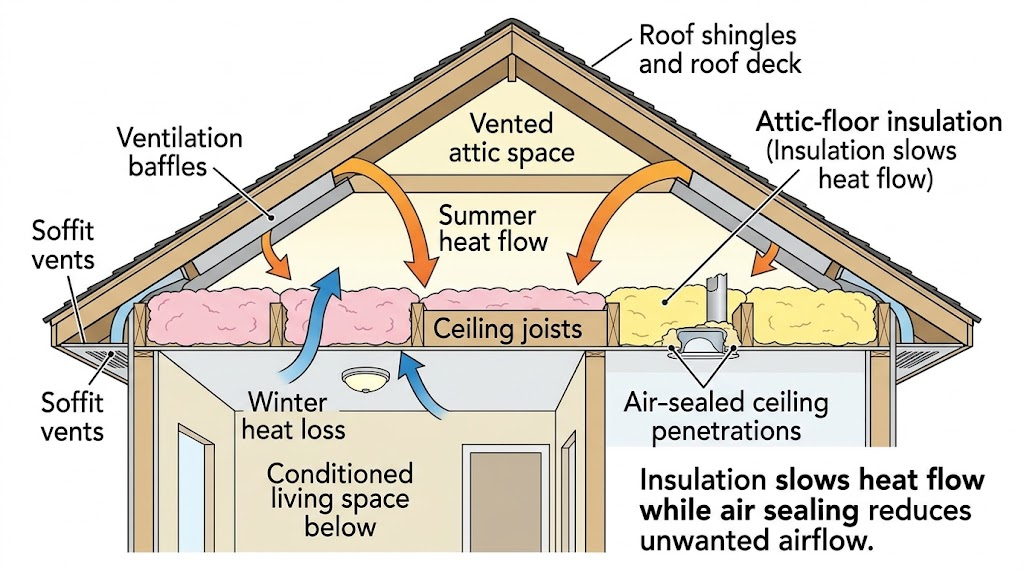
Insulation slows heat transfer between your conditioned living space and the attic.
Heat naturally moves from warmer areas toward cooler areas. During winter, heat from your home can escape through the ceiling into a cold attic.
During summer, a hot attic can increase heat flow toward the rooms below.
Insulation reduces this transfer, helping your heating and cooling equipment maintain indoor temperatures.
What Does R-Value Mean?
R-value measures resistance to heat flow.
A higher R-value means greater resistance to heat transfer.
For example:
- R-19 provides less thermal resistance than R-38.
- R-38 provides less thermal resistance than R-49.
- R-60 offers more resistance than R-49.
However, doubling R-value does not double energy savings.
Heat flow through an insulated assembly is approximately inversely related to R-value, assuming other conditions remain equal.
Read Also: Heat Pump Cost Guide: Installation Prices, Running Costs, and Payback
This means upgrading from very little insulation can produce a larger improvement than adding the same amount of resistance to an already well-insulated attic.
Why Air Sealing Matters
Insulation and air sealing solve different problems.
Insulation slows heat movement through building materials. Air sealing reduces unwanted airflow through cracks and openings.
Common attic air leaks occur around:
- Plumbing and electrical penetrations
- Attic access hatches
- Recessed lighting
- Open framing cavities
- Gaps around ducts and ceiling fixtures
These leaks can allow conditioned air to escape and may carry moisture into the attic.
The U.S. Department of Energy generally recommends addressing air leaks before adding attic insulation.
For more background, see the DOE guide to air sealing your home.
Proper insulation works best as part of a complete attic improvement rather than simply adding more material.
Attic Insulation Types Compared
Choosing insulation involves more than comparing prices.
The best option depends on your attic layout, climate, budget, and whether you’re insulating the attic floor or the underside of the roof.
Fiberglass Batts
Fiberglass batts are precut insulation blankets designed to fit between framing members.
They are widely available and can be practical for accessible attic floors with regular joist spacing.
Advantages:
- Relatively inexpensive
- Commonly available
- Suitable for some DIY projects
- Easy to add in layers when properly installed
Disadvantages:
- Gaps reduce performance
- Awkward around pipes and framing
- Compression lowers effective R-value
Batts should fit snugly without being compressed.
Blown-In Fiberglass
Blown-in fiberglass consists of loose fibers installed using specialized blowing equipment.
It is useful for covering irregular attic floors and filling spaces around framing.
Its performance depends on achieving the manufacturer’s specified installed thickness and coverage.
Contractors should provide the installed R-value and confirm that the material meets the required coverage.
Read Also: HVAC Efficiency Guide: How to Cut Heating and Cooling Costs
Blown-In Cellulose
Cellulose insulation is generally made from recycled paper fibers treated for fire resistance.
It is commonly installed on attic floors.
Cellulose can provide good coverage around obstructions, although installers must account for the manufacturer’s settled thickness requirements.
Adding too little material can leave the attic below its intended R-value.
Mineral Wool
Mineral wool insulation is made from mineral-based fibers.
It offers useful fire-resistance characteristics and is available in batt form.
However, it often costs more than fiberglass and may not be necessary for every attic.
Spray Foam vs. Fiberglass
Spray polyurethane foam expands after application and can provide insulation and air sealing in one system.
Two common types are open-cell and closed-cell foam.
Open-cell foam generally has a lower R-value per inch and is more vapor-permeable.
Closed-cell foam provides greater R-value per inch and has different moisture-control characteristics.
Neither is automatically the best choice.
Spray foam typically costs more and requires specialized equipment, ventilation, occupant protection, and trained installers.
It also changes how an attic manages air, moisture, and temperature when applied to the roof deck.
| Feature | Fiberglass | Spray Foam |
|---|---|---|
| Initial cost | Usually lower | Usually higher |
| DIY suitability | Some applications | Professional installation recommended |
| Air sealing | Requires separate sealing | Can provide air sealing when correctly installed |
| Installation complexity | Low to moderate | High |
| Best applications | Conventional attic floors | Selected roof-deck and complex assemblies |
For most conventional vented attics, air sealing followed by properly installed loose-fill insulation or batts is worth evaluating before paying for spray foam.
Recommended Attic R-Value by Climate Zone
The recommended attic R-value depends on location, existing insulation, and the home’s construction.
The United States uses climate zones to help establish insulation and energy-efficiency requirements.
For existing homes, the Department of Energy and ENERGY STAR provide guidance for insulation upgrades.
General Attic Insulation Targets
| Climate Conditions | General Attic R-Value Planning Range |
|---|---|
| Very warm climates | R-30 to R-49 |
| Warm and mixed climates | R-38 to R-60 |
| Cold climates | R-49 to R-60 |
| Very cold climates | R-49 to R-60 or higher where required |
These are broad planning ranges, not a substitute for location-specific recommendations or building-code requirements. Existing insulation levels also affect the appropriate upgrade.
Check the ENERGY STAR recommended insulation levels for more specific guidance.
How Many Inches of Insulation Do You Need?
Insulation thickness depends on the material.
Typical approximate R-values per inch include:
| Material | Approximate R-Value per Inch |
|---|---|
| Loose-fill fiberglass | R-2.2–R-2.7 |
| Fiberglass batts | R-2.9–R-3.8 |
| Cellulose | R-3.2–R-3.8 |
| Mineral wool batts | R-3.0–R-4.2 |
| Open-cell spray foam | R-3.5–R-3.8 |
| Closed-cell spray foam | R-6.0–R-7.0 |
Actual performance varies by product and installation.
For example, using cellulose rated at R-3.5 per inch:
Required thickness = Target R-value ÷ R-value per inch
R-49 ÷ 3.5 = approximately 14 inches.
This is a simplified calculation. Loose-fill insulation must be installed according to its coverage chart, including any required allowance for settling.
Before buying materials, determine the existing insulation’s approximate R-value.
Adding insulation to an attic that already meets an appropriate target may provide relatively modest additional savings.
DIY vs. Professional Installation
Attic insulation DIY projects can reduce labor expenses, but they are not appropriate for every house.
A homeowner with a clean, accessible attic and no major moisture, electrical, or ventilation concerns may be able to install fiberglass batts or certain loose-fill products.
More complicated projects generally benefit from professional assessment.
DIY Cost Considerations
DIY expenses can include:
- Insulation materials
- Protective clothing and respiratory protection
- Equipment rental
- Delivery
- Air-sealing supplies
- Disposal costs
Some retailers offer blowing-machine rentals with qualifying insulation purchases, but rental arrangements vary.
A simple material-only project may cost substantially less than professional installation.
However, DIY savings can disappear if installation mistakes require repairs.
When Professional Installation Offers Better Value
A contractor may be preferable when the attic has:
- Limited access
- Extensive air leakage
- Damaged insulation
- Complicated roof framing
- Numerous ducts or mechanical components
- Moisture problems
- Suspected hazardous materials
Professional installers may also be able to achieve more consistent loose-fill coverage.
For homeowners considering broader improvements, attic insulation is worth evaluating alongside home air sealing and weatherization.
Reducing heat loss may also affect future heating and cooling equipment sizing.
If you’re planning an HVAC replacement, ask the contractor to account for completed insulation improvements before calculating the home’s heating and cooling loads.
How to Insulate an Attic Safely
A straightforward attic-floor insulation project can be manageable, but safety comes before installation speed.
Attics contain exposed framing, electrical components, low-clearance areas, and potential fall hazards.
Never assume the ceiling drywall can support your weight.
Step-by-Step DIY Checklist
- Inspect from a safe location. Look for visible moisture damage, pest activity, disturbed insulation, and ventilation problems. Do not enter unsafe areas.
- Check existing insulation. Measure accessible insulation depth and identify the material where possible. Avoid disturbing material you cannot identify.
- Determine the target R-value. Use DOE or ENERGY STAR guidance for your location and existing insulation level.
- Check for hazards. Stop if you find suspected asbestos-containing material, vermiculite insulation, exposed wiring, water damage, or other unsafe conditions.
- Plan air sealing. Simple accessible gaps may be suitable for approved sealing products. Electrical fixtures, combustion equipment, and fire-rated assemblies require appropriate clearance and materials.
- Protect ventilation pathways. Ensure insulation will not block soffit vents or other designed airflow openings.
- Install compatible insulation. Follow the manufacturer’s instructions for spacing, thickness, coverage, protective equipment, and installation conditions.
- Check the finished coverage. Look for gaps, compressed insulation, blocked vents, and insulation displaced around the attic hatch.
Pre-Installation Checklist
| Inspection Item | What to Check | Action |
|---|---|---|
| Roof leaks | Stains, damp wood, wet insulation | Repair before insulating |
| Existing insulation | Material, depth, condition | Determine whether it can remain |
| Electrical hazards | Exposed wiring, unsafe fixtures | Consult a licensed electrician |
| Ventilation | Clear soffit and roof ventilation paths | Correct blockages |
| Air leaks | Gaps around ceiling penetrations | Seal using approved methods |
| Attic access | Safe entry and working space | Hire a contractor if unsafe |
| Pest activity | Droppings, nests, damaged materials | Arrange appropriate remediation |
| Combustion equipment | Furnaces, flues, chimneys | Maintain required clearances |
Important Attic Safety Warnings
Wear appropriate protective equipment when handling insulation.
Never step between ceiling joists unless a properly supported walking platform is provided.
Do not cover recessed fixtures unless they are specifically rated for insulation contact.
Maintain manufacturer-required clearances around chimneys, flues, and heat-producing equipment.
Homes with fuel-burning appliances also require attention to combustion safety and carbon monoxide risks.
Do not disturb vermiculite insulation that may contain asbestos. The EPA recommends treating suspect vermiculite attic insulation as potentially asbestos-containing and leaving it undisturbed.
For guidance, see the EPA’s information about vermiculite insulation.
If any condition is uncertain, professional inspection is the safer choice.
Realistic Costs & Savings
Insulation savings depend on the amount of heat entering or leaving your home before the upgrade.
Homes with little existing insulation generally have more improvement potential than homes that already have adequate insulation.
Climate, thermostat settings, air leakage, HVAC efficiency, and energy prices also influence results.
Worked Example: A 2,000-Square-Foot Home
Assume a homeowner has:
- A 2,000-square-foot house
- A 1,000-square-foot attic floor
- A mixed climate with heating and cooling needs
- Existing attic insulation below the recommended level
- A planned upgrade to approximately R-49
- Electricity costing $0.17 per kilowatt-hour
A kilowatt-hour (kWh) is a unit of electricity consumption used on utility bills.
Suppose the home uses 12,000 kWh annually, with 5,000 kWh attributed to heating and cooling.
Assume the insulation and air-sealing improvements reduce that heating and cooling electricity use by 8%–15%.
This percentage is an illustrative scenario, not a predicted result or a national average.
Calculate Annual Energy Savings
Formula:
Annual electricity savings = Heating and cooling kWh × Assumed reduction
Low estimate:
5,000 kWh × 0.08 = 400 kWh
High estimate:
5,000 kWh × 0.15 = 750 kWh
Convert Energy Savings Into Dollars
Formula:
Annual dollar savings = Saved kWh × Electricity rate
Low estimate:
400 × $0.17 = $68 annually
High estimate:
750 × $0.17 = $127.50 annually
Under these assumptions, the homeowner might save approximately $68–$128 per year on electricity.
Actual savings could be lower or higher, and some homes may see little measurable change.
Estimate Simple Payback
Suppose the insulation project costs $2,000.
Formula:
Simple payback = Project cost ÷ Annual savings
At $68 annually:
$2,000 ÷ $68 = approximately 29 years
At $128 annually:
$2,000 ÷ $128 = approximately 16 years
The illustrative simple payback is roughly 16–29 years.
This calculation excludes financing, future energy price changes, maintenance, and nonfinancial benefits such as improved comfort.
It also assumes the estimated savings continue over time.
A home starting with almost no attic insulation may have a different outcome from one that already has R-30.
How to Use Your Own Utility Bill
Find the electricity rate on your bill.
If your utility separates energy, delivery, and other charges, estimate the portion that changes with electricity consumption.
For example:
$204 in consumption-related charges ÷ 1,200 kWh = $0.17/kWh
Avoid including fixed monthly customer charges when calculating savings from reduced usage.
For homes heated with natural gas, use the applicable marginal gas rate.
Natural gas bills may show consumption in therms. One therm represents 100,000 British thermal units of energy.
Savings should be calculated separately for gas and electricity if both fuels are used for heating and cooling.
What Do Government Estimates Say?
ENERGY STAR reports that homeowners can save an average of approximately 15% on heating and cooling costs, or about 11% on total energy costs, through air sealing and adding insulation in appropriate areas.
These are estimates for combined improvements, not a guarantee for attic insulation alone.
Source: ENERGY STAR — Seal and Insulate.
The most reliable way to estimate your own project’s potential is to evaluate current insulation levels, identify air leaks, and compare improvement options through a qualified home energy assessment.
Climate and Regional Considerations
Insulation performs differently depending on outdoor temperatures, humidity, and how the home is constructed.
The right approach in a cold northern climate may not be appropriate for a hot, humid region.
Hot-Humid South
In places such as Florida, Louisiana, and parts of Texas, summer heat and humidity are major considerations.
Attic insulation helps reduce heat transfer into conditioned living spaces.
However, moisture control and air sealing are equally important.
Poorly planned vapor barriers or roof-deck insulation can create moisture problems.
Homes with air-conditioning ducts in hot attics may also benefit from properly sealed and insulated ductwork.
Cold Northern States
In northern states, attic insulation helps limit winter heat loss.
Air leakage can carry warm, moist indoor air into cold attic spaces, where condensation may occur.
Air sealing is particularly important.
Cold-climate homes often benefit from higher attic R-values, but the appropriate target depends on the existing assembly and local requirements.
Dry Western Climates
Many western locations experience large temperature swings between daytime and nighttime.
Attic insulation can help reduce heat movement during both summer and winter.
Air sealing, adequate attic ventilation where required, and appropriate cooling strategies should be considered together.
Mixed Climates
Homes in mixed climates need balanced performance across heating and cooling seasons.
A conventional attic-floor insulation upgrade is often worth evaluating, especially in older houses with limited existing insulation.
Before considering major changes such as an unvented spray-foam roof assembly, have a qualified professional assess the home’s moisture and ventilation conditions.
How to Choose an Insulation Contractor
Hiring the right contractor matters because installation quality affects performance.
Two estimates using the same insulation material may produce different results if one includes air sealing, ventilation corrections, and proper coverage while the other does not.
What Should an Insulation Quote Include?
Ask contractors to specify:
- Total attic area being insulated
- Existing insulation conditions
- Proposed insulation material
- Target installed R-value
- Installed thickness and coverage
- Air-sealing work
- Ventilation protection
- Removal or disposal charges
- Project schedule
- Warranty terms
- Total installed price
For loose-fill insulation, ask about the manufacturer’s coverage chart and required number of bags.
The Federal Trade Commission has insulation labeling requirements designed to help consumers compare products and verify advertised R-values.
See the FTC’s home insulation guidance.
Compare More Than the Lowest Price
Request at least two or three written estimates when practical.
A lower quote may exclude important preparation work.
Ask each contractor how they handle attic air leaks, ventilation, existing insulation, and electrical clearances.
Contractors should also explain whether they recommend insulating the attic floor or roof deck.
These approaches create different building conditions and should not be treated as interchangeable.
Are Attic Insulation Rebates Available?
Some utilities, states, and local programs offer rebates or incentives for insulation and air-sealing improvements.
Programs vary by state and change often; check current eligibility before beginning work.
Useful resources include:
- ENERGY STAR Rebate Finder
- Database of State Incentives for Renewables & Efficiency
- Your state energy office
- Your electric or natural gas utility
Federal residential energy tax credits under Sections 25C and 25D ended for qualifying expenditures after December 31, 2025.
Do not assume a federal residential energy tax credit is available for a new attic insulation project in 2026.
Some local programs may require a participating contractor, a pre-installation assessment, or approval before work begins.
When to Call a Professional
Some attic problems should be evaluated before any insulation is added.
Call a qualified insulation contractor, building-performance professional, or appropriate specialist when you encounter:
Water damage: Wet insulation, roof leaks, mold-like growth, or persistent condensation.
Suspected asbestos: Particularly older vermiculite attic insulation or other unidentified materials.
Electrical concerns: Exposed wiring, damaged electrical components, or fixtures with uncertain insulation-contact ratings.
Combustion equipment: Furnaces, water heaters, chimneys, or flues requiring specialized clearance and combustion-safety evaluation.
Ventilation problems: Blocked vents, unusual condensation, or proposed changes to the roof’s ventilation design.
Spray foam installation: This requires trained installers and appropriate chemical exposure controls.
Hire a licensed electrician for electrical repairs or modifications.
Use a qualified HVAC technician for heating equipment, gas appliances, combustion-safety issues, and duct-system concerns.
If fuel-burning equipment is present, maintain working carbon monoxide alarms according to applicable safety guidance.
Professional help is also worthwhile when an attic is too cramped or structurally unsafe to access.
Common Mistakes to Avoid
Even high-quality insulation can underperform when installed incorrectly.
1. Adding Insulation Without Air Sealing
Insulation does not automatically stop air leaks.
Seal appropriate attic penetrations before covering them with additional material.
2. Blocking Soffit Vents
Insulation pushed into ventilation openings can disrupt intended attic airflow.
Use correctly installed baffles where required.
3. Compressing Fiberglass Batts
Fiberglass needs its designed thickness to achieve its rated performance.
Avoid squeezing batts into spaces that are too small.
4. Ignoring Water Damage
Adding insulation over damp material can conceal ongoing problems.
Repair leaks and address moisture sources first.
5. Choosing R-Value Based Only on Price
The cheapest project may not provide the most appropriate performance.
Compare installed R-value, coverage, air sealing, and workmanship.
6. Mixing Insulation Materials Incorrectly
Many insulation types can be layered, but installation details matter.
Faced insulation, vapor retarders, and roof-deck assemblies require particular attention.
7. Covering Heat-Producing Fixtures
Some recessed lights and electrical equipment require clearance from insulation.
Follow applicable codes and manufacturer instructions.
8. Assuming Higher R-Value Always Means Better Value
Once an attic is adequately insulated, additional material produces diminishing improvements in heat-flow resistance.
Evaluate existing conditions before paying for more insulation.
Frequently Asked Questions
1. How much does it cost to insulate a 1,000-square-foot attic?
A typical 1,000-square-foot attic insulation project may cost approximately $1,000–$7,000 installed, depending on the material and project requirements. Conventional fiberglass or cellulose installations often fall toward the lower end of that broad range.
Removal, extensive air sealing, moisture repairs, and specialized spray foam can increase the total. Request itemized local quotes for a useful estimate.
2. Is R-49 or R-60 attic insulation better?
R-60 provides greater resistance to heat flow than R-49, but it does not necessarily offer better value in every home.
Cold climates may benefit from higher insulation levels, while warmer regions may have different recommended targets.
The right choice depends on your climate zone, existing insulation, local energy code, and installation cost.
3. Is blown-in insulation cheaper than fiberglass batts?
Blown-in fiberglass and fiberglass batts often have overlapping installed costs.
Batts can be economical in open, regularly framed spaces. Blown-in insulation may be more practical around obstructions and irregular framing.
Labor requirements, equipment access, insulation depth, and local contractor pricing determine which option is cheaper for a particular attic.
4. Can I put new insulation over old attic insulation?
In many cases, new insulation can be added over existing dry, undamaged insulation.
However, contaminated, wet, or otherwise unsuitable material may need professional evaluation or removal.
Avoid trapping moisture or creating inappropriate vapor-retarder layers. Existing insulation should also be checked for hazardous materials before it is disturbed.
5. Is spray foam worth the extra money?
Spray foam can be useful when a project requires specific air-sealing, space-saving, or roof-assembly performance.
However, it generally costs more than conventional attic-floor insulation.
For a typical vented attic, air sealing followed by blown-in insulation or batts may provide a more economical solution.
A professional should assess moisture control and ventilation before spray foam is applied to a roof deck.
6. How long does attic insulation last?
Fiberglass, cellulose, mineral wool, and properly installed spray foam can remain functional for many years.
Actual service life depends on moisture exposure, physical disturbance, pests, installation quality, and material condition.
Insulation does not normally need replacement simply because it reaches a particular age.
Periodic inspections are useful, especially after roof leaks or major renovations.
7. Will attic insulation make my house cooler in summer?
Attic insulation can help reduce heat transfer from a hot attic into the rooms below.
This may improve comfort and reduce air-conditioning demand, particularly where existing insulation is inadequate.
However, cooling performance also depends on windows, shading, air leakage, ductwork, HVAC condition, and indoor humidity.
Insulation alone will not correct every cooling problem.
8. Can I install attic insulation myself?
Some attic-floor insulation projects are suitable for DIY installation when access is safe and the attic has no significant hazards.
Fiberglass batts and certain loose-fill systems are common DIY options.
Professional installation is preferable when there are electrical concerns, suspected asbestos, moisture problems, complicated ventilation, or difficult access.
Spray foam should be installed by trained professionals.
9. Does attic insulation qualify for a federal tax credit in 2026?
The federal residential energy improvement credit under Section 25C is not available for qualifying expenditures made after December 31, 2025.
However, state, local, and utility insulation incentives may still be available.
Check current programs through ENERGY STAR, DSIRE, your state energy office, or your utility.
Always confirm eligibility and application requirements before scheduling work.
10. Should I insulate my attic floor or roof rafters?
In a conventional vented attic, insulation is typically installed on the attic floor to separate conditioned living space from the unconditioned attic.
Insulating the roof deck creates a different type of assembly that requires careful attention to moisture, air sealing, and building-code requirements.
The correct approach depends on the home’s design, attic equipment, and intended use of the space.
11. What can renters do about poor attic insulation?
Renters should generally avoid modifying attic insulation without written permission from the property owner.
Instead, document comfort problems, report visible leaks or damaged insulation, and ask whether an insulation assessment is possible.
With permission, simpler improvements such as weatherstripping or temporary window treatments may help comfort.
Utility-sponsored energy assessments may also be available to eligible rental properties.
12. Is attic insulation worth it in an older home?
Older homes can be strong candidates for insulation improvements, particularly when existing insulation is thin, uneven, or missing.
The potential benefit depends on current conditions rather than the home’s age alone.
A home energy assessment can help identify whether attic insulation, air sealing, duct improvements, or another upgrade should take priority.
Final Checklist: Is Attic Insulation Worth the Cost?
Attic insulation is often a sensible home improvement when existing insulation is below recommended levels.
However, choosing the right project matters more than simply installing the thickest available material.
Before spending money, use this checklist:
- Measure or assess existing attic insulation.
- Check the recommended R-value for your climate.
- Inspect for moisture, pests, and unsafe materials.
- Identify attic air leaks.
- Compare fiberglass, cellulose, and other suitable materials.
- Decide whether DIY installation is appropriate.
- Request detailed contractor estimates.
- Check current utility and state rebates.
- Estimate savings using your actual energy rates.
- Confirm ventilation and safety requirements.
For many homes, air sealing combined with correctly installed attic insulation provides a practical balance of comfort, efficiency, and upfront cost.
The best investment is the one that addresses your home’s actual weaknesses without creating new moisture, ventilation, or safety problems.
Pingback: Spray Foam vs Fiberglass vs Cellulose: Which Insulation Is Best for Your Home? – Energy Savings Perlon