Heating and cooling account for a substantial portion of energy use in many American homes. When your HVAC system works harder than necessary, the result can be higher utility bills, uneven temperatures, and unnecessary wear on expensive equipment.
Fortunately, improving efficiency doesn’t always require replacing your furnace or air conditioner.
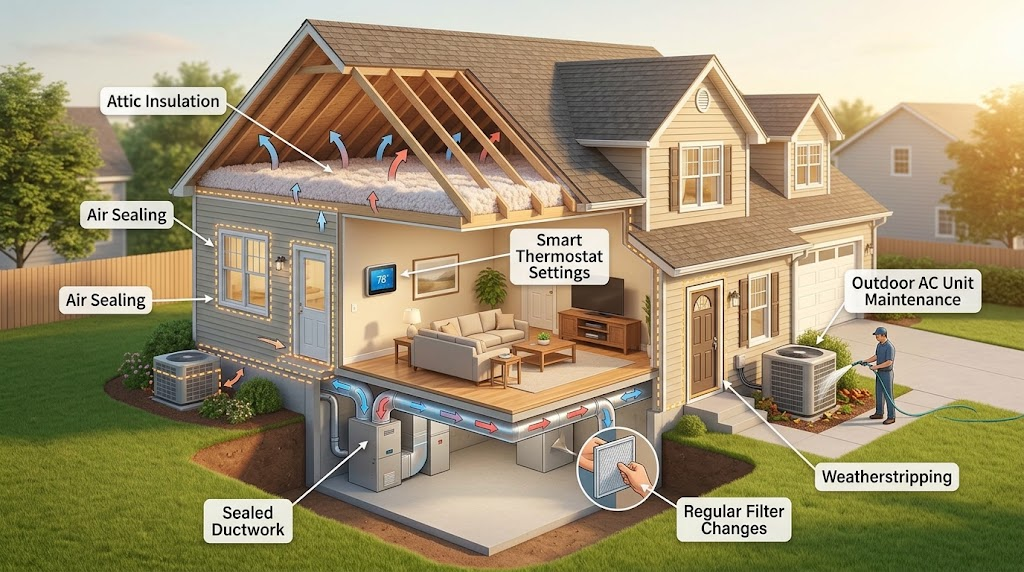
Some of the most effective HVAC efficiency tips involve inexpensive changes, including replacing dirty filters, adjusting thermostat settings, sealing air leaks, and keeping vents unobstructed.
This guide explains how heating and cooling efficiency works, which maintenance tasks homeowners can safely handle, and when professional improvements may be worth the investment.
You’ll also find realistic cost estimates, practical advice for renters, and examples showing how different upgrades may affect annual energy expenses.
Whether you’re trying to lower your summer electricity bill or reduce winter heating costs, the goal is simple: use less energy while keeping your home comfortable.
Quick Takeaways
- Replace or inspect HVAC filters regularly to maintain airflow and protect equipment.
- Use thermostat schedules to avoid unnecessary heating and cooling when appropriate.
- Seal air leaks around windows, doors, and accessible gaps before considering expensive upgrades.
- Keep supply vents, return grilles, and outdoor AC units clear of obstructions.
- Schedule professional HVAC maintenance to identify problems before they become expensive repairs.
- Improve insulation and duct sealing to reduce heating and cooling losses.
- Compare equipment efficiency, installation quality, and total costs before replacing an HVAC system.
- Use your actual utility rates and energy consumption to estimate savings rather than relying on advertised percentages.
How HVAC Efficiency Works
HVAC stands for heating, ventilation, and air conditioning. These systems regulate indoor temperature, help distribute conditioned air, and, depending on the equipment, manage humidity and ventilation.
An efficient HVAC system provides the heating or cooling your home needs while consuming as little energy as practical.
However, equipment efficiency is only part of the equation.
Your home’s insulation, air leakage, thermostat settings, ductwork, and local climate all influence how much energy your HVAC system consumes.
Understanding HVAC Efficiency Ratings
Different heating and cooling systems use different efficiency measurements.
| Rating | Equipment | What It Measures |
|---|---|---|
| SEER2 | Central air conditioners and heat pumps | Seasonal cooling efficiency |
| EER2 | Air conditioners and heat pumps | Cooling efficiency under specified test conditions |
| HSPF2 | Air-source heat pumps | Seasonal heating efficiency |
| AFUE | Gas and oil furnaces | Percentage of fuel energy converted into useful heat |
| COP | Heat pumps | Heating or cooling delivered relative to energy consumed |
SEER2, or Seasonal Energy Efficiency Ratio 2, measures seasonal cooling output relative to electricity consumption using updated federal testing procedures.
Higher SEER2 ratings generally indicate greater cooling efficiency under standardized conditions.
HSPF2, or Heating Seasonal Performance Factor 2, measures seasonal heating efficiency for heat pumps.
AFUE, or Annual Fuel Utilization Efficiency, measures how efficiently a furnace converts fuel into usable heat.
For example, a furnace rated at 95% AFUE converts approximately 95% of its fuel energy into useful heat under the rating’s test conditions.
COP, or coefficient of performance, compares useful heating or cooling output with energy input. A heat pump operating at a COP of 3 delivers approximately three units of heat for each unit of electricity consumed.
Actual performance depends on outdoor temperatures, installation quality, equipment condition, and operating settings.
Why Two Identical HVAC Systems Can Have Different Bills
Imagine two 2,000-square-foot homes using the same air conditioner.
One has adequate attic insulation, sealed ductwork, and limited air leakage.
The other has poorly insulated attic spaces, leaky ducts, and substantial afternoon sun exposure.
Even with identical equipment, the second home may require considerably more cooling.
This illustrates an important principle: reducing your home’s heating and cooling demand can be just as valuable as buying more efficient equipment.
According to the US Department of Energy’s Energy Saver program, air sealing, insulation, thermostat management, and equipment maintenance can all contribute to lower energy consumption.
Understanding these factors makes it easier to prioritize improvements.
12 HVAC Efficiency Tips That Can Lower Energy Costs
The following recommendations range from simple household habits to improvements that may require professional assistance.
Start with inexpensive maintenance and airflow improvements before investing in major equipment upgrades.
1. Replace Dirty HVAC Filters
Air filters capture dust and airborne particles before they circulate through your HVAC system.
As filters become clogged, airflow can decrease.
Restricted airflow may reduce comfort, increase operating costs, and contribute to equipment problems.
What to do:
- Locate the filter at the return grille or HVAC equipment.
- Check its dimensions and required specifications.
- Inspect it approximately every month.
- Replace it when dirty or according to the equipment manufacturer’s instructions.
- Confirm that the replacement fits properly and follows the airflow-direction marking.
Many disposable filters have replacement intervals ranging from one to three months, but actual needs vary.
Homes with pets, heavy dust, or frequent HVAC operation may require more frequent replacement.
Choose a filter compatible with your system rather than automatically selecting the most restrictive filtration option.
2. Adjust Thermostat Settings
Your thermostat determines when heating and cooling equipment operates.
During cooling season, a higher indoor temperature generally reduces the amount of heat your air conditioner must remove.
During heating season, a lower indoor temperature generally reduces heat loss to the outdoors.
For many households, 78°F is a reasonable starting point for summer cooling when someone is home.
During winter, approximately 68°F while awake can be a starting point for homes with conventional heating systems.
These are guidelines, not universal requirements.
Comfort, humidity, health needs, and household preferences matter.
For conventional heating and cooling systems, the Department of Energy notes that setting your thermostat back 7–10°F for eight hours daily can save as much as approximately 10% annually on heating and cooling under suitable conditions.
Heat pumps require additional consideration because aggressive temperature recovery may activate less-efficient auxiliary heating.
3. Keep Supply Vents and Return Grilles Clear
Supply vents deliver conditioned air into rooms.
Return grilles allow indoor air to flow back toward the HVAC equipment.
Furniture, curtains, rugs, and storage boxes can interfere with this circulation.
Check that:
- Large furniture does not cover return grilles.
- Supply vents are open unless a professional-designed system specifies otherwise.
- Curtains do not block conditioned airflow.
- Dust buildup is removed from accessible grille surfaces.
Closing multiple vents to save energy can increase duct pressure and create airflow problems.
If certain rooms receive too much or too little air, professional airflow balancing may be more effective.
4. Keep the Outdoor AC Unit Clear
Central air conditioners and many heat pumps use an outdoor unit to transfer heat.
Leaves, grass clippings, vegetation, and debris can interfere with airflow around the equipment.
Follow the manufacturer’s clearance recommendations, which commonly call for substantial open space around the unit.
Remove loose debris from the surrounding ground and trim nearby plants.
Avoid spraying electrical components or opening equipment cabinets.
Internal coil cleaning and repairs should be handled according to manufacturer instructions, preferably by a qualified technician.
5. Use Ceiling Fans Correctly
Ceiling fans improve comfort by moving air across your skin.
They do not lower the temperature of an empty room.
During summer, a fan may help occupants remain comfortable at a slightly higher thermostat setting.
Turn fans off when rooms are unoccupied.
In winter, some reversible fans can gently redistribute warm air near the ceiling, although results depend on ceiling height and airflow.
6. Reduce Solar Heat Gain
Sunlight entering windows can increase indoor temperatures.
This is especially noticeable through west-facing windows during hot afternoons.
Practical options include:
- Closing blinds during peak sunlight.
- Installing properly fitted curtains.
- Using suitable window shades.
- Adding exterior shading where permitted.
- Considering professionally selected window films.
Exterior shading can be particularly effective because it intercepts sunlight before the glass absorbs it.
Before applying window film, check window manufacturer restrictions because some products can increase thermal stress.
7. Seal Accessible Air Leaks
Outdoor air entering through gaps can increase heating and cooling demand.
Common leakage locations include window frames, exterior door edges, and openings around plumbing or cable penetrations.
Weatherstripping and appropriate caulk can help seal accessible gaps.
Do not seal intentional ventilation openings, combustion-air supplies, or appliance exhaust paths.
Larger improvements may require a contractor to assess ventilation and moisture risks.
8. Improve Attic Insulation
Heat moves between your home and its surroundings.
Insulation slows that transfer.
Its effectiveness is commonly expressed using R-value, a measure of resistance to heat flow.
Higher R-values indicate greater resistance under comparable conditions.
Recommended insulation levels depend on climate, existing insulation, and building construction.
Before adding insulation, address significant air leaks and moisture problems.
Avoid disturbing suspected asbestos-containing materials, damaged wiring, or unsafe attic conditions.
9. Check Ductwork for Problems
Ducts distribute conditioned air throughout many homes.
Leaks in ducts located in attics, crawl spaces, or garages can waste energy.
Visible disconnected sections, damaged insulation, or unusually dusty duct joints may indicate problems.
Accessible duct connections can sometimes be sealed using approved materials, but professional evaluation is often preferable.
Ordinary cloth-backed household duct tape is not a reliable long-term choice for HVAC duct sealing.
10. Schedule Professional Maintenance
Professional maintenance can identify issues that homeowners cannot safely inspect.
Depending on the equipment, a technician may check:
- Refrigerant-system performance.
- Electrical connections.
- Blower operation.
- Condensate drainage.
- Coil condition.
- Temperature differences.
- Combustion safety.
- Airflow and controls.
Maintenance does not guarantee lower bills, but correcting actual performance problems may improve efficiency and reliability.
11. Address Indoor Humidity
Humidity strongly influences comfort.
In humid climates, excessive indoor moisture can make rooms feel uncomfortable even at relatively low temperatures.
Air conditioning removes some moisture during normal operation.
However, oversized equipment may cool a space quickly without providing adequate dehumidification.
The Environmental Protection Agency generally recommends keeping indoor relative humidity below 60%, ideally around 30–50% when practical.
A hygrometer, which measures relative humidity, can help you monitor conditions.
12. Replace Inefficient Equipment When Appropriate
Older HVAC systems can remain serviceable for years, but their efficiency may be substantially below that of properly selected modern equipment.
Replacement makes the most sense when combined with factors such as frequent repairs, major component failure, poor comfort, or high operating costs.
A contractor should evaluate equipment sizing, ducts, insulation, and installation requirements.
The highest efficiency rating is not automatically the best financial choice for every household.
HVAC Maintenance Checklist
A consistent maintenance routine helps keep equipment operating as intended.
This HVAC maintenance checklist separates simple homeowner tasks from work that generally requires professional training.
| Maintenance Task | Suggested Frequency | DIY or Professional? | Why It Matters |
|---|---|---|---|
| Inspect air filter | Monthly | DIY | Helps identify restricted airflow |
| Replace disposable filter | As needed | DIY | Maintains proper filtration and airflow |
| Check thermostat settings | Seasonally | DIY | Prevents unnecessary operation |
| Clear supply and return grilles | Every few months | DIY | Supports air circulation |
| Remove debris around outdoor unit | Monthly during use | DIY | Helps maintain airflow |
| Inspect accessible weatherstripping | Twice yearly | DIY | Identifies air leaks |
| Check visible condensate leaks | Monthly during cooling | Visual inspection only | Helps identify drainage problems |
| Check indoor humidity | Seasonally | DIY | Supports comfort and moisture control |
| Inspect duct condition | Annually | Professional for repairs | Identifies leakage and damage |
| Evaluate refrigerant system | During professional service | Licensed HVAC technician | Identifies performance problems |
| Inspect furnace combustion safety | Annually | Qualified technician | Helps reduce combustion hazards |
| Check electrical components | During professional service | Qualified professional | Identifies unsafe or failing parts |
A Simple Seasonal Maintenance Routine
Before summer:
- Install a clean filter if needed.
- Test cooling operation before the hottest weather.
- Check thermostat programming.
- Clear vegetation and debris around the outdoor unit.
- Confirm that accessible supply and return grilles are unobstructed.
- Schedule service if cooling performance seems abnormal.
Before winter:
- Inspect the filter.
- Test heating operation.
- Check exterior door weatherstripping.
- Verify that carbon monoxide alarms work where fuel-burning appliances or other combustion sources are present.
- Keep furnace and heating equipment clear of stored materials.
- Schedule a qualified combustion-safety inspection for fuel-burning heating equipment.
Follow the manufacturer’s instructions if they differ from these general intervals.
For additional seasonal maintenance ideas, see our Home Energy Audit Checklist.
Why Your AC Runs Constantly (And How to Fix It)
An air conditioner that runs for long periods is not necessarily malfunctioning.
During extreme heat, a properly sized system may operate nearly continuously to maintain the desired indoor temperature.
Variable-speed systems may also run at lower output for extended periods to improve temperature control and humidity management.
The important distinction is whether the system maintains comfort without unusual symptoms.
Common Reasons for Long AC Runtime
Extreme outdoor temperatures
An air conditioner must work harder when outdoor temperatures rise.
During unusually hot weather, longer operating cycles are expected.
Dirty filters or restricted airflow
Reduced airflow can interfere with cooling performance.
Inspect the filter and confirm that vents are clear.
Air leaks and insufficient insulation
Heat entering through poorly sealed building components increases cooling demand.
Dirty cooling coils
Dust and debris on coils can reduce heat transfer.
Internal coil cleaning is generally best handled by a professional.
Incorrect equipment sizing
An undersized system may struggle to meet cooling demand.
An oversized system may cycle frequently and produce uneven humidity control.
Refrigerant problems
Low refrigerant charge, leaks, and other refrigeration-system faults can reduce performance.
Refrigerant diagnosis and handling require qualified professionals.
How to Troubleshoot Safely
Start with the simplest checks.
- Confirm the thermostat is set to cooling.
- Check whether the indoor temperature is close to the thermostat setting.
- Inspect the air filter.
- Make sure supply and return grilles are unobstructed.
- Check for debris surrounding the outdoor unit.
- Close windows and exterior doors.
- Observe whether cooling performance improves.
If the system runs continuously but cannot approach the thermostat setting during ordinary weather, schedule a professional inspection.
Also seek service if you notice ice on refrigerant lines, unusual noises, repeated shutdowns, or unexplained water leakage.
Do not attempt refrigerant repairs or electrical troubleshooting yourself.
Smart Thermostats and HVAC Efficiency
Smart thermostats can help manage heating and cooling schedules more conveniently.
Many models allow remote temperature adjustments, automated schedules, energy reports, and occupancy-based controls.
However, a smart thermostat does not automatically make an inefficient HVAC system efficient.
Its value depends on how it is programmed and how the household uses heating and cooling.
Programmable vs. Smart Thermostats
| Feature | Basic Programmable Thermostat | Smart Thermostat |
|---|---|---|
| Scheduled temperature changes | Yes | Yes |
| Remote smartphone control | Usually no | Often yes |
| Learning or adaptive schedules | Usually no | Some models |
| Energy-use reports | Limited | Often available |
| Internet connection required | No | Often for advanced features |
| Typical purchase cost | Approximately $20–$80 | Approximately $80–$300+ |
| Installation complexity | Varies | Varies |
Prices are broad planning ranges, not current retailer quotes.
Some smart thermostats require a common wire, often called a C-wire, which provides continuous low-voltage power.
Other models have alternative power arrangements.
Compatibility also varies for heat pumps, multistage equipment, and electric baseboard heating.
Because thermostat wiring requirements differ, use professional installation when wiring changes are necessary.
Can a Smart Thermostat Lower Your Bill?
Potentially.
Savings are more likely when the thermostat corrects inefficient habits, such as maintaining unnecessary heating or cooling during predictable periods when the home is empty.
Savings may be smaller when a household already follows an efficient schedule.
For heat pumps, appropriate thermostat configuration matters.
Large setbacks can sometimes trigger electric auxiliary resistance heat, reducing expected savings.
Look for models compatible with your equipment and consider ENERGY STAR-certified options.
You can compare thermostat features in our Smart Thermostat Buying Guide.
Insulation, Air Sealing, and Ductwork
HVAC improvements often focus on the equipment itself.
But the building surrounding that equipment plays a major role in operating costs.
A well-insulated, properly sealed home generally requires less heating and cooling than a similar home with substantial uncontrolled air leakage.
Air Sealing vs. Insulation
These improvements solve different problems.
Air sealing reduces uncontrolled air movement through cracks and openings.
Insulation slows heat transfer through walls, ceilings, floors, and other building assemblies.
Both matter.
Adding insulation without addressing major air leaks may leave significant energy losses unresolved.
Likewise, sealing gaps without improving inadequate insulation may still leave the home uncomfortable.
Which Improvements Should Come First?
A practical sequence is:
- Identify comfort problems and obvious drafts.
- Inspect accessible door and window seals.
- Review attic insulation conditions.
- Consider a professional home energy assessment.
- Address significant air leakage and moisture problems.
- Improve insulation where appropriate.
- Evaluate duct leakage and airflow.
A professional energy assessment may include a blower door test.
A blower door is a calibrated fan system that measures how much air leaks through a building envelope under controlled pressure conditions.
Some assessments also use infrared imaging to help identify temperature differences that may indicate insulation defects or air leakage.
How Much Difference Can Air Sealing Make?
According to ENERGY STAR, homeowners may save an average of approximately 15% on heating and cooling costs by air sealing their homes and adding insulation in suitable locations.
That is a broad program estimate, not a guaranteed outcome.
Actual savings depend on the home’s starting condition, local climate, energy prices, and the quality of the improvements.
Homes that are already well insulated may have less opportunity for additional savings.
What About New Windows?
Replacing windows solely to reduce HVAC bills is not always the most cost-effective starting point.
If existing windows are structurally sound, weatherstripping, caulking, shading, and appropriate window attachments may offer lower-cost improvements.
Replacement windows become more compelling when existing units are damaged, difficult to operate, excessively drafty, or nearing the end of their useful life.
Compare whole-window energy ratings, installation quality, and total project costs before deciding.
Realistic Costs & Savings
The best way to estimate energy savings is to start with your actual heating and cooling expenses.
National averages can provide context, but they cannot predict your household’s results.
Electricity prices, fuel types, local weather, insulation levels, and thermostat habits vary substantially across the United States.
Typical HVAC Efficiency Improvement Costs
The following figures are approximate US planning ranges for common projects.
Actual quotes may differ significantly based on location, equipment, home size, accessibility, and project scope.
| Improvement | Approximate Cost | Potential Benefit | Key Consideration |
|---|---|---|---|
| Replacement HVAC filter | $10–$40 | Maintains airflow | Must match system specifications |
| Door weatherstripping | $10–$60 per door | Reduces drafts | Proper fit matters |
| Window caulking materials | $5–$25 per tube | Seals accessible gaps | Use appropriate sealant |
| Basic programmable thermostat | $20–$80 | Better scheduling | Check compatibility |
| Smart thermostat | $80–$300+ | Scheduling and automation | Installation may cost extra |
| Professional HVAC tune-up | $100–$250+ | Identifies maintenance issues | Service scope varies |
| Professional duct sealing | $500–$2,500+ | Reduces duct leakage | Depends on access and duct condition |
| Attic insulation upgrade | $1,500–$4,500+ | Reduces heat transfer | Depends on area and existing insulation |
| Professional home energy assessment | $200–$600+ | Identifies improvement priorities | Utility programs may reduce cost |
These are illustrative budget ranges rather than verified national price averages.
Get local estimates before making purchasing decisions.
Worked Example: A 2,000-Square-Foot Home
Consider a hypothetical home with these assumptions:
- Home size: 2,000 square feet
- Climate: Mixed heating and cooling climate
- Electricity rate: $0.17 per kilowatt-hour
- Annual cooling electricity use: 3,000 kWh
- Annual electric heating use: 4,000 kWh
- Combined annual HVAC electricity use: 7,000 kWh
A kilowatt-hour (kWh) is a unit of electrical energy equal to using 1,000 watts for one hour.
Your electricity bill typically lists consumption in kWh.
First, calculate annual HVAC electricity cost.
Formula:
Annual HVAC electricity cost = Annual HVAC kWh × Electricity rate
Calculation:
7,000 kWh × $0.17 = $1,190 annually
Now suppose a combination of maintenance, thermostat improvements, and air sealing reduces HVAC electricity use by 8%.
This is a hypothetical reduction for illustration, not a prediction.
Energy savings formula:
Annual kWh savings = Annual HVAC kWh × Assumed reduction
7,000 × 0.08 = 560 kWh
Dollar savings formula:
Annual savings = kWh saved × Electricity rate
560 × $0.17 = $95.20 annually
In this example, annual savings would be approximately $95.
What If Savings Are Lower or Higher?
Using the same $1,190 annual HVAC electricity cost:
| Hypothetical HVAC Energy Reduction | Annual Savings |
|---|---|
| 3% | $35.70 |
| 5% | $59.50 |
| 8% | $95.20 |
| 10% | $119.00 |
| 15% | $178.50 |
These percentages illustrate possible outcomes rather than guaranteed results or universal expected savings.
The actual reduction could be negligible if the system and home are already efficient.
Homes with significant existing problems may have greater opportunities.
Also, do not simply add advertised savings percentages from different improvements. Benefits can overlap.
How to Calculate Savings Using Your Utility Bill
Find your electricity rate and monthly consumption.
If your utility lists only total electricity charges, calculate an approximate effective rate:
Effective electricity rate = Relevant electricity charges ÷ kWh consumed
For example:
$204 ÷ 1,200 kWh = $0.17/kWh
Be aware that fixed customer charges, tiered rates, time-of-use pricing, and other billing adjustments can affect the amount actually saved.
For the most accurate estimate, use the rate associated with the electricity you would avoid consuming.
Next, estimate HVAC-specific usage.
Some smart thermostats and energy-monitoring systems provide runtime information, but runtime alone does not equal electricity consumption.
For a rough estimate, compare months with substantial heating or cooling demand against mild-weather months.
This method is imperfect because other loads, such as water heating and appliances, may also change seasonally.
Calculating Natural Gas Heating Costs
Natural gas bills often measure consumption in therms.
One therm represents 100,000 British thermal units (Btu) of energy.
A Btu is a unit of heat energy.
Suppose a household uses 500 therms annually for space heating at a variable cost of $1.50 per therm.
Annual fuel cost:
500 × $1.50 = $750
If a hypothetical improvement reduces heating fuel consumption by 8%:
500 × 0.08 = 40 therms
40 × $1.50 = $60 annually
Fixed utility charges generally remain even when energy use decreases.
Gas and electric savings should be calculated separately when a home uses both fuels.
Understanding Payback Periods
A simple payback period estimates how long energy savings would take to equal the initial project cost.
Simple payback = Project cost ÷ Annual energy savings
Suppose an improvement costs $600 and saves an estimated $100 annually.
$600 ÷ $100 = 6 years
This calculation excludes financing costs, future energy-price changes, maintenance, equipment replacement, and other benefits.
Comfort improvements may still be worthwhile even when simple energy payback is long.
For current energy-price context, consult the US Energy Information Administration.
Should You Repair or Replace Your HVAC System?
HVAC replacement can be one of the most expensive home energy decisions.
A new system may offer better efficiency, comfort, and reliability, but replacement is not always necessary.
The right choice depends on equipment condition, repair costs, local energy prices, and how long you expect to use the system.
Signs Replacement May Be Worth Considering
Replacement deserves closer evaluation when:
- The system requires frequent expensive repairs.
- Major components have failed.
- Heating or cooling performance remains poor after proper maintenance.
- The equipment is significantly less efficient than suitable modern alternatives.
- Repair parts are difficult to obtain.
- The home has persistent comfort or humidity problems.
Equipment age matters, but age alone should not determine replacement.
Installation quality and maintenance history can substantially affect useful service life.
Central AC vs. Heat Pump
A central air conditioner provides cooling.
An air-source heat pump can provide both heating and cooling by transferring heat between indoor and outdoor air.
Modern cold-climate heat pumps can operate at low outdoor temperatures, although heating capacity and efficiency vary by model and conditions.
| Feature | Central Air Conditioner | Air-Source Heat Pump |
|---|---|---|
| Cooling | Yes | Yes |
| Heating | No | Yes |
| Main energy source | Electricity | Electricity |
| Efficiency metrics | SEER2, EER2 | SEER2, EER2, HSPF2 |
| Cold-weather performance | Not applicable for heating | Depends on model and temperature |
| Installation requirements | Indoor and outdoor cooling components | Compatible heating/cooling components |
| Best fit | Homes with separate heating systems | Homes considering electric heating and cooling |
Heat pumps can be attractive when replacing electric resistance heating or when electricity and fossil-fuel prices favor their operation.
However, switching from natural gas to a heat pump does not guarantee lower operating costs.
Climate, utility rates, installation design, and backup heating requirements matter.
Equipment Sizing Is Critical
Bigger is not automatically better.
Oversized air conditioners may cycle frequently and provide inadequate moisture removal.
Undersized systems may struggle during peak conditions.
A qualified contractor should perform a heating and cooling load calculation.
In residential HVAC design, this is commonly called a Manual J calculation, referring to an Air Conditioning Contractors of America sizing methodology.
A complete replacement proposal should also account for ductwork, airflow, equipment compatibility, and installation requirements.
Questions to Ask HVAC Contractors
Before accepting an estimate, ask:
- Will you perform a room-by-room or whole-home load calculation?
- What efficiency ratings apply to the proposed equipment?
- Does the existing duct system support the new equipment?
- Are electrical upgrades required?
- What warranty coverage is included?
- What labor and installation work is included in the price?
- How will heating performance change during extreme temperatures?
- Are local utility or state rebates currently available?
Obtain multiple written estimates when practical.
Compare complete installation proposals rather than equipment prices alone.
HVAC Rebates and Incentives in 2026
Federal residential energy tax credits under Sections 25C and 25D ended for expenditures after December 31, 2025.
Do not assume a new HVAC installation qualifies for a federal residential energy tax credit.
State, local, and utility incentives may still be available.
Check:
- ENERGY STAR Rebate Finder
- Database of State Incentives for Renewables & Efficiency
- Your state energy office
- Your electric or natural gas utility
Programs vary by state and change often; check current eligibility, equipment requirements, and application rules before purchasing.
HVAC Efficiency Tips by Climate
The most effective strategy depends partly on where you live.
A cooling-focused home in Arizona faces different challenges than a heating-focused home in Minnesota.
Hot-Humid South
In states such as Florida, Louisiana, and parts of Texas, cooling and moisture removal are major concerns.
Priorities include:
- Maintaining reliable AC airflow.
- Controlling indoor humidity.
- Improving attic insulation.
- Reducing solar heat gain.
- Sealing unwanted outdoor air leakage.
- Avoiding oversized cooling equipment.
Consider whether a system provides adequate moisture removal during mild but humid weather.
Ventilation should be managed carefully because uncontrolled outdoor air can introduce additional moisture.
Cold Northern States
In Minnesota, Michigan, Maine, and similar climates, winter heating demand can dominate annual HVAC energy use.
Priorities include:
- Sealing drafts.
- Improving attic and accessible floor insulation.
- Maintaining furnace or heat pump performance.
- Protecting combustion-air pathways.
- Using appropriate thermostat schedules.
- Evaluating cold-climate heat pump performance before purchasing.
Snow and ice should not obstruct outdoor heat pump airflow.
Keep required clearances according to the manufacturer’s instructions.
Hot-Dry West
In Arizona, Nevada, and inland California, intense sunlight and large temperature swings can create substantial cooling demand.
Priorities include:
- Exterior shading.
- Attic insulation.
- Air sealing.
- Efficient thermostat schedules.
- Well-maintained cooling equipment.
Evaporative coolers may be useful in suitable dry climates.
These systems cool air through water evaporation, but their performance declines as outdoor humidity increases.
They also require water, ventilation, and regular maintenance.
Mixed and Moderate Climates
In regions with meaningful heating and cooling seasons, balanced improvements often provide the greatest value.
Priorities include:
- Air sealing.
- Insulation.
- Efficient equipment operation.
- Appropriate thermostat schedules.
- Duct maintenance.
- Seasonal professional service.
Heat pumps may be worth evaluating because they can provide both heating and cooling.
Local energy prices remain important when comparing operating costs.
HVAC Efficiency Tips for Renters
Renters can improve comfort and manage energy costs without making permanent changes to the property.
The best options are inexpensive, reversible, and compatible with lease requirements.
Low-Cost Improvements
Consider these renter-friendly actions:
- Replace accessible HVAC filters if the lease assigns that responsibility to you.
- Keep furniture away from supply and return grilles.
- Use curtains or blinds to reduce unwanted sunlight.
- Install removable weatherstripping where permitted.
- Use ceiling or portable fans while rooms are occupied.
- Adjust thermostat settings to match your schedule.
- Report malfunctioning equipment promptly.
- Monitor electricity consumption through your utility account.
A portable fan uses electricity, but its energy consumption is generally much lower than that of a central air conditioner.
Its primary benefit comes from allowing comfortable thermostat adjustments.
What Renters Should Ask Their Landlord
Report problems such as:
- Persistent heating or cooling failure.
- Water leaks near HVAC equipment.
- Repeated system shutdowns.
- Unusual equipment noises.
- Strong or unusual odors.
- Visible moisture damage.
- Unsafe electrical conditions.
Ask for permission before installing a thermostat or altering HVAC components.
For larger issues, provide clear documentation describing the problem, when it occurs, and any relevant temperature readings.
Landlord responsibilities vary by state and local housing rules.
Apartment Energy Savings
Apartment location affects heating and cooling demand.
Top-floor apartments may experience more roof-related heat gain.
Corner units may have greater exposure to outdoor temperatures.
Units surrounded by conditioned apartments may have lower heating and cooling loads.
Because renters often cannot change insulation or equipment, thermostat management, shading, airflow, and timely maintenance requests are especially useful.
When to Call a Professional
Some HVAC problems involve electrical hazards, pressurized refrigerants, combustion gases, or dangerous temperatures.
These are not appropriate DIY repair projects.
Call a Licensed HVAC Technician When:
- Cooling or heating output is consistently inadequate.
- The system repeatedly trips a breaker.
- Refrigerant lines or indoor coils develop ice.
- The outdoor unit makes grinding or unusual mechanical noises.
- The system frequently shuts down unexpectedly.
- A condensate problem causes recurring water leakage.
- A furnace shows signs of combustion problems.
- Equipment needs refrigerant diagnosis or repair.
- Ductwork requires substantial modification.
- You need equipment sizing or replacement planning.
Hire a licensed electrician for electrical circuit, panel, or wiring problems.
Do not open electrical cabinets or attempt capacitor repairs.
Air conditioner capacitors can retain dangerous electrical charges even after equipment is switched off.
Carbon Monoxide Safety
Carbon monoxide is a colorless, odorless gas produced by incomplete combustion.
Fuel-burning furnaces, boilers, fireplaces, and other combustion appliances can create carbon monoxide hazards if equipment or venting malfunctions.
Install carbon monoxide alarms according to applicable codes and manufacturer instructions.
If a carbon monoxide alarm sounds, follow its emergency instructions, leave the building, and contact emergency services or the appropriate emergency responder.
Do not attempt to diagnose a suspected carbon monoxide problem by operating or inspecting the appliance yourself.
Space Heater Safety
Portable electric space heaters can provide localized warmth, but they require careful use.
Keep heaters at least 3 feet from combustible materials unless the manufacturer requires a greater distance.
Plug them directly into appropriate wall outlets rather than extension cords or power strips.
Do not leave portable heaters running unattended or while sleeping.
Follow the manufacturer’s operating and placement instructions.
Attic and Moisture Hazards
Attic work can involve extreme temperatures, exposed wiring, unsafe walking surfaces, and airborne particles.
Do not walk between structural framing members or disturb suspected hazardous insulation materials.
Moisture problems should be corrected before insulation is added.
Air sealing and insulation work must preserve required ventilation and combustion safety.
Common Mistakes to Avoid
Even well-intentioned energy improvements can create problems when they ignore how HVAC systems operate.
1. Closing Vents in Unused Rooms
Closing multiple vents can increase duct pressure and interfere with airflow.
Use professional zoning or balancing solutions when significant room-by-room temperature control is needed.
2. Buying the Most Restrictive Air Filter
A higher filtration rating does not automatically mean better overall HVAC performance.
Choose a filter that meets indoor air quality needs without exceeding the system’s airflow capabilities.
3. Setting the AC Extremely Low to Cool Faster
Most conventional air conditioners do not cool faster simply because the thermostat is set much lower.
An unnecessarily low setting can cause longer operation and wasted energy.
4. Ignoring Humidity
A comfortable temperature reading does not guarantee comfortable indoor conditions.
Monitor humidity and address persistent moisture problems.
5. Skipping Maintenance Until Something Breaks
Filters, drainage systems, coils, and mechanical components need appropriate attention.
Preventive maintenance may identify problems before they cause major failures.
6. Replacing Equipment Without Checking Insulation
A new HVAC system may still consume excessive energy if the house has substantial air leakage or poor insulation.
Evaluate the building envelope before finalizing equipment sizing.
7. Assuming Every Smart Device Saves Money
Automation only helps when it changes energy consumption in a useful way.
A smart thermostat with inefficient settings may produce little or no savings.
8. Assuming Higher Efficiency Always Means Lower Total Cost
A more efficient HVAC system may cost more to purchase and install.
Compare expected operating costs, installation expenses, maintenance, equipment life, and local energy prices before deciding.
Frequently Asked Questions
1. What are the best HVAC efficiency tips for lowering energy bills?
Start by inspecting your air filter, reviewing thermostat settings, clearing blocked vents, and checking accessible door and window seals. These actions are relatively inexpensive and can address common sources of wasted energy.
For larger improvements, consider a professional energy assessment, duct leakage evaluation, and insulation upgrades. The most valuable action depends on your home’s existing problems.
2. How can I reduce heating and cooling costs without buying a new HVAC system?
Use appropriate thermostat schedules, maintain filters, reduce unwanted solar heat, and seal accessible air leaks. Proper attic insulation and duct sealing may also reduce energy demand.
Professional maintenance can identify performance problems that simple household changes cannot fix. Start with low-cost improvements and measure results before committing to expensive upgrades.
3. Does changing my HVAC filter really save electricity?
A clean, properly selected filter helps maintain the airflow your HVAC system needs.
Replacing a severely clogged filter may improve performance and reduce unnecessary energy consumption. However, replacing a reasonably clean filter more frequently than needed is unlikely to produce meaningful additional savings.
Follow your equipment manufacturer’s guidance and inspect filters regularly.
4. What temperature should I set my thermostat to save money in summer?
Approximately 78°F can be a reasonable starting point when you’re home, provided that temperature is comfortable and safe for household members.
Higher cooling setpoints generally reduce cooling demand.
When the home is unoccupied, a higher setting may save additional energy. Consider pets, humidity, medical needs, and the time required to restore comfort.
5. What is the cheapest way to lower my AC bill?
The cheapest options often involve changing how cooling equipment is used.
Try raising the thermostat slightly, closing blinds during strong afternoon sunlight, using fans while rooms are occupied, and maintaining clean filters.
Also inspect accessible weatherstripping and keep vents unobstructed.
These measures cost little, although the resulting savings depend on your current habits and home conditions.
6. How often should HVAC systems be serviced?
Many homeowners schedule professional cooling maintenance before summer and heating maintenance before winter.
A combined visit may be appropriate for some systems, while others require different service schedules.
Follow manufacturer guidance and warranty requirements.
Fuel-burning heating systems should receive appropriate combustion-safety checks by qualified professionals. Filters and visible airflow obstructions should be checked more frequently.
7. Is a smart thermostat worth the money?
A smart thermostat may be worthwhile if automated scheduling, remote control, and energy reports help you manage heating and cooling more effectively.
Savings are less certain when you already use efficient thermostat schedules.
Before purchasing, confirm compatibility with your HVAC equipment, especially if you have a heat pump or multistage system.
Check for utility rebates that could reduce the purchase cost.
8. Can insulation lower both heating and cooling bills?
Yes. Insulation reduces heat transfer through the building envelope.
During winter, it helps slow heat loss from conditioned spaces. During summer, it helps limit heat entering the home.
The benefit depends on existing insulation, climate, and installation quality.
Air sealing is often an important complementary improvement because insulation alone does not stop all uncontrolled airflow.
9. Is it cheaper to leave the AC running all day?
Maintaining a low indoor temperature while nobody is home generally requires more cooling energy than allowing the temperature to rise moderately.
However, the most effective schedule depends on equipment type, humidity, occupancy, and utility pricing.
Homes with variable-speed systems or unusual moisture conditions may require more careful settings.
Avoid extreme changes that create discomfort or excessive recovery demands.
10. Do heat pumps work efficiently in cold climates?
Modern cold-climate heat pumps can provide useful heating at temperatures well below freezing.
However, their heating capacity and efficiency change as outdoor temperatures fall.
Some installations require backup heating during extremely cold weather.
Compare manufacturer performance data at relevant outdoor temperatures, local electricity prices, installation requirements, and available service support before choosing a system.
11. How much can duct sealing reduce HVAC costs?
Savings depend heavily on where ducts are located and how much conditioned air they leak.
Sealing substantial leaks in an unconditioned attic or crawl space may provide meaningful benefits.
However, sealing already-tight ducts may produce little measurable change.
A qualified contractor can evaluate duct leakage, airflow, and accessibility before recommending repairs.
12. Should I replace a 15-year-old air conditioner?
A 15-year-old air conditioner may be worth evaluating, but replacement is not automatically necessary.
Consider maintenance history, repair costs, cooling performance, efficiency, refrigerant availability, and expected future use.
If the system operates reliably and repairs are manageable, continued service may be reasonable.
When replacement is appropriate, request load calculations and multiple written estimates.
Final HVAC Efficiency Checklist
Improving HVAC efficiency is usually a series of practical changes rather than one expensive purchase.
Start by correcting obvious problems, then evaluate larger upgrades based on actual energy use and comfort needs.
Your HVAC efficiency action checklist:
- Inspect the HVAC filter and replace it when necessary.
- Review heating and cooling thermostat settings.
- Keep supply vents and return grilles unobstructed.
- Clear debris from around outdoor equipment.
- Use window coverings to limit unwanted summer heat.
- Check accessible door and window weatherstripping.
- Evaluate attic insulation and potential air leaks.
- Consider duct leakage testing if comfort problems persist.
- Schedule appropriate professional maintenance.
- Review utility bills to track seasonal energy consumption.
- Compare repair and replacement costs before upgrading equipment.
- Check current state and utility rebates before purchasing qualifying equipment.
The most useful HVAC efficiency tips are the ones that address your home’s actual sources of energy waste.
For some households, that means replacing a dirty filter and improving thermostat schedules.
For others, professional duct sealing, insulation improvements, or more efficient heating and cooling equipment may offer greater long-term value.
Track your energy consumption over time, account for weather differences, and prioritize improvements that make your home more comfortable without unnecessary spending.
Pingback: HVAC Efficiency Guide: Best Thermostat Settings for Summer and Winter (Save Money, Stay Comfortable) – Energy Savings Perlon
Pingback: How to Lower Your AC Bill: 15 Fixes That Actually Work – Energy Savings Perlon